Jharkhand Prelims Final

Table of Contents

Jharkhand Prelims Final

1 झारखण्ड का सामान्य परिचय

विवरण

जानकारी

नाम का शाब्दिक अर्थ

जंगल-झाड़ प्रदेश या वन प्रदेश

राज्य का गठन

15 नवंबर, 2000* (नोट:- 15 नवंबर को भगवान बिरसा मुंडा का जन्मदिवस होता है, इसी महत्व के कारण उनके 125वें जन्म-जयंती पर झारखण्ड राज्य का निर्माण किया गया। प्रतिवर्ष 15 नवंबर को झारखण्ड राज्य स्थापना दिवस के रूप में मनाया जाता है)

भारतीय राज्यों के स्थापना क्रम में स्थान

28वाँ*

राजधानी

राँची* (नोट:- राँची संयुक्त बिहार की ग्रीष्मकालीन राजधानी* थी)

उपराजधानी

दुमका* (प्रस्तावित – मेदिनीनगर, चाईबासा, गिरिडीह)

भौगोलिक अवस्थिति

विश्व तथा भारत के मानचित्र पर उत्तर-पूर्वी भाग में अवस्थित

अक्षांशीय विस्तार

21°58’10” से 25°19’15” उत्तरी अक्षांश

देशांतर विस्तार

83°19’50” से 87°57′ पूर्वी देशांतर

कर्क रेखा पर अवस्थित जिले

लातेहार (नेतरहाट), लोहरदगा (किस्को), गुमला (बिशुनपुर), राँची (काँके व ओरमांझी), रामगढ़ (गोला)

उत्तर-दक्षिण विस्तार (लंबाई)

380 कि.मी.

पूर्व-पश्चिम विस्तार (चौड़ाई)

463 कि.मी.

भौगोलिक सीमाएँ

उत्तर में बिहार*, दक्षिण में उड़ीसा, पूर्व में पश्चिम बंगाल तथा पश्चिम में छत्तीसगढ़ एवं पश्चिमोत्तर में उत्तर प्रदेश

क्षेत्रफल

79,714* वर्ग कि.मी. (नोट:- भारतीय वन सर्वेक्षण रिपोर्ट, 2023 व जनगणना-2011 के अनुसार झारखण्ड राज्य का क्षेत्रफल 79,716 वर्ग कि.मी. है)

देश के कुल क्षेत्रफल का %

2.42%*

क्षेत्रफल की दृष्टि से राज्यों में स्थान

15वाँ (जम्मू-कश्मीर के पुनर्गठन के बाद)

ग्रामीण क्षेत्रफल

77,922 वर्ग कि.मी. (97.75%)

शहरी क्षेत्रफल

1,792 वर्ग कि.मी. (2.25%)


विवरण

जानकारी

सर्वाधिक क्षेत्रफल वाला जिला

पश्चिमी सिंहभूम* (7,224 वर्ग कि.मी.)

न्यूनतम क्षेत्रफल वाला जिला

रामगढ़ (1,341 वर्ग कि.मी.)

सर्वाधिक वनाच्छादित जिला

पश्चिमी सिंहभूम (3,368 वर्ग कि.मी.)

न्यूनतम वनाच्छादित जिला

जामताड़ा (106 वर्ग कि.मी.)

सर्वाधिक वन% वाला जिला

लातेहार (56%)

न्यूनतम वन% वाला जिला

जामताड़ा (5.85%)

सर्वोच्च शिखर

सम्मेद शिखर (पारसनाथ पहाड़ी)* – 1365 मी. (4,478 फीट)

राज्यपाल

संतोष गंगवार (11वें राज्यपाल) [31 जुलाई, 2024 से अब तक] (नोट:- कार्यवाहक राज्यपाल विनोद चंद्र पाण्डेय को शामिल करते हुए वर्तमान राज्यपाल का क्रम 12वाँ है।)

मुख्यमंत्री

हेमंत सोरेन (14वें मुख्यमंत्री) [28 नवंबर, 2024 से अब तक] (नोट:- झारखण्ड राज्य में सात व्यक्ति* मुख्यमंत्री पद पर आसीन हुए हैं।)

विधानसभा अध्यक्ष

रवीन्द्रनाथ महतो (कार्यवाहक सहित 12वें अध्यक्ष) (नोट:- ये झारखण्ड विधानसभा में लगातार दूसरी बार अध्यक्ष बनने वाले पहले व्यक्ति हैं।)

मुख्य न्यायाधीश

न्या. एम. एस. रामचन्द्र राव (16वें)

उच्च न्यायालय

राँची* (देश का 21वाँ उच्च न्यायालय)*

विधायिका

एकसदनीय*

विधानसभा सीट

81* (नोट:- 104वें संविधान संशोधन द्वारा राज्य विधानसभा में एंग्लो-इंडियन सदस्य के मनोनयन का प्रावधान समाप्त कर दिया गया है।)

लोकसभा सीट

14* (SC – 01, ST – 05, अन्य – 08)

राज्यसभा सीट

06*

प्रमंडल

05* (उत्तरी छोटानागपुर, दक्षिणी छोटानागपुर, पलामू, कोल्हान तथा संथाल परगना)

जिला

24* (राज्य निर्माण के समय 18 जिले* थे)

अनुमंडल

45 (राज्य निर्माण के समय 33 अनुमंडल थे)

प्रखंड

264* [नवीनतम प्रखंड – सरयू प्रखंड, लातेहार जिला] (झारखण्ड गठन के समय राज्य में प्रखंडों की संख्या – 210)

अधिसूचित प्रखंड

135 (Source- Jharkhand Economic Survey 2024-25)


विवरण

जानकारी

जिला परिषद

24

गांव *

32,746 (Source- lgdirectory.gov.in) (नोट:- 2011 की जनगणना के समय राज्य में 32,620 गांव थे)

वार्ड

1400

ग्राम पंचायत

4345 (Source- Jharkhand Economic Survey 2024-25) (नोट:- पंचायतीराज मंत्रालय, भारत सरकार के अनुसार 4297 पंचायतें) (Source- पंचायत प्रगति सूचकांक, 2025)

अधिसूचित पंचायत

2074 (Source- Jharkhand Economic Survey 2024-25)

पंचायत समिति

264 (Source- Jharkhand Economic Survey 2024-25)

शहरी स्थानीय निकाय

51 (छावनी बोर्ड सहित)

नगर निगम

09 (राँची, धनबाद, देवघर, आदित्यपुर, चास, मेदिनीनगर, हजारीबाग, मानगो, गिरिडीह)

नगर परिषद्

20 (31 दिसंबर, 2020 को गोमिया नगर परिषद के भंग होने के बाद)

नगर पंचायत

20

अधिसूचित क्षेत्र समिति

01 (जमशेदपुर)

छावनी बोर्ड

01 (रामगढ़)

राँची नगर निगम की स्थापना

15 सितंबर, 1979

शहरों (Towns) की संख्या

228

राज्य में 1 लाख से 10 लाख तक जनसंख्या वाले जिले

10 (बोकारो, रामगढ़, सरायकेला-खरसावां, कोडरमा, देवघर, हजारीबाग, पश्चिमी सिंहभूम, साहिबगंज, पलामू, गिरिडीह)

राज्य में महानगर की संख्या

03 (धनबाद, जमशेदपुर व राँची)

राष्ट्रीय राजमार्ग

3,500 कि.मी.* (Source- Jharkhand Economic Survey 2024-25)

राजकीय राजमार्ग

1,232 कि.मी. (Source- Jharkhand Economic Survey 2024-25)

विश्वविद्यालय

01+12+01+18+01+05 (केंद्रीय+राज्य+डीम्ड+निजी+खुला+राष्ट्रीय महत्व के संस्थान) (Source- Jharkhand Economic Survey 2024-25)

राजकीय भाषा (प्रथम)

हिन्दी *

राजकीय भाषा (द्वितीय)-16

उर्दू *, संथाली, बांग्ला, उड़िया, मुंडारी, हो, खड़िया, कुड़ुख, कुरमाली, खोरठा, पंचपरगनिया, नागपुरी, माही, भोजपुरी, मैथिली, अंगिका *

सबसे बड़ा शहर

जमशेदपुर

प्रमुख औद्योगिक नगर

जमशेदपुर, धनबाद, बोकारो, हजारीबाग


विवरण

जानकारी

झारखण्ड की सीमा से सन्नलग्न राज्य

05* (बिहार, पश्चिम बंगाल, उड़ीसा, छत्तीसगढ़, उत्तर प्रदेश)

झारखण्ड गठन के बाद निर्मित जिला

लातेहार, सिमडेगा, जामताड़ा, सरायकेला-खरसावां, खूंटी, रामगढ़

सर्वाधिक प्रखण्ड वाले तीन जिले

पलामू (21), गढ़वा (20), राँची (18)

सर्वाधिक जिला वाला प्रमंडल

उत्तरी छोटानागपुर (7)

सबसे कम जिला वाला प्रमंडल

पलामू एवं कोल्हान (03) (नोट:- कोल्हान राज्य का नवीनतम प्रमंडल है)

सबसे बड़ा संसदीय क्षेत्र

पश्चिमी सिंहभूम

सबसे छोटा संसदीय क्षेत्र

चतरा

अनुसूचित जनजाति

33* (2022 में जारी गजट अधिसूचना के अनुसार राज्य में ‘पुरान’ को जनजाति सूची में शामिल करने के बाद राज्य में 33 मान्य जनजातीय समुदाय हो गये हैं)

आदिम जनजाति

08* (असुर, बिरहोर, बिरजिया, कोरवा, सवर, पहाड़िया, माल पहाड़िया, सौरिया पहाड़िया)

सर्वाधिक जनसंख्या वाली जनजाति

संथाल > उराँव > मुंडा > हो

सर्वाधिक जनजातीय जनसंख्या (जिला)

राँची

न्यूनतम जनजातीय जनसंख्या (जिला)

कोडरमा

सर्वाधिक जनजातीय जनसंख्या% (जिला)

खूंटी (73.25%)

न्यूनतम जनजातीय जनसंख्या% (जिला)

कोडरमा (0.9%)

झारखण्ड पुलिस का ध्येय वाक्य

सेवा ही लक्ष्य

राज्य में पुलिस थानों की संख्या

427

राज्य में केंद्रीय कारा की संख्या

07 (बिरसा मुंडा केंद्रीय कारा, राँची; दुमका केंद्रीय कारा; जय प्रकाश केंद्रीय कारा, हजारीबाग; पलामू केंद्रीय कारा, मेदिनीनगर; घाघीडीह केंद्रीय कारा, जमशेदपुर; देवघर केंद्रीय कारा; गिरिडीह केंद्रीय कारा)

राज्य में पहली बार राष्ट्रपति शासन

19 जनवरी, 2009* (कुल तीन बार)*

भारत मानव विकास सूचकांक में झारखण्ड की स्थिति (2021)

0.589 (मध्यम मानव विकास) (Source- globaldatalab.org)

HDI में देश में स्थान

33वाँ (राज्य + UT)


झारखण्ड गठन के बाद निर्मित जिले*

क्र.सं.

जिला का क्रम

निर्माण की तारीख

जिला का नाम

जिसमें पहले शामिल था

1.

19वाँ

4 अप्रैल, 2001

लातेहार

पलामू

2.

20वाँ

26 अप्रैल, 2001

जामताड़ा

दुमका

3.

21वाँ

30 अप्रैल, 2001*

सिमडेगा*

गुमला

4.

22वाँ

30 अप्रैल, 2001

सरायकेला-खरसावां

पश्चिमी सिंहभूम

5.

23वाँ

12 सितम्बर, 2007

खूंटी

राँची

6.

24वाँ

12 सितम्बर, 2007*

रामगढ़

हजारीबाग


मानचित्र द्वारा जिलों का अध्ययन

दिशाएँ:

  • NORTH (उत्तर) → बिहार
  • EAST (पूर्व) → पश्चिम बंगाल
  • SOUTH (दक्षिण) → ओडिशा
  • WEST (पश्चिम) → छत्तीसगढ़

विवरण

संख्या

जिला का नाम

बिहार राज्य से संलग्न जिले

10

गढ़वा, पलामू, चतरा, हजारीबाग, कोडरमा, गिरिडीह, देवघर, दुमका, गोड्डा, साहेबगंज

पश्चिम बंगाल राज्य से संलग्न जिले

10

साहेबगंज, पाकुड़, दुमका, जामताड़ा, धनबाद, बोकारो, रामगढ़, राँची, सरायकेला-खरसावां, पूर्वी सिंहभूम

ओडिशा राज्य से संलग्न जिले

04

सिमडेगा, पश्चिमी सिंहभूम, सरायकेला-खरसावां, पूर्वी सिंहभूम

छत्तीसगढ़ राज्य से संलग्न जिले

04

गढ़वा, लातेहार, गुमला, सिमडेगा

उत्तर प्रदेश राज्य से संलग्न जिले

01

गढ़वा


विवरण जिला का नाम

विवरण

जिला का नाम

सबसे उत्तरी जिला

साहेबगंज

सबसे दक्षिणी जिला

पश्चिमी सिंहभूम

सबसे पूर्वी जिला

साहेबगंज

सबसे पश्चिमी जिला

गढ़वा


राज्यों से संलग्न जिलों का विवरण

विवरण

संख्या

जिला का नाम

राज्य

3 राज्यों से संलग्न जिला

01

गढ़वा

उत्तर प्रदेश + बिहार + छत्तीसगढ़

2 राज्यों से संलग्न जिला

05

साहेबगंज

बिहार + पश्चिम बंगाल


दुमका

बिहार + पश्चिम बंगाल


सरायकेला-खरसावां

पश्चिम बंगाल + ओडिशा


पूर्वी सिंहभूम

पश्चिम बंगाल + ओडिशा


सिमडेगा

ओडिशा + छत्तीसगढ़

1 राज्य से संलग्न जिला

16

पलामू, चतरा, हजारीबाग, कोडरमा, गिरिडीह, देवघर, गोड्डा

बिहार


पाकुड़, जामताड़ा, धनबाद, बोकारो, रामगढ़, राँची

पश्चिम बंगाल


पश्चिमी सिंहभूम

ओडिशा


गुमला, लातेहार

छत्तीसगढ़

0 राज्य से संलग्न जिला

02

लोहरदगा, खूंटी


प्रमंडल अनुसार जिलों का वितरण

क्रम सं.

प्रमंडल

जिलों की संख्या

जिला का नाम

01

उत्तरी छोटानागपुर

07

चतरा, हजारीबाग, कोडरमा, गिरिडीह, धनबाद, बोकारो, रामगढ़

02

संथाल परगना

06

देवघर, दुमका, गोड्डा, साहेबगंज, पाकुड़, जामताड़ा

03

दक्षिणी छोटानागपुर

05

राँची, खूंटी, लोहरदगा, गुमला, सिमडेगा

04

पलामू

03

पलामू, लातेहार, गढ़वा

05

कोल्हान

03

पूर्वी सिंहभूम, पश्चिमी सिंहभूम, सरायकेला-खरसावां

2. State Symbols of Jharkhand

State Symbols


1. State Tree

SymbolNameScientific NameImage
State TreeSal*Shorea robusta

Key Points:

    • Other names: Agnivallbha, Ashavkarn, Ashavkarnika

    • The Sal tree and its flowers are highly sacred in Sarna religion (tribal religion)

    • Gautama Buddha was born under the Sal tree, hence it is sacred in Buddhism

    • Mahavira attained knowledge under the Sal tree, making it sacred in Jainism

    • Its wood and products have domestic, commercial, and medicinal importance

राजकीय प्रतीक

प्रतीक

चिन्ह

वैज्ञानिक नाम

तस्वीर

राजकीय वृक्ष

साल *

Shorea Robusta (शोरिया रोबस्टा)


अन्य नाम अग्निवल्लभा, अश्वकर्ण, अश्वकर्णिका

✔ साल का वृक्ष व पुष्प –  सरना धर्म (आदिवासी धर्म) में अति पवित्र व पूजनीय

गौतम बुद्ध का जन्म साल वृक्ष के नीचे होने के कारण बौद्ध धर्म में पवित्र

महावीर स्वामी को ज्ञान प्राप्त साल वृक्ष के नीचे होने के कारण जैन धर्म में पवित्र

✔ इसके लकड़ियों व उत्पादों का घरेलू, व्यावसायिक औषधीय महत्व है।


2. State Flower

SymbolNameScientific NameImage
State Flower*PalashButea monosperma

Key Points:

    • Other names: Tesu flower, Dhak flower, Parsa flower, Brahmavriksha, Kimshukam

    • Palash flowers are used for making natural colors

    • It has various medicinal properties:

      • Antioxidant

      • Antibacterial

      • Antifungal

      • Anti-inflammatory

      • Anti-helminthic

प्रतीक

चिन्ह

वैज्ञानिक नाम

तस्वीर

राजकीय पुष्प *

पलाश *

Butea Monosperma (ब्यूटिया मोनोस्पर्मा)


✔ अन्य नाम टेसू फूल, ढाक फूल. परसा फूल, ब्रहावृक्षम, किम्शुकम
✔ पलाश के फूल का प्रयोग रंग बनाने हेतु किया जाता है।
✔ यह विभिन्न औषधीय गुणों से युक्त (एंटी-ऑक्सीडेंट, एंटी-बैक्टीरियल, एंटी-फंगल, एंटी-इन्फ्लेमेटरी, एंटी-हेल्मिन्थिक आदि) होता है।


3. State Animal

SymbolNameScientific NameImage
State AnimalElephant*Elephas maximus indicus

Key Points:

    • The Indian elephant is one of the three subspecies of Asian elephants (Indian, Sri Lankan, Sumatran)

    • It has been declared the National Heritage Animal of India

    • Only male elephants have tusks (in African elephants, both males and females have tusks)

    • Compared to African elephants, their skin is smoother and lighter in color

प्रतीक

चिन्ह

वैज्ञानिक नाम

तस्वीर

राजकीय पशु

हाथी *

Elephas Maximus Indicus (एलिफस मैक्सिमस इंडिकस)


✔ भारतीय हाथी, एशियाई हाथी की तीन उपप्रजातियों (भारतीय, श्रीलंकाई तथा सुमात्राई) में से एक है।
✔ यह भारत का राष्ट्रीय विरासत पशु घोषित किया गया है।
केवल नर हाथियों के दाँत होते हैं (अफ्रीकी हाथी में नर व मादा दोनों के)
अफ्रीकी हाथियों की तुलना में इनकी त्वचा चिकनी रंग हल्का होता है।


4. State Bird

SymbolNameScientific NameImage
State BirdKoel (Asian Koel)*Eudynamys scolopaceus

Key Points:

    • Found mainly in South and Southeast Asia

    • Length: 40–45 cm

    • Weight: 190–350 grams

प्रतीक

चिन्ह

वैज्ञानिक नाम

तस्वीर

राजकीय पक्षी

कोयल *

Eudynamys Scolopaceus (यूडाइनामिस स्कोलोपेसियस)


✔ ये मुख्यतः दक्षिण दक्षिणपूर्व एशिया में पाये जाते हैं।
✔ इनकी लम्बाई 40–45 सेमी. तथा वजन 190–350 ग्राम तक होता है।


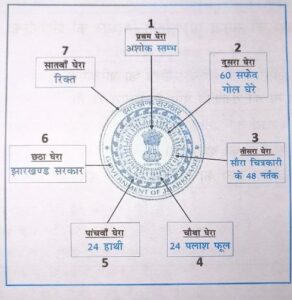
New State Emblem of Jharkhand
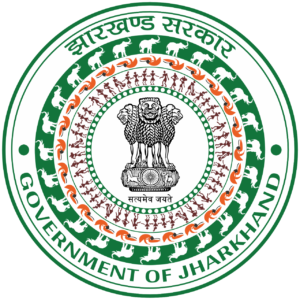
  • On 14 August 2020, the new state emblem of Jharkhand was unveiled at Aryabhatta Auditorium, Ranchi, and it came into effect from 15 August 2020

  • The design of the emblem is circular, symbolizing the progress of the state

  • The emblem uses green color, representing Jharkhand’s lush greenery and forest wealth

  • The emblem consists of a total of 7 concentric circles (rings)


Structure of the Emblem

Order of CircleDisplayed in the CircleDescription / Feature
1Ashoka Pillar & “Satyameva Jayate”The Ashoka Pillar represents India’s cooperative federalism, highlighting Jharkhand’s participation and important role
260 white dots
348 dancers of Sohrai artReflects the rich cultural heritage of tribal communities
424 Palash flowersSymbol of the state’s unique natural beauty; Palash is also the state flower of Uttar Pradesh
524 ElephantsSymbolizes the prosperity and richness of the state and its abundant natural resources; Elephant is also the state animal of Kerala and Karnataka
6“Jharkhand Sarkar / Government of Jharkhand”
7Empty circle

झारखण्ड का नया राजचिह्न

  • 14 अगस्त, 2020 को राँची के आर्यभट्ट सभागार में झारखण्ड राज्य के नये राजचिह्न का अनावरण किया गया तथा यह प्रतीक चिह्न 15 अगस्त, 2020 से प्रभावी हो गया।
  • प्रतीक चिह्न का विन्यास चक्राकार/वृत्ताकार है, जो राज्य की प्रगति का प्रतीक है।
  • प्रतीक चिह्न में वृत्ताकार खण्ड में हरा रंग का प्रयोग किया गया है, जो झारखण्ड की हरीभरी धरती एवं वन सम्पदा को प्रतिबिम्बित करता है।
  • झारखण्ड के प्रतीक चिह्न में कुल 7 घेरे/वृत्त हैं।

तालिका

घेरा/वृत्त का क्रम

घेरे में प्रदर्शित

विवरण / विशेषता

1

अशोक स्तम्भ एवं सत्यमेव जयते

अशोक स्तम्भ भारत के उत्तम सहकारी संघवाद, इसमें झारखण्ड की सहभागिता एवं अहस्तीय भूमिका को रेखांकित करता है।

2

60 सफेद वृत्त

3

सोहरा चित्रकारी के 48 नर्तक

यह जनजातियों की समृद्ध सांस्कृतिक विरासत को प्रतिबिम्बित करता है।

4

24 पलाश के फूल

• यह राज्य के अपूर्व प्राकृतिक सौंदर्य का परिचायक है। • उत्तर प्रदेश राज्य का राजकीय पुष्प भी पलाश ही है।

5

24 हाथी

यह राज्य के वैभव का प्रतीक है तथा राज्य के प्रचुर प्राकृतिक संसाधनों एवं समृद्धि को दर्शाता है।

केरल तथा कर्नाटक राज्य का राजकीय पशु भी हाथी ही है।

6

झारखण्ड सरकार / GOVERNMENT OF JHARKHAND

7

यह घेरा रिक्त है।


Sohra Painting / Sora Tribe

  • The Sora tribe (other name – Lauda tribe) mainly resides in the southern part of Odisha. Along with Odisha, this tribe also lives in the eastern coastal region of Andhra Pradesh.
  • This tribe is one of the oldest tribes of Odisha.
  • Ethnically, this tribe belongs to the Munda tribal group.
  • This tribe considers itself to be the descendants of Shabari.
  • The painting done by the Sora tribe is called Sora painting. This painting is also known as Italon or Ikon (Italon/Ikon).
  • This painting is made on rectangular frames on the inner walls of houses using bamboo brushes. It is a form of wall painting (mural art).
  • In this painting:
    • White color is made from rice powder
    • Black color from soot
    • Other colors from flower extracts, etc.
  • In this painting, the Sora tribe depicts their deities (Idital/Edital).
  • The main purpose of this painting is to please their deities and honor ancestors, so that fertility of land increases and protection from diseases is ensured.
  • Tribal communities living in the northern Sahyadri (Maharashtra) region use Warli painting, which is similar to Sora painting.

Old State Emblem of Jharkhand

  1. The first state emblem of Jharkhand had the Ashoka Chakra placed between four ‘J’ letters.
  2. It was designed by Amitabh Pandey of the National Institute of Design, Ahmedabad.

सोरा चित्रकारी / सोरा जनजाति

  • सोरा जनजाति (अन्य नाम लाउदा जनजाति) का निवास मुख्यतः उड़ीसा के दक्षिणी भाग में है। उड़ीसा के साथसाथ यह जनजाति आंध्र प्रदेश के पूर्वीतटीय भाग में भी निवास करती है।
  • यह जनजाति उड़ीसा की सबसे प्राचीन जनजातियों में से एक है।
  • नृजातीय रूप से यह जनजाति मुंडा जनजाति समूह से संबंध रखती है।
  • यह जनजाति स्वयं को शबरी के वंशज मानते हैं।
  • सोरा जनजाति द्वारा की जाने वाली चित्रकारी को सोरा चित्रकारी कहा जाता है। इस चित्रकारी को इटालोन या इकॉन (Italon/Ikon) भी कहा जाता है।
  • यह चित्रकारी आयताकार फ्रेम पर बाँस के कूंचे से घर की आंतरिक दीवारों पर की जाती है। यह एक भित्ति चित्रकारी है।
  • इस चित्रकारी में सफेद रंग हेतु चावल पाउडर, काले रंग हेतु कालिख तथा अन्य रंग हेतु फूल आदि के रसों का प्रयोग किया जाता है।
  • इस चित्रकारी में सोरा जनजाति द्वारा अपने देवीदेवताओं (Idital/Edital) को प्रदर्शित किया जाता है।
  • इस चित्रकारी का प्रमुख उद्देश्य अपने देवीदेवताओं को प्रसन्न करना तथा पूर्वजों का सम्मान करना है, ताकि भूमि की उर्वरता में वृद्धि के साथसाथ बीमारियों से स्वयं की रक्षा की जा सके।
  • उत्तरी सह्याद्रि (महाराष्ट्र) क्षेत्र में निवास करने वाले जनजातीय समुदाय के लोग सोरा चित्रकारी से मिलतीजुलती वारली चित्रकारी का प्रयोग करते हैं।


झारखण्ड का पुराना राजचिह्न

  1. झारखण्ड राज्य के प्रथम राजकीय चिह्न में चार J अक्षरों के बीच अशोक चक्र था।
  2. इसका प्रारूप राष्ट्रीय डिजाइन संस्थान, अहमदाबाद के अमिताभ पाण्डेय ने किया था।

Data

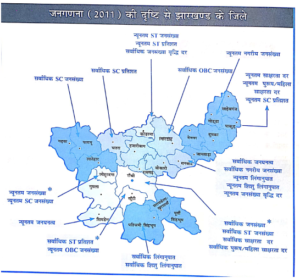
झारखण्ड : जनगणना (2011)

महत्वपूर्ण आँकड़े

  • कुल जनसंख्या329,88,134 * (~3.25 Cr)
  • 2001 में जनसंख्या – 2,69,45,829
  • देश की कुल जनसंख्या का प्रतिशत2.72% *
  • जनसंख्या की दृष्टि से देश में स्थान14वाँ

जनसंख्या का वर्गीकरण

वर्गीकरण

जनसंख्या

जनसंख्या %

पुरुष जनसंख्या

1,69,30,315

51.32%

महिला जनसंख्या

1,60,57,819

48.68%

ग्रामीण जनसंख्या

2,50,55,073 * (~2.5 cr)

75.95

नगरीय जनसंख्या

79,33,061

24.05

अनुसूचित जाति

39,85,644

12.08

अनुसूचित जनजाति

86,45,042

26.20

अल्पसंख्यक

19.12

0-6 आयु वर्ग

53,89,595

16.33

न्यूनतम vs सर्वाधिक


न्यूनतम

सर्वाधिक

जनसंख्या

लोहरदगा * (4,61,790)

राँची * (29,14,253)

जनसंख्या वृद्धि दर वाले जिले

धनबाद (11.99%)

कोडरमा (43.42%)

जनसंख्या घनत्व 414 / sq km* (14th position in india)

जनसंख्या घनत्व वाले जिले

सिमडेगा (159/sq km)

धनबाद (1316/sq km)

लिंगानुपात 948 female/1000 male * (17th position in india)

ग्रामीण लिंगानुपात

961

नगरीय लिंगानुपात

910

SC लिंगानुपात

950

ST लिंगानुपात

1003

लिंगानुपात वाले जिले


धनबाद  (909)

पश्चिमी सिंहभूम (1005)


  • साक्षरता दर – 66.41% * (2001 – 53.56%) 32वाँ


पुरुष साक्षरता दर

76.84%

महिला साक्षरता दर

55.42%

ग्रामीण साक्षरता दर

61.1%

नगरीय साक्षरता दर

82.3%

साक्षरता दर

पाकुड़ 48.82%

राँची 76.06%


पुरुष साक्षरता

पाकुड़ (57.06%)

रांची (84.26%)

महिला साक्षरता

पाकुड़ (40.52%)

रांची (67.44%)

SC

लोहरदग्गा (3.31%)

(15,330/4,61,790)

पलामू (27.6%)

(5,36,385/19,39,869)

SC%

पाकुड़ (3.16%)
28,453/9,00,422
population high but SC less

चतरा (32.65%)
3,40,502/10,42,886

ST

कोडरमा

6,903/ 7,16,259

रांची

10,42,016/29,14,253

ST%

कोडरमा (0.96%)
6
,876/ 7,16,259

खूँटी (73.25%)

3,89,605/5,31,885

OBC

खूँटी

गिरीडीह

अल्पसंखयक %

सरायकेला (6.86%)

सिमडेगा (53.81%)

नगरीय जनसंख्या (Urban Population)

गोड्डा

धनबाद


सामाजिक, आर्थिक एवं जातीय जनगणना2011

  • सामाजिक, आर्थिक एवं जातीय जनगणना–2011 के अनुसार झारखण्ड राज्य में अन्य पिछड़ा वर्ग (OBC) की कुल जनसंख्या 1.33 करोड़ है। यह राज्य की कुल जनसंख्या का 40.42% है।
  • राज्य में OBC की सर्वाधिक जनसंख्या वाला जिला गिरिडीह है। इसके बाद क्रमशः देवघर, पलामू एवं सरायकेला-खरसावाँ हैं।
  • राज्य में OBC की न्यूनतम जनसंख्या वाला जिला खूंटी है।

अल्पसंख्यक आबादी प्रतिशत

  • राज्य में अल्पसंख्यक आबादी का सर्वाधिक प्रतिशत सिमडेगा (53.81%) तथा न्यूनतम प्रतिशत सरायकेला-खरसावाँ (6.86%) में है।
  • केंद्र सरकार द्वारा घोषित अल्पसंख्यक केंद्रित जिले (6) – सिमडेगा, पाकुड़, साहेबगंज, खूंटी, राँची, गुमला


झारखण्ड एवं भारत के जनसंख्या संबंधी आँकड़ों का तुलनात्मक अध्ययन

विवरण

झारखण्ड

भारत

कुल जनसंख्या

3,29,88,134

1,21,05,69,573

पुरुष जनसंख्या

1,69,30,315 (51.32%)

62,31,21,843 (51.47%)

महिला जनसंख्या

1,60,57,819 (48.68%)

58,74,47,730 (48.53%)

ग्रामीण जनसंख्या

2,50,55,073 (75.95%)

83,34,63,448 (68.8%)

शहरी जनसंख्या

79,33,061 (24.05%)

37,71,06,125 (31.2%)

SC जनसंख्या

39,85,644 (12.08%)

20,13,78,086 (16.6%)

ST जनसंख्या

86,45,042 (26.20%)

10,42,81,034 (8.6%)


विवरण

झारखण्ड

भारत

दशकिय जनसंख्या वृद्धि दर

22.42%

17.7%

जनसंख्या घनत्व

414

382

लिंगानुपात

948

943

ग्रामीण लिंगानुपात

961

949

शहरी लिंगानुपात

910

929

SC लिंगानुपात

950

945

ST लिंगानुपात

1003

990

शिशु लिंगानुपात

948

919

साक्षरता दर

66.41%

73.0%

पुरुष साक्षरता दर

76.84%

80.9%


अन्य महत्वपूर्ण तथ्य

    • 2011 की जनगणना के समय झारखण्ड के जनगणना महानिदेशक सुनील कुमार बनवाला थे। इनके नेतृत्व में ही 2011 की जनगणना रिपोर्ट जारी की गयी थी।
    • सर्वाधिक जनसंख्या वाला प्रमण्डल उत्तरी छोटानागपुर तथा सबसे कम जनसंख्या वाला प्रमण्डल पलामू है।
    • 2011 की जनगणना के अनुसार, झारखण्ड में बेरोजगारी दर का प्रतिशत 3.1 प्रतिशत * था।


सर्वाधिक जनसंख्या वाले जिले

क्र.सं.

जिला

जनसंख्या

1

राँची *

29,14,253

2

धनबाद

26,84,487

3

गिरिडीह

24,45,474

4

पूर्वी सिंहभूम

22,93,919

5

बोकारो

20,62,330


न्यूनतम जनसंख्या वाले जिले

क्र.सं.

जिला

जनसंख्या

1

लोहरदगा *

4,61,790

2

खूंटी

5,31,885

3

सिमडेगा

5,99,578

4

कोडरमा

7,16,259

5

लातेहार

7,26,978


सर्वाधिक जनसंख्या वृद्धि दर वाले जिले

क्र.सं.

जिला

जनसंख्या

1

कोडरमा

43.42%

2

चतरा

31.77%

3

गिरिडीह

28.40%

4

पाकुड़

28.33%

5

देवघर

28.03%


न्यूनतम जनसंख्या वृद्धि दर वाले जिले

क्र.सं.

जिला

जनसंख्या

1

धनबाद

11.99%

2

पूर्वी सिंहभूम

15.68%

3

बोकारो

16.01%

4

रामगढ़/हजारीबाग

17.85%

5

जामताड़ा/दुमका

20.05%

पेज 13

  • जनसंख्या घनत्व – 414 *
    (2001 – 338)
  • जनसंख्या घनत्व की दृष्टि से देश में स्थान – 14वाँ

सर्वाधिक जनसंख्या घनत्व वाले जिले

क्र.सं.

जिला

जनसंख्या

1

धनबाद

1316

2

बोकारो

715

3

रामगढ़

708

4

पूर्वी सिंहभूम

644

5

देवघर

602


न्यूनतम जनसंख्या घनत्व वाले जिले

क्र.सं.

जिला

जनसंख्या

1

सिमडेगा

159

2

लातेहार

169

3

गुमला

191

4

पश्चिमी सिंहभूम

208

5

खूंटी

210


  • लिंगानुपात948 *
    (2001 – 941)
  • लिंगानुपात की दृष्टि से देश में स्थान – 17वाँ

लिंगानुपात का वर्गीकरण

वर्गीकरण

लिंगानुपात

2001 में लिंगानुपात

ग्रामीण लिंगानुपात

961

962

नगरीय लिंगानुपात

910

870

SC लिंगानुपात

950

ST लिंगानुपात

1003


सर्वाधिक लिंगानुपात वाले जिले

क्र.सं.

जिला

जनसंख्या

1

पश्चिमी सिंहभूम

1005

2

सिमडेगा

997

3

खूंटी

997

4

गुमला

993

5

पाकुड़

989


न्यूनतम लिंगानुपात वाले जिले

क्र.सं.

जिला

जनसंख्या

1

धनबाद

909

2

रामगढ़

921

3

बोकारो

922

4

देवघर

925

5

पलामू

928


  • साक्षरता दर – 66.41% * (2001 – 53.56%)
  • साक्षरता दर की दृष्टि से देश में स्थान – 32वाँ

साक्षरता दर का वर्गीकरण

वर्गीकरण

2011 में साक्षरता दर

2001 में साक्षरता दर

पुरुष साक्षरता दर

76.84%

67.3%

महिला साक्षरता दर

55.42%

38.9%

ग्रामीण साक्षरता दर

61.1%

45.7%

नगरीय साक्षरता दर

82.3%

79.1%


सर्वाधिक साक्षरता दर वाले जिले

क्र.सं.

जिला

जनसंख्या

1

राँची

76.06%

2

पूर्वी सिंहभूम

75.49%

3

धनबाद

74.52%

4

रामगढ़

73.17%

5

बोकारो

72.01%


न्यूनतम साक्षरता दर वाले जिले

क्र.सं.

जिला

जनसंख्या

1

पाकुड़

48.82%

2

साहेबगंज

52.04%

3

गोड्डा

56.40%

4

पश्चिमी सिंहभूम

58.63%

5

लातेहार

59.51%


आँकड़ों में अन्य महत्वपूर्ण जिले

विवरण

जिला

संबंधित आँकड़ा

सर्वाधिक पुरुष साक्षरता

राँची

84.26%

न्यूनतम पुरुष साक्षरता

पाकुड़

57.06%

सर्वाधिक महिला साक्षरता

राँची

67.44%

न्यूनतम महिला साक्षरता

पाकुड़

40.52%

सर्वाधिक SC

पलामू

5,36,385

न्यूनतम SC

लोहरदगा

15,330

सर्वाधिक ST

राँची

10,42,016

न्यूनतम ST

कोडरमा

6,903

सर्वाधिक SC %

चतरा

32.65%

न्यूनतम SC %

पाकुड़

3.16%

सर्वाधिक ST %

खूंटी *

73.25%

न्यूनतम ST %

कोडरमा

0.96%

सर्वाधिक अल्पसंख्यक %

सिमडेगा

53.81%

न्यूनतम अल्पसंख्यक %

सरायकेला-खरसावाँ

6.86%


धर्म आधारित जनगणना के आँकड़े

क्र.सं.

धर्म

प्रतिशत

1

हिन्दू

67.83%

2

मुस्लिम

14.53%

3

ईसाई

4.30%

4

सिख

0.22%

5

जैन

0.05%

6

बौद्ध

0.03%

7

अन्य

13.04%


झारखण्ड में अनुसूचित जाति (SC) के जनसंख्या के आँकड़े

  • SC की कुल जनसंख्या – 39,85,644
  • कुल जनसंख्या का प्रतिशत – 12.08%

सर्वाधिक SC जनसंख्या वाले जिले

क्र.सं.

जिला

जनसंख्या

SC का %

1

पलामू

5,36,382

13.46%

2

धनबाद

4,37,309

10.97%

3

चतरा

3,40,553

8.54%

4

गिरिडीह

3,25,493

8.16%

5

गढ़वा

3,19,946

8.03%


न्यूनतम SC जनसंख्या वाले जिले

क्र.सं.

जिला

जनसंख्या

SC का %

1

लोहरदगा

15,330

0.38%

2

खूंटी

24,037

0.60%

3

पाकुड़

28,469

0.71%

4

गुमला

32,459

0.81%


झारखण्ड में अनुसूचित जनजाति (ST) के जनसंख्या के आँकड़े

  • ST की कुल जनसंख्या – 86,45,042
  • कुल जनसंख्या का प्रतिशत – 26.20%
  • झारखण्ड राज्य में कुल 32 अनुसूचित जनजाति समूहों का निवास है (पुराना के जुड़ने पर 33)

सर्वाधिक ST जनसंख्या वाले जिले

क्र.सं.

जिला

जनसंख्या

ST का %

1

राँची

10,42,016

12.05%

2

प. सिंहभूम

10,11,296

11.70%

3

गुमला

7,06,754

8.18%

4

पू. सिंहभूम

6,53,923

7.56%

5

दुमका

5,71,077

6.61%


न्यूनतम ST जनसंख्या वाले जिले

क्र.सं.

जिला

जनसंख्या

ST का %

1

कोडरमा

6,903

0.08%

2

चतरा

45,556

0.53%

3

हजारीबाग

1,21,768

1.41%

4

देवघर

1,80,962

2.09%

5

पलामू

1,81,208

2.10%


राज्य की कुल जनजातीय आबादी में विभिन्न जनजातियों का प्रतिशत

क्र.सं.

जनजाति

2011

2001

1

संथाल *

31.86%

34.01%

2

उराँव

19.86%

19.62%

3

मुंडा

14.22%

14.81%

4

हो

10.74%

10.51%

5

खड़िया

2.88%

2.71%


राज्य की कुल आदिम जनजातीय आबादी में विभिन्न समूहों का प्रतिशत

क्र.सं.

जनजाति

प्रतिशत

1

माल पहाड़िया

46%

2

सौरिया पहाड़िया

16%

3

कोरवा

12%

4

परहिया

9%

5

असुर

8%

6

बिरहोर

4%

7

सवर

3%

8

बिरजिया

2%

  • राज्य की 91% अनुसूचित जनजाति ग्रामीण क्षेत्रों में निवास करती है।

झारखण्ड में नगरीकरण

  • राज्य में नगरीय जनसंख्या (प्रतिशत में) – 24% *
  • राज्य में ग्रामीण जनसंख्या (प्रतिशत में) – 76%
  • नगरीय जनसंख्या की दृष्टि से झारखण्ड का देश में स्थान – 27वाँ


सर्वाधिक नगरीय जनसंख्या वाले पाँच जिले

क्र.सं.

जिला

जनसंख्या %

1

धनबाद *

58.13%

2

पूर्वी सिंहभूम

55.56%

3

बोकारो

47.70%

4

रामगढ़

44.13%

5

राँची

43.14%


न्यूनतम नगरीय जनसंख्या वाले पाँच जिले

क्र.सं.

जिला

जनसंख्या %

1

गोड्डा

4.91%

2

गढ़वा

5.27%

3

चतरा

6.04%

4

गुमला

6.35%

5

दुमका

6.82%


1. दक्षिणी छोटानागपुर प्रमंडल
Ranchi

रांची जिला
महत्वपूर्ण तथ्य

मद

विवरण

गठन

1899

मुख्यालय

राँची

क्षेत्रफल

5,097 वर्ग कि.मी.

कुल जनसंख्या

29,14,253

दशकीय जनसंख्या वृद्धि दर

23.9%

जनसंख्या घनत्व

572*

लिंगानुपात

949

शिशु लिंगानुपात

938

साक्षरता दर

76.06%

अनुमंडल

02 (राँची सदर एवं बुंडू)


महत्वपूर्ण तथ्य

1.      सर्वाधिक जनसंख्या*,

2.      सर्वाधिक साक्षरता दर (76.06%),

3.      सर्वाधिक पुरुष साक्षरता दर (84.26%),

4.      सर्वाधिक महिला साक्षरता दर (67.44%),

5.      सर्वाधिक अनुसूचित जनजाति की जनसंख्या,

6.      सर्वाधिक विधानसभा क्षेत्र (07),

7.      संयुक्त बिहार की ग्रीष्मकालीन राजधानी,

8.      उपनाम झरनों का शहर*,

9.      HEC के साथसाथ CCL SAIL का मुख्यालय अवस्थित


अन्य विवरण

शीर्षक

विवरण

प्रखण्ड

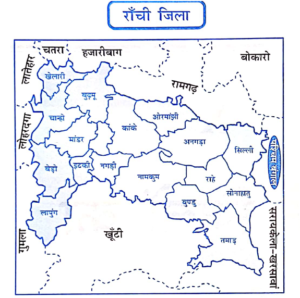
18* (रातू, कांके, मांडर, नामकुम, बेड़ो, लापुंग, चान्हो, ओरमांझी, अनगड़ा, नगड़ी, खलारी, राहे, इटकी, सिल्ली, बुंडू, तमाड़, सोनाहातु, बुढ़मू)

विधानसभा क्षेत्र

07 (राँची, हटिया, कांके, मांडर, तमाड़, सिल्ली, खिजरी)

राष्ट्रीय राजमार्ग

20, 39, 43, 143AG

प्रमुख नदियाँ

1.      स्वर्ण रेखा,

2.      दक्षिणी कोयल,

3.      शंख,

4.      हरमु नदी

प्रमुख खनिज

कोयला, चूना पत्थर, फायर क्ले, ग्रेनाइट, चायना क्ले, जस्ता, टिन, एस्बेस्टस, थोरियम, इल्मेनाइट

प्रमुख उद्योग

1.      हेवी इंजीनियरिंग कॉर्पोरेशन लि. (राँची)*,

2.      इंडियन एल्युमिनियम कंपनी लि. (मुरी),

3.      ए.सी.सी. सिमेंट लि. (खलारी),

4.      उषा मार्टिन कंपनी (नामकुम),

5.      गार्डन रीच शिपबिल्डर्स एण्ड इंजीनियरिंग लि.

प्रमुख पर्यटन स्थल

1.      हुंडरू जलप्रपात,

2.      जोन्हा (गौतमीधारा) जलप्रपात,

3.      दशम जलप्रपात,

4.      सीता जलप्रपात*,

5.      टैगोर हिल (मोरहाबादी पहाड़ी),

6.      पहाड़ी मंदिर,

7.      जगन्नाथपुर मंदिर,

8.      बिरसा जैविक उद्यान (ओरमांझी),

9.      मैक्लुस्कीगंज,

10. गेतलसूद डैम (ओरमांझी),

11. रॉक गार्डन*,

12. नक्षत्र वन,

13. रातू किला,

14. सिद्धूकान्हू पार्क,

15. योगदा मठ आश्रम,

16. पिठोरिया (पहाड़ के ऊपर टुंगरी)

मैक्लुस्कीगंज*

  • मैक्लुस्कीगंज राँची जिला मुख्यालय से लगभग 60 कि.मी. की दूरी पर है।
    • यह विश्व का एकमात्र एंग्लो-इंडियन गाँव है।
  • मैक्लुस्की ने 1933 ई. में ‘कोलोनाइजेशन सोसायटी ऑफ इंडिया’ का गठन किया तथा राँची महाराज से एक समझौते के तहत 10,000 एकड़ जमीन मैक्लुस्कीगंज गाँव की स्थापना हेतु प्राप्त किया था।


श्रेणी

विवरण

प्रमुख धार्मिक स्थल

1.      सूर्य मंदिर,

2.      देउड़ी मंदिर,

3.      पहाड़ी मंदिर,

4.      जगन्नाथपुर मंदिर

प्रमुख शैक्षणिक संस्थान

5.      राँची विश्वविद्यालय,

6.      डॉ. श्यामा प्रसाद मुखर्जी विश्वविद्यालय,

7.      बिरसा कृषि विश्वविद्यालय,

8.      केंद्रीय विश्वविद्यालय (ब्रांबे),

9.      राष्ट्रीय विधि अध्ययन एवं अनुसंधान विश्वविद्यालय,

10. बिरला इंस्टिट्यूट ऑफ टेक्नोलॉजी,

11. मेसरा,

12. राँची कृषि महाविद्यालय,

13. छोटानागपुर लॉ कॉलेज,

14. इंडियन लाह एंड रिसर्च इंस्टिट्यूट (नामकुम),

15. कुष्ठ रोग अनुसंधान केन्द्र,

16. द जेवियर इंस्टिट्यूट ऑफ सोशल साइंसेज (XISS),

17. भारतीय विधि माप विज्ञान संस्थान,

18. राँची आयुर्विज्ञान संस्थान,

19. रिनपास,

20. श्री कृष्ण लोक प्रशासन प्रशिक्षण संस्थान,

21. झारखण्ड न्यायिक अकादमी,

22. रक्षा शक्ति विश्वविद्यालय,

23. भारतीय प्रबंधन संस्थान (IIM)

महत्वपूर्ण तथ्य

1.      सर्वाधिक जनसंख्या*,

2.      सर्वाधिक साक्षरता दर (76.06%),

3.      सर्वाधिक पुरुष साक्षरता दर (84.26%),

4.      सर्वाधिक महिला साक्षरता दर (67.44%),

5.      सर्वाधिक अनुसूचित जनजाति की जनसंख्या,

6.      सर्वाधिक विधानसभा क्षेत्र (07),

7.      संयुक्त बिहार की ग्रीष्मकालीन राजधानी,

8.      उपनाम झरनों का शहर*,

9.      HEC के साथसाथ CCL SAIL का मुख्यालय अवस्थित

अन्य विवरण

1.      एक मान्यता के अनुसार राँची का नामकरण अरची (बांस के जंगल) से किया गया है।

2.      शरत चंद्र राय के अनुसार राँची का नाम एक मुंडारी शब्द अरांची (छोटी छड़ी) के नाम पर किया गया है।

3.      एक लोककथा के अनुसार राँची का नामकरण पहाड़ी मंदिर क्षेत्र में पाये जाने वाले पक्षी रिंची के नाम पर किया गया है।

4.      पहाड़ी मंदिर को प्राचीन काल में रिंची बुरू के नाम से जाना जाता था।

5.      1834 . में कैप्टन विल्किन्सन ने दक्षिणीपश्चिमी सीमांत एजेंसी की राजधानी किसुनपुर में स्थापित की, जिसका नाम बाद में राँची हो गया।

6.      1983 ई. में राँची जिला को तीन जिलों (राँची, लोहरदगा गुमला) में विभाजित* किया गया था।

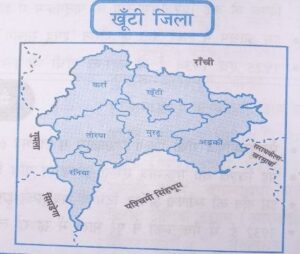
खूंटी जिला

महत्वपूर्ण तथ्य

सर्वाधिक अनुसूचित जनजाति प्रतिशत*


  • खूंटी जिला के सरिदकेल नामक स्थान से प्राचीन काल के कई अवशेष जैसे- जले हुए ईंटों के घर, लाल मिट्टी के बर्तन, सिक्के व लोहे उपकरण आदि प्राप्त हुए हैं।


श्रेणी

विवरण

गठन

12 सितम्बर, 2007 (राँची जिला से विभाजित) 23वाँ जिला

मुख्यालय

खूंटी

क्षेत्रफल

2,535 वर्ग कि.मी.

कुल जनसंख्या

5,31,885

दशकीय जनसंख्या वृद्धि दर

22.32%

जनसंख्या घनत्व

210

लिंगानुपात

997

शिशु लिंगानुपात

964

साक्षरता दर

63.86%

अनुमंडल

01 (खूंटी)

प्रखण्ड

06 (खूंटी, तोरपा, मुरहू, अड़की, कर्रा एवं रनिया)

विधानसभा क्षेत्र

02 (खूंटी एवं तोरपा)

राष्ट्रीय राजमार्ग

20, 143D, 143AG

प्रमुख नदियाँ

1.      कांची,

2.      कारो,

3.      करकरी,

4.      बनाई नदी

प्रमुख खनिज

चूना-पत्थर,

इमारती पत्थर

प्रमुख पर्यटन स्थल

1.      पंचघाघ जलप्रपात,

2.      रानी जलप्रपात,

3.      बिरसा मृग विहार हिरण पार्क,

4.      डोंबारी पहाड़ी (बिरसा मुंडा का जन्म स्थान),

5.      उलिहातू,

6.      उलिहातू पहाड़ी,

7.      पांडुपुडिंग

प्रमुख धार्मिक स्थल

शिव मंदिर,

अमरेश्वर धाम

महत्वपूर्ण तथ्य

सर्वाधिक अनुसूचित जनजाति प्रतिशत*

अन्य विवरण

खूंटी जिला के सरिदकेल नामक स्थान से प्राचीन काल के कई अवशेष जैसे- जले हुए ईंटों के घर, लाल मिट्टी के बर्तन, सिक्के व लोहे उपकरण आदि प्राप्त हुए हैं।


डोंबारी बुरु (पहाड़ी)*

  • यह पहाड़ी खूंटी जिले के अड़की प्रखण्ड में स्थित है।
    बिरसा उलगुलान के दौरान 9 जनवरी, 1899 . को बिरसा मुंडा अपने 12 अनुयायियों के साथ एक सभा कर रहे थे। उन्हें सुनने हेतु आस-पास के गाँव से सैकड़ों लोग (महिलाओं एवं बच्चों सहित) सभा में आ गए जिसे अंग्रेजों ने चारों ओर से घेर कर निर्दोष लोगों को गोलियों से भून दिया था।
    • इस दर्दनाक घटना में सैकड़ों लोग शहीद हो गये जबकि बिरसा मुंडा बचकर भागने में सफल रहे थे।

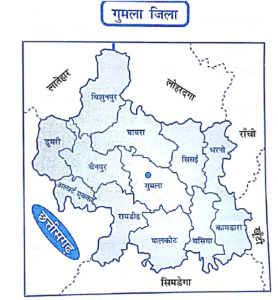
गुमला जिला

महत्वपूर्ण तथ्य

महत्वपूर्ण तथ्य

गठन

18 मई, 1983

मुख्यालय

गुमला

क्षेत्रफल

5,360 वर्ग कि.मी.

कुल जनसंख्या

10,25,213

दशकीय जनसंख्या वृद्धि दर

23.16%

जनसंख्या घनत्व

191

लिंगानुपात

993

शिशु लिंगानुपात

963

साक्षरता दर

75.55%

अनुमंडल

03 (गुमला, चैनपुर और बसिया)

प्रखण्ड

12 (गुमला, सिसई, बिशुनपुर, चैनपुर, घाघरा, डुमरी, बसिया, रायडीह, कामडारा, भरनो, पालकोट, अल्बर्ट एक्का)

विधानसभा क्षेत्र

03 (गुमला, सिसई, बिशुनपुर)

राष्ट्रीय राजमार्ग (NH)

43, 143, 143A, 143B, 143D

प्रमुख नदियाँ

1.      दक्षिण कोयल,

2.      शंख

प्रमुख खनिज

1.      बॉक्साइट,

2.      चूनापत्थर,

3.      सीसा,

4.      क्वार्ट्ज,

5.      क्यानाइट,

6.  लोहा

प्रमुख पर्यटन स्थल

1.      घाघरा जलप्रपात,

2.      हेपाद जलप्रपात,

3.      प्रेमाघाघ जलप्रपात,

4.      पालकोट अभयारण्य*,

5.      नवरत्नगढ़ का किला,

6.      पालकोट का राजमहल,

7.      नागफेनी का राजमहल,

8.      अंबाघाट,

9.  पालकोट की गुफा*

प्रमुख धार्मिक स्थल

महामाया मंदिर,

अंजनधाम मंदिर,

टांगीनाथ मंदिर

अन्य विवरण

माना जाता है कि गुमला शब्द की उत्पत्ति ‘गो-मेला’ से हुई है। गुमला जिला हनुमानजी की जन्मस्थली मानी जाती है। यहाँ अवस्थित ऋष्यमूक चोटी का उल्लेख रामायण में है।

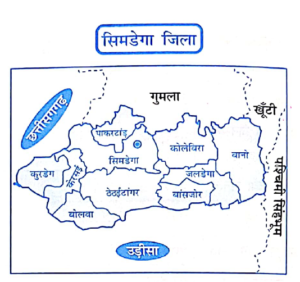
सिमडेगा जिला

महत्वपूर्ण तथ्य

न्यूनतम जनसंख्या घनत्व (जनघनत्व) (159)


महत्वपूर्ण तथ्य समेकित तालिका

मद

विवरण

गठन

30 अप्रैल, 2001* (गुमला जिला से विभाजित)

मुख्यालय

सिमडेगा

क्षेत्रफल

3,774 वर्ग कि.मी.

कुल जनसंख्या

5,99,578

दशकीय जनसंख्या वृद्धि दर

16.58%

जनसंख्या घनत्व

159

लिंगानुपात

997

शिशु लिंगानुपात

969

साक्षरता दर

67.99%

अनुमंडल

01 (सिमडेगा)

प्रखण्ड

10 (सिमडेगा, कोलेबिरा, बानो, बांसजोर, जलडेगा, बोलबा, कुरडेग, पाकरटांड, केरसई, ठेठईटांगर)

विधानसभा क्षेत्र

02 (सिमडेगा, कोलेबिरा)

राष्ट्रीय राजमार्ग

143, 143D, 143H, 320G

प्रमुख नदियाँ

1.      दक्षिण कोयल,

2.      शंख

प्रमुख खनिज

1.      क्वार्ट्ज,

2.  चूनापत्थर

महत्वपूर्ण तथ्य

न्यूनतम जनघनत्व (159)

अन्य विवरण

प्राचीन समय में सिमडेगा को राजा कटंग देव द्वारा शासित बीरूकेशलपुर परगना* के नाम से जाना जाता था।

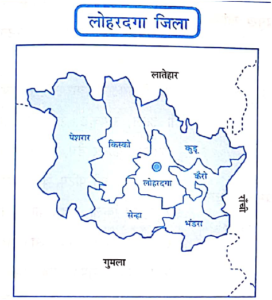
लोहरदगा जिला

महत्वपूर्ण तथ्य

1.      न्यूनतम जनसंख्या*,

2.  अनुसूचित जनजाति की न्यूनतम जनसंख्या


महत्वपूर्ण तथ्य (लोहरदगा जिला)

मद

विवरण

गठन

1983*

मुख्यालय

लोहरदगा

क्षेत्रफल

1,502 वर्ग कि.मी.

कुल जनसंख्या

4,61,790

दशकीय जनसंख्या वृद्धि दर

26.68%

जनसंख्या घनत्व

307

लिंगानुपात

985

शिशु लिंगानुपात

970

साक्षरता दर

67.61%

अनुमंडल

01 (लोहरदगा)

प्रखण्ड

07 (लोहरदगा, कुडू, किस्को, सेन्हा, पेशरार, केरू, भंडरा)

विधानसभा क्षेत्र

01 (लोहरदगा)

राष्ट्रीय राजमार्ग

39, 143A, 143AG

प्रमुख नदियाँ

1.      दक्षिणी कोयल

प्रमुख खनिज

2.      बॉक्साइट,

3.  लेटराइट

प्रमुख शैक्षणिक संस्थान

राजकीय आयुर्वेद महाविद्यालय

महत्वपूर्ण तथ्य

3.      न्यूनतम जनसंख्या*,

4.  अनुसूचित जनजाति की न्यूनतम जनसंख्या

धार्मिक स्थल

वासुदेव राय मंदिर

अन्य विवरण

लोहरदगा का शाब्दिक अर्थ ‘लोहा बनाने वालों का केंद्र’ होता है। आईनअकबरी पुस्तक में किस्मते लोहरदगा शब्द का उल्लेख किया गया है।

लोहरदगा के बारे में

  • वर्ष 1983* में राँची जिला को तीन जिलों में (राँची, लोहरदगा गुमला) में बाँटा गया, जिसके परिणामस्वरूप लोहरदगा जिला अस्तित्व में आया।
    • लोहरदगा को 1972 ई. में अनुमंडल का दर्जा प्रदान किया गया था।
    जैन साहित्य के अनुसार, महावीर जैन ने लोहरयुद्धा (लोहरदगा) की यात्रा की थी, जिसका मुंडारी में अर्थ ‘आँसुओं की नदी’ होता है।
    • आईन-ए-अकबरी पुस्तक में ‘किस्मते लोहरदगा’ नामक एक स्थान का वर्णन मिलता है, जिसका संबंध वर्तमान लोहरदगा से बताया जाता है।
    • लोहरदगा (लोहार+डागा) माना जाता है, जिसका शाब्दिक अर्थ ‘लौह खनन का केंद्र माना जाता है।
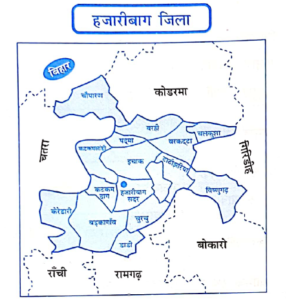
हजारीबाग

हजारीबाग जिला

समेकित तालिका (भाग1)

मद

विवरण

गठन

1834

मुख्यालय

हजारीबाग

क्षेत्रफल

3,555 वर्ग कि.मी.

कुल जनसंख्या

17,34,495

दशकीय जनसंख्या वृद्धि दर

20.65%

जनसंख्या घनत्व

488

लिंगानुपात

947

शिशु लिंगानुपात

933

साक्षरता दर

69.75%

अनुमंडल

02 (हजारीबाग एवं बरही)

प्रखण्ड

16 (हजारीबाग सदर, बरही, बड़कागाँव, बरकट्टा, केरेडारी, चौपारण, पदमा, इचाक, विष्णुगढ़, चुरचु, टाटीझरिया, दारू, कटकमदाग, कटकमसांडी, चलकुशा, डाडी)

विधानसभा क्षेत्र

04 (हजारीबाग, बरही, बड़कागांव, बरकट्ठा)

राष्ट्रीय राजमार्ग (NH)

19, 20, 522

प्रमुख नदियाँ

1.      दामोदर,

2.      बराकर,

3.      भैरवी

प्रमुख खनिज

कोयला, चूना-पत्थर, अभ्रक, क्वार्ट्ज, चायराइट, फेल्स्पार, फायरक्ले, जस्ता, टिन, टंगस्टन, अभ्रक, लोहा

प्रमुख पर्यटन स्थल

1.  हजारीबाग अभयारण्य,

2.  सालपण् झील,

3.  सूर्यकुंड,

4.  रानीबहल गर्म जलकुंड,

5.  कोनार डैम,

6.  चंद्रपुरा हिरण पार्क,

7.  इस्को की पेंटिंग,

8.  बरसो पानी,

9.  पद्मा का किला,

10. बादम का किला,

11. सीतागढ़ा पहाड़ (4 आकृतियों वाला बौद्ध स्तूप),

12. महुदी पहाड़ (गुप्तकालीन पत्थर काटकर मंदिर का निर्माण)

प्रमुख शैक्षणिक संस्थान

1.      विनोबा भावे विश्वविद्यालय*,

2.      भारतीय कृषि अनुसंधान संस्थान (बरही),

3.      मृदा शोध एवं अनुसंधान संस्थान,

4.      चावल अनुसंधान संस्थान,

5.      पुलिस प्रशिक्षण केंद्र,

6.  सीमा सुरक्षा बल प्रशिक्षण केंद्र एवं स्कूल (मेरु)

महत्वपूर्ण तथ्य

झारखण्ड में सर्वाधिक वर्षा वाला जिला,

प्रमुख चोटियाँ – चंदवार व जिलिंजा

अन्य विवरण

उपनाम – हजार बागों का शहर

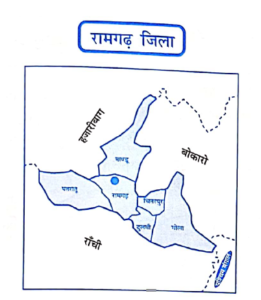
रामगढ़ जिला

महत्वपूर्ण तथ्य

न्यूनतम क्षेत्रफल वाला जिला (1,341 वर्ग कि.मी.)


मद

विवरण

गठन

12 सितम्बर, 2007* (हजारीबाग जिला से विभाजित)

मुख्यालय

रामगढ़

क्षेत्रफल

1,341 वर्ग कि.मी.

कुल जनसंख्या

9,49,443

दशकीय जनसंख्या वृद्धि दर

13.10%

जनसंख्या घनत्व

708

लिंगानुपात

921

शिशु लिंगानुपात

927

साक्षरता दर

73.17%

अनुमंडल

01 (रामगढ़)

प्रखण्ड

06 (रामगढ़, मांडू, पतरातू, गोला, चितरपुर, दुलमी)

विधानसभा क्षेत्र

02 (रामगढ़ एवं मांडू)

राष्ट्रीय राजमार्ग (NH)

20, 320, 419

प्रमुख नदियाँ

1.      दामोदर,

2.      कोनार,

3.      भैरवी,

4.      बोकारो

प्रमुख खनिज

कोयला, चूना-पत्थर, क्वार्ट्ज, फायरक्ले, फेल्स्पार

प्रमुख उद्योग

इंडो-आसाई ग्लास फैक्ट्री

1.  प्रमुख पर्यटन स्थल

2.      रजरप्पा जलप्रपात,

3.      पतरातू डैम,

4.      चुटुपालू घाटी*,

5.  ललकी घाटी*

प्रमुख धार्मिक स्थल

माँ छिन्नमस्तिका मंदिर (रजरप्पा)

महत्वपूर्ण तथ्य

न्यूनतम क्षेत्रफल वाला जिला (1,341 वर्ग कि.मी.)

अन्य विवरण

रामगढ़ जिला का नामकरण दलेल सिंह (रामगढ़ के राजा) के पिता राम सिंह के नाम पर किया गया है।

बुजुर्ग जमीर गांव

  • पतरातू प्रखण्ड में अवस्थित इस गाँव में ऐतिहासिक कब्रिस्तान है, जिसे चाइना कब्रिस्तान के नाम से जाना जाता है।
    • इस कब्रिस्तान में द्वितीय विश्वयुद्ध के दौरान मारे गये 670 चीनी सैनिकों को (मेजर जनरल यांग सहित) दफन किया गया था।
    • यह गाँव भदानीनगर के समीप अवस्थित है।

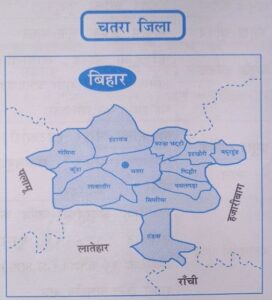
चतरा जिला

महत्वपूर्ण तथ्य

1.      सर्वाधिक अनुसूचित जाति का प्रतिशत (32.65%),

2.      दूसरा सर्वाधिक वन प्रतिशत (47.80%),

3.      सबसे छोटा संसदीय क्षेत्र


महत्वपूर्ण तथ्य

गठन

29 मई, 1991*

मुख्यालय

चतरा

क्षेत्रफल

3,718 वर्ग कि.मी.*

कुल जनसंख्या

10,42,886

दशकीय जनसंख्या वृद्धि दर

31.77%

जनसंख्या घनत्व

280

लिंगानुपात

953

शिशु लिंगानुपात

967

साक्षरता दर

60.18%

अनुमंडल

02 (चतरा एवं सिमरिया)

प्रखण्ड

12 (चतरा, सिमरिया, हंटरगंज, इटखोरी, टंडवा, प्रतापपुर, लावालोंग, पत्थलगड़ा, मयूरहंड, कुंडा, गिद्धौर, कान्हा चट्टी)

विधानसभा क्षेत्र

02 (चतरा एवं सिमरिया)

राष्ट्रीय राजमार्ग

22, 522

प्रमुख नदियाँ

1.      दामोदर,

2.      बराकर,

3.      पुनपुन

प्रमुख खनिज

कोयला, अभ्रक, चूना-पत्थर

प्रमुख पर्यटन स्थल

1.      कोल्हुआ पहाड़,

2.      लावालोंग अभयारण्य,

3.      दुग्धेश्वर जलप्रपात,

4.      महेंद्रपाल का शिलालेख

प्रमुख धार्मिक स्थल

1.      भद्रकाली मंदिर (इटखोरी),

2.      कौलेश्वरी मंदिर*,

3.      सहस्त्रबुद्ध मंदिर

महत्वपूर्ण तथ्य

4.      सर्वाधिक अनुसूचित जाति का प्रतिशत (32.65%),

5.      दूसरा सर्वाधिक वन प्रतिशत (47.80%),

6.      सबसे छोटा संसदीय क्षेत्र

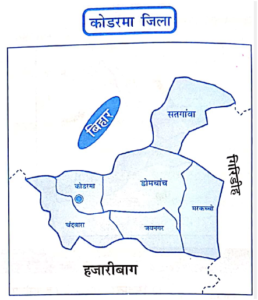
कोडरमा जिला समेकित तालिका


महत्वपूर्ण तथ्य

1.      न्यूनतम अनुसूचित जनजाति जनसंख्या वाला जिला,

2.      न्यूनतम अनुसूचित जनजाति का प्रतिशत (0.96%),

3.  सर्वाधिक जनसंख्या वृद्धि दर (43.42%)

अन्य विवरण

कोडरमा को भारत की अभ्रक राजधानी भी कहा जाता है।


मद

विवरण

गठन

10 अप्रैल, 1994

मुख्यालय

कोडरमा

क्षेत्रफल

2,540 वर्ग कि.मी.

कुल जनसंख्या

7,16,259

दशकीय जनसंख्या वृद्धि दर

43.42%

जनसंख्या घनत्व

280

लिंगानुपात

953

शिशु लिंगानुपात

949

साक्षरता दर

66.84%

अनुमंडल

01 (कोडरमा)

प्रखण्ड

06 (कोडरमा, सतगांवा, डोमचांच, मरकच्चो, चंदवारा, जयनगर)

विधानसभा क्षेत्र

01 (कोडरमा)

राष्ट्रीय राजमार्ग (NH)

20

प्रमुख नदियाँ

1.      बराकर,

2.      सकरी,

3.      बरसोती

प्रमुख खनिज

अभ्रक, चूना, क्वार्ट्ज

प्रमुख पर्यटन स्थल

1.      तिलैया डैम,

2.      गौतम बुद्ध अभयारण्य,

3.      कोडरमा अभयारण्य,

4.  सतगांव

महत्वपूर्ण तथ्य

4.      न्यूनतम अनुसूचित जनजाति जनसंख्या वाला जिला,

5.      न्यूनतम अनुसूचित जनजाति का प्रतिशत (0.96%),

6.  सर्वाधिक जनसंख्या वृद्धि दर (43.42%)

अन्य विवरण

कोडरमा को भारत की अभ्रक राजधानी भी कहा जाता है।

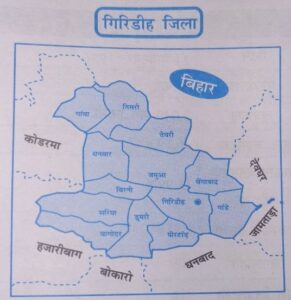
गिरिडीह जिला

महत्वपूर्ण तथ्य

सर्वाधिक अनुमंडल वाला जिला (04)


मद

विवरण

गठन

4 दिसम्बर, 1972

मुख्यालय

गिरिडीह

क्षेत्रफल

4,962 वर्ग कि.मी.

कुल जनसंख्या

24,45,474

दशकीय जनसंख्या वृद्धि दर

28.41%

जनसंख्या घनत्व

493

लिंगानुपात

944

शिशु लिंगानुपात

942

साक्षरता दर

63.14%

अनुमंडल

04 (गिरिडीह, बगोदर/सरिया, डुमरी, खोरीमहुआ)

प्रखण्ड

13 (गिरिडीह, बगोदर, डुमरी, धनवार, जमुआ, गांडेय, देवरी, गाँवा, तिसरी, पीरटांड़, बिरनी, बेंगाबाद, सरिया)

विधानसभा क्षेत्र

06 (गिरिडीह, बगोदर, डुमरी*, धनवार, जमुआ, गांडेय*)

राष्ट्रीय राजमार्ग

19, 114A, 522

प्रमुख नदियाँ

1.      दामोदर,

2.      बराकर,

3.      सकरी

प्रमुख खनिज

कोयला, अभ्रक, क्वार्ट्जाइट

प्रमुख उद्योग

भारत माइका इंडस्ट्रीज प्रा. लि.

प्रमुख पर्यटन स्थल

1.      पारसनाथ*,

2.      उसरी जलप्रपात*,

3.  खंडोली

प्रमुख धार्मिक स्थल

1.      पारसनाथ,

2.      झारखण्ड धाम मंदिर,

3.  मधुबन का जैन मंदिर

प्रमुख शैक्षणिक संस्थान

मुग्धिपाल शोध एवं विकास संस्थान,

यूनानी मेडिकल कॉलेज

महत्वपूर्ण तथ्य

सर्वाधिक अनुमंडल वाला जिला (04)

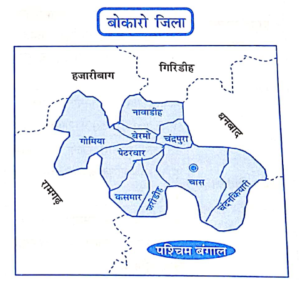
बोकारो जिला

महत्वपूर्ण तथ्य

गठन

1 अप्रैल, 1991*

मुख्यालय

बोकारो

क्षेत्रफल

2,883 वर्ग कि.मी.

कुल जनसंख्या

20,62,330*

दशकीय जनसंख्या वृद्धि दर

16.01%

जनसंख्या घनत्व

715

लिंगानुपात

922

शिशु लिंगानुपात

923

साक्षरता दर

72.01%

अनुमंडल

02 (चास एवं बेरमो)

प्रखण्ड

09 (चास, बेरमो, गोमिया, चंदनक्यारी, चंद्रपुरा, नावाडीह, कसमार, पेटरवार, जरीडीह)

विधानसभा क्षेत्र

04 (बोकारो, बेरमो, गोमिया, चंदनक्यारी)

राष्ट्रीय राजमार्ग

18, 218, 320

प्रमुख नदियाँ

1.      दामोदर,

2.      कोनार,

3.      घाघो

प्रमुख खनिज

कोयला

प्रमुख पर्यटन स्थल

1.      तेनुघाट डैम,

2.      बोकारो थर्मल पावर स्टेशन (बीटीपीएस),

3.      जवाहरलाल जैविक उद्यान,

4.      दुर्गापुर पहाड़,

5.      नेहरू पार्क,

6.      सिटी पार्क,

7.      चंद्रपुरा पक्षी विहार

अन्य विवरण

बोकारो भारत के नियोजित शहरों (Planned Cities) में शामिल है।

माराफारी बोकारो जिला का सबसे पुराना अधिवासित क्षेत्र (Settlement Area) है।

बोकारो जिला का निर्माण गिरिडीह धनबाद* जिला को काटकर किया गया है।

धनबाद जिला


गठन

24 अक्टूबर, 1956*

मुख्यालय

धनबाद

क्षेत्रफल

2,040 वर्ग कि.मी.

कुल जनसंख्या

26,84,487

दशकीय जनसंख्या वृद्धि दर

11.99%

जनसंख्या घनत्व

1,316

लिंगानुपात

909

शिशु लिंगानुपात

916

साक्षरता दर

74.52%

अनुमंडल

01 (धनबाद)

प्रखण्ड

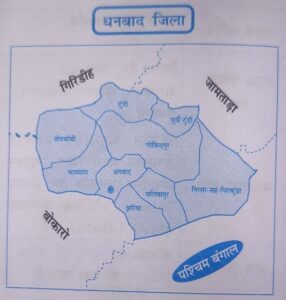
10 (धनबाद, निरसा, बाघमारा, टुंडी, पूर्वी टुंडी, गोविंदपुर, तोपचांची, बलियापुर, कलियासोल, एगारकुंड)

(नोटमानचित्र में दर्शाए गये झरिया प्रखण्ड का धनबाद नगर निगम में विलय के बाद अब जिले में 10 प्रखण्ड हैं।)

विधानसभा क्षेत्र

06* (धनबाद, झरिया, निरसा, बाघमारा, निरसा, टुंडी)

राष्ट्रीय राजमार्ग

18, 19, 218, 419

प्रमुख नदियाँ

1.      दामोदर,

2.      बराकर,

3.      गोवाई

प्रमुख खनिज

कोयला, क्वार्ट्ज, फेल्स्पार, फायरक्ले, थोरियम

1.  प्रमुख उद्योग

2.      खाद एवं रसायन उद्योग (सिंदरी),

3.  रिलायंस,

4.      फायरब्रिक्स एंड पौटरिज कंपनी (चिरकुंडा* यहाँ 25 वर्ग कि.मी. के दायरे में 250 उद्योग स्थापित हैं),

5.      बिहार फायरब्रिक्स (मुगमा),

6.      शालीमार तार प्रोडक्ट्स (झरिया),

7.      धनबाद इंजीनियरिंग वर्क्स (कुमारधुबी),

8.      हिंदुस्तान स्टील लिमिटेड,

9.  बीसीसीएल

प्रमुख पर्यटन स्थल

1.      मैथन डैम,

2.      पंचेत डैम,

3.      तोपचांची झील*,

4.      तिलैया गर्म जलकुंड,

5.      पंचकोट का किला,

6.  झरियागढ़ महल

प्रमुख शैक्षणिक संस्थान

1.      इंडियन स्कूल ऑफ माइन्स (IIT),

2.      केंद्रीय खनन एवं अनुसंधान संस्थान,

3.  बिरसा इंस्टिट्यूट ऑफ टेक्नोलॉजी (सिंदरी),
धनबाद लॉ कॉलेज

महत्वपूर्ण तथ्य

1.  दूसरी सर्वाधिक जनसंख्या वाला जिला,

2.  सर्वाधिक जनघनत्व (1316),

3.  न्यूनतम लिंगानुपात (909),

4.  न्यूनतम शिशु लिंगानुपात (916),

5.  तीसरा न्यूनतम क्षेत्रफल (213 वर्ग कि.मी.)

अन्य विवरण

धनबाद जिला का गठन मानभूम जिला को विभाजित करके राज्य पुनर्गठन आयोग की सिफारिश पर किया गया था।

पलामू जिला

पलामू जिला

महत्वपूर्ण तथ्य

गठन

1 जनवरी, 1892

मुख्यालय

मेदिनीनगर

क्षेत्रफल

4,393 वर्ग कि.मी.

कुल जनसंख्या

19,39,869

दशकीय जनसंख्या वृद्धि दर

26.17%

जनसंख्या घनत्व

442

लिंगानुपात

928

शिशु लिंगानुपात

945

साक्षरता दर

63.63%

अनुमंडल

03 (मेदिनीनगर, हुसैनाबाद, छतरपुर)

प्रखण्ड

21 (मेदिनीनगर, हुसैनाबाद, छतरपुर, विश्रामपुर, पांकी, चैनपुर, हरिहरगंज, पाटन, लेस्लीगंज/नीलांबरपीताम्बरपुर, सतबरवा, मनातू, नवाबाजार, उंटारी रोड, पांडू, मोहम्मदगंज, हैदरनगर, पंडवा, नावडीहा बाजार, पिपरा, तरहसी, रामगढ़)

विधानसभा क्षेत्र

05 (डाल्टनगंज, हुसैनाबाद, छतरपुर, विश्रामपुर, पांकी)

राष्ट्रीय राजमार्ग

39, 139

प्रमुख नदियाँ

1.      उत्तरी कोयल,

2.      अमानत,

3.      सोन नदी

प्रमुख खनिज

कोयला, फायरक्ले, चूना-पत्थर, ग्रेफाइट*, लोहा, सीसा, चाँदी, जस्ता, बॉक्साइट, डोलोमाइट, मैग्नेटाइट, क्वार्ट्जाइट, लोहा

प्रमुख उद्योग

जपला सीमेंट संयंत्र,

बिहार कास्टिक सोडा एंड केमिकल्स

प्रमुख पर्यटन स्थल

1.      पलामू अभयारण्य,

2.      मेदिनीनगर का किला,

3.      शाहपुर का किला,

4.  रोहिल्ला का किला

प्रमुख शैक्षणिक संस्थान

1.      नीलांबर-पीताम्बर विश्वविद्यालय,

2.  राष्ट्रीय तिलहन शोध व विकास संस्थान

महत्वपूर्ण तथ्य

सर्वाधिक अनुसूचित जाति की जनसंख्या वाला जिला,

सर्वाधिक प्रखण्ड (21)

अन्य विवरण

मेदिनीनगर का पुराना नाम डाल्टनगंज है, जो कर्नल एडवर्ड टी. डाल्टन के नाम पर रखा गया था।

गढ़वा जिला

महत्वपूर्ण तथ्य

गठन

1 अप्रैल, 1991*

मुख्यालय

गढ़वा

क्षेत्रफल

4,093 वर्ग कि.मी.

कुल जनसंख्या

13,22,784

दशकीय जनसंख्या वृद्धि दर

27.75%

जनसंख्या घनत्व

323

लिंगानुपात

935

शिशु लिंगानुपात

960

साक्षरता दर

60.33%

अनुमंडल

03 (गढ़वा, नगर उंटारी, रंका)

प्रखण्ड

20 (गढ़वा, भवनाथपुर*, नगर उंटारी, रंका, मेराल, रमना, मझिआंव, धुरकी, रमकंडा, डंडा, कांडी, खरौंधी, चिनिया, विशुनपुर, केतार, बरडीहा, बड़गड़, डंडई, बरडीहा)

विधानसभा क्षेत्र

02* (गढ़वा एवं भवनाथपुर)

राष्ट्रीय राजमार्ग

39, 343

प्रमुख नदियाँ

1.      उत्तरी कोयल,

2.      अमानत,

3.      सोन नदी

प्रमुख खनिज

चूना-पत्थर, ग्रेफाइट, डोलोमाइट

प्रमुख उद्योग

बिहार कास्टिक एंड केमिकल लि.

प्रमुख पर्यटन स्थल

1.      सूखाडांडी जलप्रपात,

2.      बलचौरा जलप्रपात,

3.      गुरसिंधु जलप्रपात,

4.      विश्रामपुर का किला,

5.      रोहिल्ला का किला

प्रमुख शैक्षणिक संस्थान

वंशीधर मंदिर (नगर उंटारी)

अन्य विवरण

यह झारखण्ड का सबसे पश्चिमी जिला है।

लातेहार जिला

महत्वपूर्ण तथ्य

सर्वाधिक वन प्रतिशत वाला जिला (56.0%)


महत्वपूर्ण तथ्य

गठन

4 अप्रैल, 2001 (पलामू जिला से विभाजित)

मुख्यालय

लातेहार

क्षेत्रफल

4,291 वर्ग कि.मी.

कुल जनसंख्या

7,26,978

दशकीय जनसंख्या वृद्धि दर

29.61%

जनसंख्या घनत्व

169

लिंगानुपात

967

शिशु लिंगानुपात

968


साक्षरता दर

59.51%

अनुमंडल

02 (लातेहार एवं महुआडांड़)

प्रखण्ड

10* (लातेहार, मनिका, महुआडांड़, गारू, बरवाडीह, चंदवा, बालूमाथ, बारियातू, हेरहंज, सरयू)

विधानसभा क्षेत्र

02* (लातेहार एवं मनिका)

राष्ट्रीय राजमार्ग

22, 39, 143B

प्रमुख नदियाँ

1.      उत्तरी कोयल,

2.      औरंगा नदी,

3.      दामोदर (उद्गम)

प्रमुख खनिज

कोयला, चूना-पत्थर, बॉक्साइट, लोहा

प्रमुख पर्यटन स्थल

1.      बूढ़ाघाघ जलप्रपात,

2.      कांति जलप्रपात,

3.      लोध जलप्रपात,

4.      घाघरी जलप्रपात,

5.      मिरचइया जलप्रपात, बेतला राष्ट्रीय उद्यान*,

6.      महुआडांड़ अभयारण्य,

7.      पलामू टाइगर रिजर्व,

8.      पलामू किला,

9.      नेतरहाट,

10. तातापानी गर्म जलकुंड

प्रमुख धार्मिक स्थल

माँ उग्रतारा मंदिर (चंदवा)

प्रमुख शैक्षणिक संस्थान

नेतरहाट आवासीय विद्यालय

महत्वपूर्ण तथ्य

सर्वाधिक वन प्रतिशत वाला जिला (56.0%)

अन्य विवरण

एक मान्यता के अनुसार लातेहार का नामकरण लताओं का हार के नाम पर किया गया है।

नेतरहाट

  • नेतरहाट को पहाड़ों की रानी, ‘पहाड़ियों की मल्लिका तथा सूर्योदय एवं सूर्यास्त का सौंदर्यस्थल भी कहते हैं।
  • नेतरहाट एक पठारी क्षेत्र है जो चारों ओर से पहाड़ियों, नदी, झरने और जंगलों से घिरा हुआ है।
  • नेतरहाट की ऊँचाई समुद्रतल से लगभग 3700 फीट है।
  • नेतरहाट झारखण्ड में न्यूनतम तापमान वाला स्थान भी है।
  • नेतरहाट के निकट विभिन्न घाट हैं जैसे नेतरहाट घाट, पुसरी घाट, दुर्मा घाट, जोभी घाट, झुमरी घाट, तस्सम घाट आदि।
  • नेतरहाट के नामकरण को लेकर दो धारणाएँ हैं।
  • पहली धारणा यह है कि यहाँ पहले बाँस का बाजार लगता था जिसके कारण इसका नाम बाँस (नेतर) बाजार (हाट) को मिलाकर किया गया।
  • दूसरी धारणा के अनुसार अंग्रेजी के शब्द नेचर हार्ट को मिलाकर यह नाम बना है।


  • बिहार एवं उड़ीसा के तत्कालीन गवर्नर जनरल सर एडवर्ड गेट ने ग्रीष्मकालीन प्रवास हेतु नेतरहाट को विकसित किया था।
    नेतरहाट में लगभग 100 वर्षों तक ब्रिटिश सरकार का मिलिट्री कैंप भी स्थापित रहा, जिसे पानी की अनुपलब्धता के कारण बंद कर दिया गया था।
    • यहाँ मुख्य रूप से असुर, बिरजिया, बिरहोर आदि जनजातियाँ निवास करती हैं, जिनमें असुर सबसे पुरानी जनजाति है।
    • नेतरहाट का ‘मैग्नोलिया पॉइंट सूर्यास्त के मनोरम दृश्य हेतु अत्यंत लोकप्रिय है।
पूर्वी सिंहभूम जिला

पूर्वी सिंहभूम जिला


मद

विवरण

गठन

16 जनवरी, 1990*

मुख्यालय

जमशेदपुर

क्षेत्रफल

3,562 वर्ग कि.मी.

कुल जनसंख्या

22,93,919

दशकीय जनसंख्या वृद्धि दर

15.68%

जनसंख्या घनत्व

644

लिंगानुपात

949

शिशु लिंगानुपात

923

साक्षरता दर

75.49%

अनुमंडल

02 (घाटशिला एवं दलभूम)

प्रखण्ड

11 (घाटशिला, पोटका, बहरागोड़ा, गोलमुरी सह जुगसलाई, धालभूमगढ़, मुसाबनी, पटमदा, चाकुलिया, बोड़ाम, डुमरिया, गुड़ाबांधा)

विधानसभा क्षेत्र

06 (जमशेदपुर पूर्वी, जमशेदपुर पश्चिमी*, घाटशिला, पोटका, बहरागोड़ा, जुगसलाई)

राष्ट्रीय राजमार्ग (NH)

18, 43, 49, 118

प्रमुख नदियाँ

1.      स्वर्णरेखा,

2.      गारानाला ,

3.      खरकई

प्रमुख खनिज

लोहा, चूना-पत्थर, बालू, सोना, यूरेनियम, टंगस्टन, क्यानाइट, पाइराइट, फायरक्ले, मैंगनीज, तांबा, क्वार्ट्जाइट, मैग्नेटाइट

प्रमुख उद्योग

1.      टाटा स्टील,

2.      टाटा मोटर्स,

3.      इंडियन कॉपर कॉर्पोरेशन,

4.      इंडियन स्टील एंड वायर कंपनी,

5.      इंडियन ट्यूब कंपनी,

6.      उषा मार्टिन इंडस्ट्रीज,

7.      तांबा शोधन केन्द्र (घाटशिला),

8.  हिंदुस्तान कॉपर लि. (जादूगोड़ा)

प्रमुख पर्यटन स्थल

1.      जुबली पार्क*,

2.      डिमना लेक,

3.      दालमा अभयारण्य,

4.      दालमा पहाड़ी,

5.      धारागिरी जलप्रपात,

6.      जादूगोड़ा का यूरेनियम खान,

7.      घाटशिला का फुलडुंगरी पहाड़ी (घाटशिला),

8.  माइकल जॉन सभागार (जमशेदपुर)

प्रमुख धार्मिक स्थल

चित्रेश्वर, रंकिनी मंदिर

प्रमुख शैक्षणिक संस्थान

1.      राष्ट्रीय धातु विज्ञान प्रयोगशाला (जमशेदपुर),

2.      नेशनल इंस्टिट्यूट ऑफ टेक्नोलॉजी (जमशेदपुर),

3.      एमजीएम मेडिकल कॉलेज (जमशेदपुर)*,

4.      एक्स.एल.आर.आई (जमशेदपुर),

5.      परमाणु ऊर्जा केंद्रीय विद्यालय (जादूगोड़ा)

अन्य विवरण

स्वतंत्रता से पूर्व पूर्वी सिंहभूम मानभूम तथा धालभूम क्षेत्र का भाग था।

पश्चिमी सिंहभूम जिला

गठन

16 जनवरी, 1990

मुख्यालय

चाईबासा

क्षेत्रफल

7,224 वर्ग कि.मी.

कुल जनसंख्या

15,02,338

दशकीय जनसंख्या वृद्धि दर

21.75%

जनसंख्या घनत्व

208

लिंगानुपात

1005

शिशु लिंगानुपात

983

साक्षरता दर

58.63%

अनुमंडल

03 (सिंहभूम सदर, जगन्नाथपुर, पोड़ाहाट)

प्रखण्ड

18 (चाईबासा, जगन्नाथपुर, मनो. हरपुर, चक्रधरपुर, मंझगाँव, हाट गम्हरिया, झींकपानी, कुमारडुगी, खूँटपानी, मंझरी, गुदड़ी, बंदगाँव, टोंटो, आनंदपुर, सोनुआ, गोईलकेरा, तांतनगर, नोआमुंडी)


विधानसभा क्षेत्र

05 (चाईबासा, जगन्नाथपुर, मनो. हरपुर, चक्रधरपुर, मंझगांव)


राष्ट्रीय राजमार्ग

20, 43, 220, 320D, 320G

प्रमुख नदियाँ

1.  स्वर्णरेखा,

2.  दक्षिणी कोयल,

3.  खरकई,

4.  वैतरणी,

5.  कारो,

6.  कोयना,

7.  देव


प्रमुख खनिज

लौह-अयस्क, चूना-पत्थर, मैंगनीज, सोना, तांबा, एस्बेस्टस, बॉक्साइट, क्यानाइट, जस्ता, क्रोमाइट, क्वार्ट्जाइट

प्रमुख उद्योग

1.      इंजीनियरिंग वर्क्सशॉप (सीनी),

2.      एसीसी सीमेंट गेज लि. (चाईबासा),

3.  झींकपानी सीमेंट वर्क्स

प्रमुख पर्यटन स्थल

4.  हिरनी जलप्रपात,

5.  लुपुंगटु प्रपात,

6.  घाघीरथी प्रपात,

7.  जोजोहातू,

8.  रामतीर्थ,

9.  बेनीसागर,

10. सारंडा वन *,

11. जैतगढ़ का किला,

12. जगन्नाथ का किला


प्रमुख धार्मिक स्थल

बेनिसागर का शिव मंदिर,

महादेवशाला मंदिर

प्रमुख शैक्षणिक स्थान

कोल्हान विश्वविद्यालय (चाईबासा)

महत्वपूर्ण तथ्य

1.  सर्वाधिक लिंगानुपात (1005),

2.  सर्वाधिक शिशु लिंगानुपात (983),

3.  सर्वाधिक क्षेत्रफल* (7,224 वर्ग कि.मी.),

4.  सर्वाधिक वनक्षेत्र (3,368 वर्ग कि.मी.),

5.  सबसे बड़ा संसदीय क्षेत्र

अन्य विवरण

·         एक मान्यता के अनुसार सिंहभूम (सिंहों की भूमि) का नामकरण पोड़ाहाट के सिंह राजाओं के नाम पर किया गया है।

·         एक अन्य मान्यता के अनुसार सिंहभूम नामकरण मुंडा-भूमिज जनजातियों के देवता ‘सिंह-बोंगा’ (सिंगबोंगा) के नाम किया गया है। यह झारखण्ड का सबसे दक्षिणी जिला है।


सारंडा वन

  • सारंडा वन को ‘सात सौ पहाड़ियों का घर’ कहा जाता है।
  • सारंडा वन को एशिया में साल वृक्ष का सबसे घना वन माना जाता है। साल के अतिरिक्त इस वन में सागवान, महुआ, केंदू, बेर, अर्जुन, कुसुम आदि के वृक्ष भी मौजूद हैं।
  • जैव-विविधता से पूर्ण इस वन में वृक्षों के साथ-साथ वन्यजीवों की भी कई प्रजातियाँ पायी जाती हैं, जिसमें चीता, तेंदुआ, हाथी, भालू, जंगली सूअर, जंगली भैंसा, सांभर, चीतल आदि प्रमुख हैं|

सरायकेलाखरसावाँ जिला

गठन

30 अप्रैल, 2001 (पश्चिमी सिंहभूम जिला से विभाजित)

मुख्यालय

सरायकेला

क्षेत्रफल

2,657 वर्ग कि.मी.

कुल जनसंख्या

10,65,056

दशकीय जनसंख्या वृद्धि दर

25.47%

जनसंख्या घनत्व

401

लिंगानुपात

956

शिशु लिंगानुपात

943

साक्षरता दर

67.70%

अनुमंडल

02 (सरायकेला एवं चांडिल)

प्रखण्ड

09 (सरायकेला, खरसावाँ, ईचागढ़, चांडिल, गमहरिया, कुकडू, नीमडीह, राजनगर, कुचई)

विधानसभा क्षेत्र

03 (सरायकेला, खरसावाँ, ईचागढ़)

राष्ट्रीय राजमार्ग

43, 320D

प्रमुख नदियाँ

1.      स्वर्णरेखा,

2.      खरकई (सरायकेला शहर इसी नदी के तट पर स्थित है) *

3.      करकरी,

4.      संजय

प्रमुख खनिज

सोना, कायनाइट, एस्बेस्टस, वेनेडियम, तांबा, क्रोमाइट, क्वार्टजाइट

प्रमुख उद्योग

सरायकेला ग्लास वर्क्स प्रा. लि.,

 बिहार स्पंज आयरन (चांडिल)*

प्रमुख पर्यटन स्थल

1.      ईचागढ़

2.  पक्षी विहार

अन्य विवरण

सरायकेला के सिंह देव परिवार के सदस्य छऊ नृत्य के संरक्षक हैं।

दुमका जिला

दुमका जिला

मद

विवरण

गठन

1983 (1855 में उपजिला के रूप में गठन)

मुख्यालय

दुमका

क्षेत्रफल

3,761 वर्ग कि.मी.

कुल जनसंख्या

13,21,442

दशकीय जनसंख्या वृद्धि दर

19.42%

जनसंख्या घनत्व

351

लिंगानुपात

977

शिशु लिंगानुपात

966

साक्षरता दर

61.02%

अनुमंडल

01 (दुमका सदर)

प्रखण्ड

10* (दुमका, शिकारीपाड़ा, जरमुंडी, जामा, सरैयाहाट, रामगढ़, रानेश्वर, काठीकुंड, गोपिकांदर, मसलिया)

विधानसभा क्षेत्र

04 (दुमका, शिकारीपाड़ा, जरमुंडी, जामा)

राष्ट्रीय राजमार्ग

114A, 133

प्रमुख नदियाँ

1.      मयूराक्षी,

2.      बांसलोई,

3.      ब्राह्मणी,

4.      अजय

प्रमुख खनिज

कोयला, सीसा, चूना-पत्थर, फायरक्ले, क्वार्ट्जाइट, फेल्स्पार

प्रमुख पर्यटन स्थल

1.  मसानजोर डैम,

2.  झुमका जलकुंड *,

3.  तपातपानी जलकुंड,

4.  झरियापानी जलकुंड,

5.  ततलोई जलकुंड *,

6.  बाराझरना,

7.  मलूटी गाँव *

प्रमुख धार्मिक स्थल

1.      वासुकीनाथ मंदिर,

2.      छोटेनाथ की मूर्ति,

3.      दानीनाथ मंदिर (काठीकुंड) *


प्रमुख शैक्षणिक संस्थान

सिद्धो-कान्हू विश्वविद्यालय (दुमका)

अन्य विवरण

एक मान्यता के अनुसार दुमका नाम संथाली शब्द दुमक (छोटा) से जुड़ा है, क्योंकि ब्रिटिश काल में रामपुरहाट भागलपुर की तुलना में दुमका छोटा शहर था।


·         एक अन्य मान्यता के अनुसार फारसी शब्द दामिनकोह से लिया गया है, जिसका शाब्दिक अर्थ पहाड़ियों का किनारा होता है।


मलूटी गाँव

  • यह गाँव दुमका जिले के शिकारीपाड़ा प्रखण्ड में अवस्थित है।
    • इसे ‘मंदिरों का गाँव* नगर कहा जाता है। इस गाँव को गुप्तकाशी भी कहा जाता है।
    • इस गाँव में पूर्व में यहाँ 108 मंदिर थे जिनमें से वर्तमान में 72 मंदिर ही शेष बचे हैं। इनमें से 52 शिव मंदिर तथा शेष अन्य देवीदेवताओं के मंदिर हैं।
    सभी शिव मंदिरों का निर्माण बंगाल शैली में किया गया है, जो एक कक्षावाला चार चाला कुटीर की आकृति में है
    • इन मंदिरों में टेराकोटा से अत्यंत मनोहारी चित्र बनाये गये हैं, जिसके कारण इसे टेराकोटा मंदिर भी कहा जाता है
    • इन मंदिरों का निर्माण नानकर राज्य के संस्थापक बसंत राय एवं उनके राजपरिवार द्वारा 16वीं शताब्दी में कराया गया था।

    • 1979 से पूर्व इस गाँव के बारे में गांव के बाहर के लोग अधिक नहीं जानते थे। परन्तु 1979 में भागलपुर के तत्कालीन आयुक्त अशोक कुमार पाठक इस गाँव में पहुंचे तथा मंदिरों के इस गाँव को देखकर इसकी जानकारी भारतीय पुरातत्व विभाग एवं बिहार पुरातत्व विभाग को दी, जिसके बाद इसके संरक्षण का कार्य प्रारम्भ किया गया।
    • सन् 2015 के गणतंत्र दिवस समारोह में झारखण्ड के मलूटी मंदिर झांकी* को राष्ट्रीय स्तर पर द्वितीय पुरस्कार प्रदान किया गया था।

जामताड़ा जिला

महत्वपूर्ण तथ्य

न्यूनतम वन क्षेत्र (101 वर्ग कि.मी.), न्यूनतम वन प्रतिशत (5.56%)


गठन

26 अप्रैल, 2001 (दुमका जिला से विभाजित)

मुख्यालय

जामताड़ा

क्षेत्रफल

1,811 वर्ग कि.मी.

कुल जनसंख्या

7,91,042

दशकीय जनसंख्या वृद्धि दर

21.12%

जनसंख्या घनत्व

437

लिंगानुपात

954

शिशु लिंगानुपात

954

साक्षरता दर

64.59%

अनुमंडल

01 (जामताड़ा)

प्रखण्ड

06 (जामताड़ा, नाला, नारायणपुर, कुंडहित, करमाटांड़विद्यासागर, फतेहपुर)

विधानसभा क्षेत्र

02 (जामताड़ा, नाला)

राष्ट्रीय राजमार्ग

419

प्रमुख नदियाँ

अजय

प्रमुख खनिज

चूना-पत्थर, क्वार्ट्ज, फेल्स्पार

प्रमुख पर्यटन स्थल

मिहिजाम

प्रमुख धार्मिक स्थल

कल्याणेश्वरी मंदिर

महत्वपूर्ण तथ्य

न्यूनतम वन क्षेत्र (101 वर्ग कि.मी.), न्यूनतम वन प्रतिशत (5.56%)

देवघर जिला

महत्वपूर्ण तथ्य

दूसरा न्यूनतम वन क्षेत्र (203 वर्ग कि.मी.)

वन प्रतिशत (8.22%)

अन्य विवरण

प्राचीन काल में इसे हरितकीवान नाम से जाना जाता था। *


मद

विवरण

गठन

1 जून, 1983

मुख्यालय

देवघर

क्षेत्रफल

2,477 वर्ग कि.मी.

कुल जनसंख्या

14,92,073

दशकीय जनसंख्या वृद्धि दर

28.03%

जनसंख्या घनत्व

602

लिंगानुपात

925

शिशु लिंगानुपात

950

साक्षरता दर

64.85%

अनुमंडल

02 (देवघर एवं मधुपुर)

प्रखण्ड

10 (देवघर, मधुपुर, सारठ, मोहनपुर, करों, सारवां, देवीपुर, पालोजोरी, मारगो मुंडा, सानारायठाडी)

विधानसभा क्षेत्र

03 (देवघर, मधुपुर, सारठ *)

राष्ट्रीय राजमार्ग

114A, 133, 333

प्रमुख नदियाँ

1.      अजय,

2.      पथरा,

3.      जयंती,

4.      मयूराक्षी,

5.      ब्राह्मणी

प्रमुख खनिज

क्वार्टजाइट

प्रमुख उद्योग

डॉबर दवा कंपनी (जसीडीह),

हैदराबाद इंडस्ट्रीज

प्रमुख पर्यटन स्थल

1.      त्रिकूट पहाड़ी,

2.      बकुलिया प्रपात,

3.  करों गाँव

प्रमुख धार्मिक स्थल

1.      वैद्यनाथ मंदिर,

2.      युगल मंदिर,

3.      तपोवन मंदिर,

4.      लीला मंदिर,

5.      कुंडेश्वरी मंदिर,

6.  सत्संग नगर

प्रमुख शैक्षणिक संस्थान

हिन्दी विद्यापीठ

महत्वपूर्ण तथ्य

दूसरा न्यूनतम वन क्षेत्र (203 वर्ग कि.मी.)

वन प्रतिशत (8.22%)

अन्य विवरण

प्राचीन काल में इसे हरितकीवान नाम से जाना जाता था। *


त्रिकूट पहाड़ी

  • यह पहाड़ी देवघर से लगभग 16 किमी दूर दुमका रोड पर है।
  • इस पहाड़ी पर 840 फीट की ऊँचाई पर रोपवे बना हुआ है।
  • किंवदंती है कि माता सीता का हरण करके जाते समय रावण इस पर्वत पर रुका था तथा माता सीता ने यहाँ दीप जलाया था। अतः इसे रावण का हेलिपैड कहा जाता है।

करों गाँव

  • करौ ऐतिहासिक गाँव है जो अशोक कालीन है।
  • इस गाँव को अशोक के पुत्र राजा महेंद्र ने बौद्ध विहार के रूप में बसाया था।
  • इस गाँव में अशोक के स्तूप तथा गाँव के आसपास भगवान बुद्ध की प्रतिमाएँ भी मिलती हैं।
  • एक किंवदंती के अनुसार इस गाँव का नामकरण महाभारतकालीन कर्ण के नाम पर किया गया था, बाद में इसका नाम करों हो गया।
  • यहाँ कर्ण द्वारा स्थापित कर्णेश्वर मंदिर भी है।
  • इस गाँव के अंतिम राजा काली प्रसाद सिंह थे, जो ईस्ट इंडिया स्टेट के भी राजा थे।

सत्संग नगर

  • वर्ष 1946 में बांग्लादेश के पवना से आकर श्रीश्री ठाकुर अनुकूलचंद्र जी ने देवघर में सत्संग आश्रम की स्थापना की थी।
  • बाद में इसका विस्तार हुआ तथा एक बड़े क्षेत्र में यह सत्संग नगर रूप में बस गया।

साहेबगंज जिला

महत्वपूर्ण तथ्य

गठन

17 मई, 1983

मुख्यालय

साहेबगंज

क्षेत्रफल

2,063 वर्ग कि.मी.

कुल जनसंख्या

11,50,567

दशकीय जनसंख्या वृद्धि दर

24.01%

जनसंख्या घनत्व

558

लिंगानुपात

952

शिशु लिंगानुपात

960

साक्षरता दर

52.04%

अनुमंडल

02 (साहेबगंज एवं राजमहल)

प्रखण्ड

09 (साहेबगंज, राजमहल, बोरियो, बरहेट, उधवा, तालझारी, बरहरवा, पाथना, मंडरो)

विधानसभा क्षेत्र

03 (राजमहल *, बोरियो, बरहेट)

राष्ट्रीय राजमार्ग

33, 133A, 133B

प्रमुख नदियाँ

1.      गंगा,

2.      गुमानी,

3.      ब्राह्मणी,

4.      बांसलोई,

5.      पालसी,

6.      अजय

प्रमुख खनिज

कोयला, फायरक्ले, नीलम, गोमेद, क्वार्टजाइट, बेंटोनाइट, पत्थर

प्रमुख उद्योग

मेटल प्रेस वर्क्स,

टीनकेन कंपनी

प्रमुख पर्यटन स्थल

1.      तेलियागढ़ किला,

2.      राजमहल जीवाश्म अभयारण्य,

3.      उधवा पक्षी विहार,

4.      दामिन-ए-कोह,

5.      मोतीझरा जलप्रपात,

6.      राजमहल पहाड़ी,

7.      भगवा कुआं (इसका निर्माण 1815 ई. में एडवर्ड VII की स्मृति में कराया गया था)


अन्य विवरण


1.      साहेबगंज का शाब्दिक अर्थ मालि. कों का स्थान (साहेव गंज) होता है। इस क्षेत्र में ब्रिटिश काल में यूरोपीय लोगों के इस क्षेत्र में निवास के कारण यह नाम पड़ा है।

2.      इस क्षेत्र के इतिहास का प्रमुख स्रोत राजमहल व तेलियागढ़ किला के इतिहास के रूप में मिलता है. जिसका विवरण मेगस्थनीज व हवेन सांग की रचनाओं में उल्लखित है।

3.      यह झारखण्ड का सबसे उत्तरी जिला है।


गोड्डा जिला

महत्वपूर्ण तथ्य

गठन

25 मई, 1983 *

मुख्यालय

गोड्डा

क्षेत्रफल

2,266 वर्ग कि.मी.

कुल जनसंख्या

13,13,551

दशकीय जनसंख्या वृद्धि दर

25.35%

जनसंख्या घनत्व

580

लिंगानुपात

938

शिशु लिंगानुपात

960

साक्षरता दर

56.40%

अनुमंडल

02 (गोड्डा एवं महगामा)

प्रखण्ड

09 (गोड्डा, महगामा, पोड़ैयाहाट, मेहरमा, पथरगामा, सुंदरपहाड़ी, बोआरीजोर, ठाकुरगंगटी, बसंतराय *)

विधानसभा क्षेत्र

03 (गोड्डा, महगामा, पोड़ैयाहाट)

राष्ट्रीय राजमार्ग

133, 333A

प्रमुख नदियाँ

1.      सुंदर नदी,

2.      मयूराक्षी,

3.      ब्राह्मणी,

4.      बांसलोई

प्रमुख खनिज

कोयला, सीसा, फेल्स्पार

प्रमुख पर्यटन स्थल

1.      बाराकोपा पहाड़ी,

2.  सुंदर डैम जलाशय

प्रमुख धार्मिक स्थल

माँ योगिनी मंदिर (बाराकोपा पहाड़ी)

पाकुड़ जिला


महत्वपूर्ण तथ्य

1.      न्यूनतम साक्षरता दर (48.82%),

2.      न्यूनतम पुरुष साक्षरता दर (57.06%),

3.      न्यूनतम महिला साक्षरता दर (40.52%),

4.  न्यूनतम अनुसूचित जाति का प्रतिशत (3.16%)

अन्य विवरण

यह झारखण्ड का सबसे पूर्वी जिला है।


महत्वपूर्ण तथ्य

गठन

28 जनवरी, 1994

मुख्यालय

पाकुड़

क्षेत्रफल

1,811 वर्ग कि.मी.

कुल जनसंख्या

9,00,422

दशकीय जनसंख्या वृद्धि दर

28.33%

जनसंख्या घनत्व

497

लिंगानुपात

989

शिशु लिंगानुपात

975

साक्षरता दर

48.82%

अनुमंडल

01 (पाकुड़)

प्रखण्ड

06 (पाकुड़, महेशपुर, लिट्टीपाड़ा, हिरणपुर, पाकुड़िया, अमरापाड़ा)

विधानसभा क्षेत्र

03 (पाकुड़, महेशपुर, लिट्टीपाड़ा)

राष्ट्रीय राजमार्ग

133A, 333A

प्रमुख नदियाँ

गंगा, बांसलोई, ब्राह्मणी

प्रमुख खनिज

कोयला, फायरक्ले, गोमेद

प्रमुख पर्यटन स्थल

1.      बारामसिया,

2.      शिवपुर सोता गर्मकुंड,

3.      अलीगंज का छोटा किला,

4.      वीरखाता का किला

महत्वपूर्ण तथ्य

5.      न्यूनतम साक्षरता दर (48.82%),

6.      न्यूनतम पुरुष साक्षरता दर (57.06%),

7.      न्यूनतम महिला साक्षरता दर (40.52%),

8.  न्यूनतम अनुसूचित जाति का प्रतिशत (3.16%)

अन्य विवरण

यह झारखण्ड का सबसे पूर्वी जिला है।

CHAPTER 5

Indian Union and its Territories


INTRODUCTION

Article 1 to 4 under Part I of the Indian constitution deal with Union and its territories.


Table

ArticlesSubject-Matter
Article 1Name and territory of the Union.
Article 2Admission or establishment of new States.
Article 3Formation of new States and alteration of areas, boundaries or names of existing States.
Article 4Laws made under articles 2 and 3 to provide for the amendment of the First and the Fourth Schedules and supplemental, incidental and consequential matters.

Article 1: Name and territory of the Union

Provisions under Article 1 of Indian Constitution

Name of the countryConstituent Assembly adopted both names; India (modern name), that is, Bharat (Traditional name).
India as a ‘Union of States’Indian has been described as a ‘union of states’ this has 2 implications 1) Indian federation is not the result of an agreement among states 2) Indian states have no right to secede from the federation.
‘Territory of India’ is wider expression than ‘Union of India’Union of India: All the states in India form the part of Union of India. Territory of India: Territory of India includes states + union territories + territories that may be acquired by the GoI in future

Article 2: Admission or establishment of new states

Provisions under Article 2 of Indian Constitution

ScopeThe article talks about admission or establishment of new States.
Power of ParliamentThe article provides the Parliament with two powers: a) Power to admit new states (which already exist) b) Power to establish new states (States which are non – existent)
ExampleSikkim was included in India in 1975 under the provisions of this article. It was not part of India before this.

Article 3: Formation of new States and alteration of areas, boundaries or names of existing States

Provisions under Article 3 of Indian Constitution

ScopeArticle talks about formation of ‘new states’ and alteration of areas, boundaries or names of ‘existing states’.
Power of ParliamentParliament can create new states out of existing states by separation of territory or by merging two or more states or part of states or by uniting territory to a part of any state. Parliament can increase or diminish the area of any state. Parliament can alter the boundaries of any state. Parliament can change the name of any state.


Here is the extracted text exactly as in the image, preserving bullets and tables:


Provisions under Article 3 of Indian Constitution

Special requirements

• Before exercising its power under Article 3 there are 2 special conditions which need to be fulfilled:
• Prior recommendation of the President is needed before introduction of the bill for the purpose in parliament (State legislature view is taken by the President before recommending this bill in parliament (State in which changes are being made).


Limited power of the State Legislature (Unitary feature)

• Non – binding: State’s views are not binding and the President (or the Parliament) can choose to ignore the state’s suggestions.
• No reference for new changes: If new changes are made in the bill, it is not necessary to refer that bill to the concerned state again for its views.
• Provision in case of Union territories: If the bill is related to a Union territory with a state legislature in it (such as Delhi and Pondicherry), no reference is needed to be made to that legislature for its view on the bill.


Article 4: Laws made under articles 2 and 3 provide for the amendment of the First and the Fourth schedule

• There are two parts to this article:
• Any law which contains provisions under Article 2 or Article 3 shall contain provisions for the amendment of the First schedule and the Fourth Schedule which may be necessary to give effect to the provisions of the law.
• Laws made under Art 2 and Art 3 shall not be considered as “constitutional amendment” under Article 368.


EVOLUTION OF STATES AND UNION TERRITORIES

Important Committees

Dhar commission (1948)
• Recommended re organisation of the states on the basis of administrative convenience instead of linguistic factor.

JVP committee (1948)
• It formally rejected language as the basis for the reorganisation of states.

State Reorganization commission (1955)
• Fazl Ali (Chairman)
• K.M. Panikkar
• A.N. Kunzru
• It broadly accepted the language as a basis for the reorganisation of states but rejected the theory of one language- one state. Recommended doing away with the four fold classification (Division of States into Part A, B, C and D).
• Based on Fazl Ali commission, States reorganisation act 1956 and 7th CAA were passed which led to abolition of four fold classification of states and led to formation of 14 states and 6 UTs.
• First linguistic state created in India – ‘Andhra State’ in 1953


STATES FORMED AFTER 1956

• 1960: Maharashtra, Gujarat from Bombay
• 1963: Nagaland
• 1966: Haryana, Chandigarh and HP from Punjab
• 1972: Manipur, Tripura and Meghalaya.
• 1975: Sikkim (36 CAA)
• 1987: Mizoram, Arunachal Pradesh and Goa
• 2000: Chattisgarh, Uttarakhand and Jharkhand
• 2014: Telangana


RECENT DEVELOPMENTS

• Union territories of Dadra and Nagar Haveli and Daman and Diu were merged into a single union territory in 2019.
• Union territories of Jammu and Kashmir and Ladakh were created. This was the 1st time that a State had been turned into a Union territory.

CHAPTER 6

Citizenship


INTRODUCTION

Citizenship implies full and equal membership of a political community. India has two kinds of people i.e., citizens and aliens. Unlike aliens, citizens are full time members of the Indian state and are provided with certain civil and political rights.
The Indian constitution has not provided any detailed or elaborate provisions related to citizenship and has mainly empowered Parliament to deal with such matters.


CONSTITUTIONAL PROVISIONS RELATED TO CITIZENS

Provisions Related to Citizenship in India

Part IIArticle 5 to Article 11.
Constitutional provisionNot permanent or elaborate. Identify only those who became citizens at the commencement of the constitution.
ParliamentEmpowered to deal with matters related to citizenship (Article 11).
LegislationCitizenship Act, 1955 (amended various times)
ListUnion list
TypeSingle citizenship
BorrowedFrom British Constitution

Constitutional provisions

ArticlesSubject-Matter
Article 5Citizenship at the commencement of the constitution.
Article 6Rights of citizenship of certain persons who have migrated to India from Pakistan.
Article 7Rights of citizenship of certain migrants to Pakistan.
Article 8Rights of citizenship of certain persons of Indian origin residing outside India.
Article 9Persons voluntarily acquiring citizenship of a foreign State not to be citizens.
Article 10Continuance of rights of citizenship.
Article 11Parliament to regulate the right of citizenship by law.

Constitutional provision provide for citizenship under 4 categories:

  1. Person who is domiciled in India: the parent is Indian (descent) or resident in India for 5 years.

  2. People who came from Pakistan

  3. People who went to Pakistan and returned back to India before commencement of this constitution.

  4. Persons of Indian origin residing outside India (by registration)

CITIZENSHIP ACT, 1955

The Constitution has empowered Parliament to make provisions related to Citizenship. Parliament enacted Citizenship Act, 1955 which provided certain ways to acquire Citizenship:


By Birth

Date of BirthConditions for citizenship
January 26th 1950 – July 1, 1987Individual shall be a citizen irrespective of the nationality of his parents.
On or after July 1, 1987Individual shall be a citizen if either of his parents is a citizen of India at the time of his/her birth.
On or after December 3, 2004Individual shall be a citizen if both of their parents are Indian citizens or if one of their parents is an Indian citizen and the other is not an illegal migrant in the country at the time of his birth.

By Descent

A person born outside IndiaCitizenship
On or after 26th January 1950 but before December 1992Considered as a citizen if his Father was a citizen at the time of his birth.
On or after December 10, 1992Considered as a citizen if either of his Parents is a citizen of India at the time of his birth.
December 3, 2004The parents (who are citizens of India) have to declare that their minor child does not hold a passport of any other country. Register within one year of the date of birth at an Indian Consulate in that country. If the said term has expired, registration can be done with the approval of the Central Government.

By Registration

• Central Government can register as a citizen of India any person based on application (not being an illegal migrant)
• Person of Indian origin (ordinarily resident in India for 7 years).
• Spouse of Indian Citizen (ordinarily resident in India for 7 years).
• Minor children of parents who are citizens of India.
• Previous citizen of independent India (ordinarily resident in India for 12 months).
• Overseas citizen of India cardholder for 5 years (ordinarily resident in India for 12 months).


By Naturalisation

Central Government may grant a certificate of naturalisation to any person (who is not an illegal migrant) on application based on the following conditions:

• Resided in India or been in the service of a Government of India (12 months preceding the application + should have resided/been in government service for an aggregate not less than 11 years)
• Good character.
• Adequate knowledge of a language specified in the 8th Schedule to the Constitution.


By incorporation of Territory

• If a foreign territory becomes part of India, the Indian Government specifies the persons who shall be the citizens of India (from the notified date).


LOSS OF CITIZENSHIP

The provisions related to loss of citizenship are found in the constitution but are majorly dealt by the Parliament via citizenship act, 1955. The act provides for loss of citizenship by renunciation, termination and deprivation.

Here is the extracted text exactly as in the image, preserving bullets and tables:


Provisions Related to Loss of Citizenship

Constitutional ProvisionsArticle 9 of the constitution provides that if an Indian Citizen becomes a citizen of any other country then he/she will automatically lose his/her Indian Citizenship
Citizenship Act 1955By Renunciation: Declaration renouncing his/her citizenship. Minor child also lose citizenship (can re-apply after age of 18). By Termination: If a person consciously acquires citizenship of another country (does not apply during war). By Deprivation: On grounds of 1) Fraud 2) Disloyalty to constitution 3) Connection with enemy 4) Imprisonment of naturalised citizen 5) Ordinary resident (out of Indian for 7 years)

Indians living abroad can be segmented into Non – resident Indians (NRI) and OCI (Overseas citizen of India). Below is a comparative chart showing difference b/w Indian resident, NRI and OCI.

Table

CategoryIndian passportResident in IndiaExpatriateTax statusOCI card
Indian (resident)YesYesNoYesNo
Non-resident Indian (NRI)YesNoYes (of India)NoNo
OCI (Overseas citizen of India)NoYes (in India)Yes (in India)Yes (if resident of India) rest noYes

OVERSEAS CITIZEN OF INDIA

• OCI is not a Citizenship. No right to vote or hold public offices.
• Provides similar rights available to residents or citizens of India.
• Provides for permanent residency i.e. allowing them to live and work in India indefinitely.
• Registration of OCI is done by Central Government based on application.
• Renunciation of OCI card can be done by OCI by making a declaration.
• Cancellation of OCI Card: Fraud, Disaffection towards constitution, Conspiring with enemy nation, Imprisonment (two years or more), Decision of Government, Violation of law by OCI, dissolution of marriage.


Rights with Overseas Citizen of India Cardholder

Rights available to OCI CardholderRights not available to OCI Cardholder
• Multiple entries, multi-purpose lifelong visa to visit India; • Exemption from reporting to Police authorities for any length of stay in India; • Parity with NRIs in financial, economic and educational fields except in the acquisition of agricultural or plantation properties; • Treated at par with Non-Resident Indian in the matter of inter-country adoption of Indian children; • Treated at par with resident Indian nationals in the matter of tariffs in air fares in domestic sectors in India; • Charged the same entry fee as domestic Indian visitors to visit national parks and wildlife sanctuaries in India; • Parity with Non-Resident Indian in respect of entry fees to be charged for visiting the national monuments, historical sites and museums in India; • Parity with Non-Resident Indians to appear for the All India Pre-Medical Test etc; • OCI Registration booklet is treated as OCI’s identification for any service rendered to him/her; • In case proof of residence is required, OCI may give an affidavit attested by a notary stating that a particular/specific address may be treated as their place of residence in India and may also give their overseas residential address as well as email address if any• Not entitled to the right to equality of opportunity in matters of public employment. • Ineligible for election as President. • Ineligible for election as Vice-President. • Ineligible for appointment as a Judge of the Supreme Court. • Ineligible for appointment as a Judge of the High Court. • Cannot register as a voter. • Ineligible for being a member of the House of the People or of the Council of States. • Ineligible for being a member of the State Legislative Assembly or the State Legislative Council. • Ineligible for appointment to public services and posts in connection with affairs of the Union or of any State except for appointment in such services and posts as the Central Government may specify.


Citizenship

The citizenship act, 1955 has been amended various times. The most recent amendment took place in 2019 and brought changes mainly to provide citizenship to certain category of illegal migrants.


CITIZENSHIP (AMENDMENT) ACT, 2019

Background:

• Regulation of Citizenship in India: Citizenship Act, 1955. Provides 5 methods to acquire citizenship – Birth, descent, registration, naturalisation (extended residence in India), and by incorporation of territory into India.
• Illegal migrant: Foreigner who enters India illegally, i.e., without valid travel documents, like a visa and passport. Those who enter India legally, but stay beyond the time period permitted in their travel documents.
• Provision for illegal migrants: Regulation by Foreigners Act, 1946 + the Passport (Entry into India) Act, 1920. Central government can regulate the entry, exit and residence of foreigners within India.


Provisions under Citizenship amendment Act, 2019

The 2019 amendment made some significant changes to the Citizenship Act of 1955. Below are its major features:

• Specified class of illegal migrants from the 3 countries will not be treated as illegal migrants.
• Should belong to any of the six communities i.e. Hindu, Sikh, Buddhist, Jain, Parsi, or Christian + 3 countries i.e. Afghanistan, Pakistan and Bangladesh.
• Entered India before or on the cut off date of 31st December 2014.
• Citizenship through naturalisation. Requirement of residency has been decreased from 11 years to 5 years.
• Does not apply to two categories i.e. 6th schedule states + States under Inner line permit for example Arunachal Pradesh, Mizoram, Nagaland, and Manipur.
• Central Government can cancel OCI membership if provisions of the Citizenship amendment act are violated or any other law so notified by the Central Government. Opportunity to be heard should be provided.

Due to the recent agitations in Assam (against violation of Assam accord) and various other parts of the country (due to provisions of citizenship amendment act, 2019) both NRC and NPR have been in news.


NATIONAL REGISTER OF CITIZENS (NRC)

ParametersDetails
DefinitionIt is an official, verified and valid record of all Indian citizens, containing details of individuals which are essential to establish their claim to citizenship. Creation was mandated by the 2003 amendment of the Citizenship Act, 1955
ObjectiveTo document all the legal citizens of India so that the illegal immigrants can be identified and deported
ComponentsIt includes demographic information about all those individuals who qualify as citizens of India as per the Citizenship Act, 1955. It will contain details of only Indian Citizens.
HistoryIt was first prepared after the 1951 Census of India. NRC has not been updated till today (except in Assam in 2013 -14) but only after the Supreme Court order).

NATIONAL POPULATION REGISTER (NPR)

ParametersDetails
Usual residentsThe NPR or National Population Register is a list of “usual residents” of the country.
Compulsory registrationIt is compulsory for every usual resident of India to register in the NPR.
InclusionIncludes both Indian citizens and foreign citizens. Objective is to create a database of every “usual resident” in the country.
Preparation of NPRIt is supposed to be prepared at the local (village/sub-town), sub-district, district, state and national levels under provisions of the Citizenship Act 1955 and the Citizenship (Registration of Citizens and Issue of National Identity Cards) Rules, 2003.


ParametersDetails
Data collectionThe data for the National Population Register was first collected in 2010 by the Government of India. It was expected to be repeated every 10 years.
RequirementsNo documents are required for NPR. Self-declaration will be treated as enough for data entry in the population registrar.

DIFFERENCE BETWEEN NPR, NRC AND CENSUS

NRC, Census and NPR are fundamentally different from each other. NPR will include all the usual residents of the country whereas NRC is intended to list only the citizens of India. Below we will look in detail the difference between National population register, National register of citizens and Census.


Table

ParametersNRCNPRCensus
DefinitionIt is a registry of citizensIt is a registry of usual resident of an areaIt is an exercise for calculating the total population of the country.
HistoryFirst prepared in 1951 during the census and has not been updated since.First time prepared in 2011 during census and has not been updated since.First census was conducted in 1872.
CoverageOnly citizens are included where documents and information proving citizenship are sought.Usual residents including citizens and non-citizens are included in the list. Its purpose is to count the number of people irrespective of their citizenship.It includes the whole population of the country where information on demography, economics activity, literacy and education, etc. are collected.
ObjectiveTo identify Indian citizens and identify illegal migrants living in the country.To calculate all the residents of a local area and data collected here is also to be used for creation of NRC as per Citizenship Rule 2003.Its purpose is for population assessment, policy formulation and planning.
RegulationRegulated under Citizenship Act 1955.It is regulated by Citizenship Rule 2003It is regulated by Census Act 1948


CHAPTER 7

Fundamental Rights


INTRODUCTION

Rights are essentially an entitlement or a justified claim. They denote what we are entitled to as citizens, as individuals and as human beings. Various types of rights exist which differ in origin, scope enforcement etc., we will look at some important ones below.


DIFFERENT TYPES OF RIGHTS

Table

TypesMeaning
Natural rights• Rights given to us by nature or God instead of ruler or society. • Inalienable rights • Other rights are derived from these basic rights. • Example: Right to preserve life was considered a natural right.
Human rights• Rights available to us simply because we are humans. • Every human has an intrinsic value. Should be given equal opportunity to realise their full potential.
Constitutional rights• These rights are provided by the constitution to the people. • Not applicable to all citizens unlike Fundamental rights. • Example: Right to vote under Article 326 is available only after achieving maturity i.e. 18 years.
Statutory rights• Provided to people by various laws passed by the Legislature example MNREGA (Provides Right to work), National food security act (Provides Right to food) etc.
Fundamental rights• Fundamental as they are essential for all round development of the Individual • Enforceable and Justiciable in the Supreme court (under Article 32) and High court (under Article 226). • Rights are enforced by using writs.

Difference Between Fundamental Rights and Legal Rights

Table

ParametersFundamental rightsLegal rights
ProtectionProtected and guaranteed by the constitution of IndiaProtected and guaranteed by the ordinary law of India
AmendmentIt can be changed by amending the constitution itself.It may be changed by the legislature by ordinary law making process.
Basic structurePart of the basic structure of the constitution.Not part of the basic structure doctrine.
JusticiabilityIf these are violated one can move to the Supreme court or High court. Can directly approach the Supreme courtIn case, legal rights are violated an individual has to move to the ordinary court first. The Judicial hierarchical process has to be followed.
SafeguardsMost of the Fundamental rights provide protection against the state action and not against private individual. Exception: Rights pertaining to abolition of untouchability + rights against exploitation.These rights impose obligation on the individual (and in some cases against the state too).


ABOUT FUNDAMENTAL RIGHTS

Fundamental rights are considered ‘fundamental’ because first, they are mentioned in the constitution and second they are justiciable in nature i.e. one can approach the court in case they are violated. Only the most important rights are recognised by the state as fundamental and enshrined in the constitution.


Details Related to Fundamental Rights

About

• Part III of the constitution from Article 12 to Article 35.
• Described as the ‘Magna Carta of India’.
• Inspired from US – Bill of Rights
• Promote Political democracy
• Original constitution – 7 Fundamental rights. Presently 6 Fundamental rights (Right to property was deleted (Article 31) was deleted.


Features

• Not absolute rights but qualified. Reasonable restrictions can be imposed on them.
• Mostly available against arbitrary actions of the state. Some of them are available against actions of Private Individual as well.
• Defended and guaranteed by both the Supreme court (under Article 32) and High court (under Article 226).
• Most have negative nature i.e. place limitations on the authority of the State. Some are positive as well i.e. conferring certain privileges on the persons.
• Can be amended i.e. Not sacrosanct or permanent. Amendment can be done without affecting the ‘basic structure’ of the constitution.
• With the exception of Article 20 and Article 21 they can be suspended during ‘National emergency’.
• Scope is limited because of Article 31 A, Article 31 B and Article 31 C. Can also be limited when martial law has been imposed in the area.
• Most of the FR are directly enforceable. Other require enabling law to be made ‘only’ by the Parliament (Article 35). Example Article 21 A etc.


The Fundamental rights mentioned in the constitution can be divided into the following:

Table

Fundamental RightsArticles
Right to equalityArticles 14–18
Right to freedomArticles 19–22
Right against exploitationArticles 23–24
Right to freedom of religionArticles 25–28
Cultural and educational rightsArticles 29–30
Right to constitutional remediesArticle 32

APPLICABILITY OF FUNDAMENTAL RIGHTS

Table

ApplicabilityArticles and Availability
Few are available ‘Only to Citizens’Article 15,16,19,29 and 30 are available with citizens only and not to foreigners.
Available to Citizens and foreigners. Not for enemiesArticle 14,20,21,21A,22,23,24,25,26,27,28 are available with both citizens and foreigners (not enemy aliens).
Against CitizensArticle 15,17,23,24,32(Only Habeas Corpus) are available against State + Private Citizen.

ARTICLE 12: DEFINITION OF STATE

The fundamental rights basically impose obligation on the state therefore it becomes important to define the state and to understand which institutions come under it.

Here is the extracted text exactly as in the image, preserving bullets and tables:


Fundamental Rights


Scope of State under Article 12

Definition of the state

Community of Persons permanently occupying a definite territory independent of external control and possessing an organised Government.

Following come under the definition of the State
• Government and Parliament of India i.e. the Executive and Legislature of the Union.
• Government and Legislature of each State i.e. the Executive and Legislature of the various States of India.
• All the local authorities such as municipalities, panchayats, district boards, port and improvement trusts, etc.
• All other authorities that are present in Indian territory or are operating under the supervision of the Government of India i.e. statutory or non-statutory authorities like LIC, ONGC, SAIL, etc.


Position of Judiciary

Judiciary has not been defined under Article 12. Through various Judgments it has been held that ‘only’ when the Judiciary performs ‘non – Judicial functions’ they come under the definition of the State.


Important Judgment

• Ajay Hasia v. Khalid Mujib, 1981: 6 factor test laid down to determine what would be considered state under Article 12.
• Zee Telefilms v. The Union of India 2005: 6 factor test laid down was implemented in this case to determine that BCCI cannot be called ‘state’ under Article 12.


ARTICLE 13: LAWS INCONSISTENT WITH FUNDAMENTAL RIGHTS

This article aids the courts to keep the legislature under check. The article gives duty to the state to implement the fundamental rights and provides the court power to declare laws or act void in case it violates fundamental rights.


Scope of Laws under Article 13

About

• Addresses all those laws which are inconsistent with or in derogation of fundamental rights.
• Laws which are inconsistent with the provisions of Part-III of the Indian Constitution, shall be void.
• Forms the basis of the doctrine of judicial review


Scope

Law under Article 13 include:

• Permanent laws enacted by Parliament or state legislatures.
• Temporary laws like ordinances issued by the president or the state governors.
• Statutory instruments like order, bye-law, rule, regulation or notification.
• Non-legislative sources of law i.e. custom or usage having the force of law.


RIGHT TO EQUALITY (ARTICLE 14–18)

Article 14: Equality Before Law

• Article 14 deals with two concepts: Equality before the law + Equal Protection of Laws
• Rights available to all persons whether citizens + foreigners.
• Below the difference between equality before law and equal protection of law has been mentioned.


Table

ParametersEquality Before LawEqual Protection of Laws
DefinitionLaw must be enforced and administered equally among all.All persons in similar circumstances shall be given the same rights and liabilities.
ImplicationsNo special privileges in favour of any person, Equal subjection of all persons to the ordinary law of the land administered by ordinary law courts. No person (whether rich or poor, high or low, official or non-official) is above the law.Equal treatment in similar circumstances, both in the privileges and liabilities imposed by the law. Similar application of the same laws to all persons who are similarly situated. Like should be treated alike without any discrimination.
OriginBritish originUS Constitution
NatureNegative concept as it implies the absence of any special privilege in favour of individuals.Positive obligation as state ensures every person enjoys equal protection. Provides ‘similar treatment instead of identical one i.e. equality is advocated for only those who are equal. No discrimination amongst equal. However, the equals and unequals cannot be put in the same footing and be treated without discrimination.


Here is the extracted text exactly as in the image, preserving bullets and tables:


Article 15: Prohibition of Discrimination on Certain Grounds

Provisions Related to Article 15 of Indian Constitution

Article 15(1)
State shall not discriminate against any citizen on grounds only of religion, race, caste, sex or place of birth, or any combination thereof. Applicable against ‘state action’ only and available to citizens. (Discrimination on other grounds is allowed For example: Qualifications of weight, height, etc. in case of police services.)

Article 15 (2)
No discrimination with regards to giving

  1. Access to shops, Public restaurants, hotels and places of public entertainment (applicable to state).

  2. No discrimination in Use of wells, tanks, bathing ghats maintained by state funds for general public (Applies to both citizens and state).

Article 15 (3)
State can make special provisions for Women and Children

Article 15 (4)
State is permitted to make any special provision for the advancement of any socially and educationally backward classes of citizens or for the SC/ST’s. This clause was added by the 1st constitutional amendment act. Added after the Judgment in Champakam Dorairajan case.

Article 15 (5)
Reservations in Private educational institutions whether aided or unaided for OBCs + SC’s/ST’s other than Minority educational Institutions. Added by the 93rd constitutional amendment act.

Article 15 (6)
State is empowered to provide reservations to Economically weaker sections for admission to educational institutions including private educational institutions, whether aided or unaided by the State, other than the minority educational institutions. Added by the 103rd CAA, 2019.


Table

Criteria applicable to OBC: Creamy layer criteriaEligibility criteria for EWSs in Educational Institutions
• Constitutional posts: President, Vice President, Judges of SC and HCs etc. • Officers: Top ranked officials (Group A/Group B) • Top ranked army officers: Rank of colonel and above in the Army and equivalent posts in the Navy, the Air Force and the Paramilitary Forces. • Other professions: Doctor, lawyer etc. • Agricultural land: Above certain limit • Annual Income: Gross annual income of more than Rs.8 lakh or wealth above the exemption limit.• Annual income: Gross annual income (aggregate) below Rs.8 lakh. • Possession of asset: Following asset should be under their possession ♦ 5 acres of Agricultural land and above. ♦ Residential flat of 1000 sq. ft. and above. ♦ Residential plots of 100 sq. yards and above in notified municipalities. (d) Residential plots of 200 sq. yards and above in areas other than the notified municipalities. • Determination of property: Cumulative asset to determine EWS status. • Definition of family: Person who seeks the benefit of reservation + parents + siblings (below 18 years).

Article 16: Equality of Opportunity in Public Employment

• This Right is available only with Citizens and is applicable ‘only’ to public Institutions and not the private Institutions.


Provisions Related to Article 16 of Indian Constitution

Article 16 (1)
Equality of opportunity in Public employment.

Article 16 (2)
No citizen can be discriminated or made ineligible for employment of any office under the state and on the grounds of only religion, race, caste, sex, descent, place of birth or residence or any combination thereof. (Descent and place of residence are not present in Article 15)

Article 16 (3)
Residence can be prescribed for certain types of Employment or appointment in the state by the Parliament.

Article 16 (4)
State can provide for reservation of appointments or posts in favour of any backward class that is not adequately represented in the state services.

Article 16 (4A)
Provides reservation of seats in matter of ‘promotion’ with consequential seniority (85th amendment) for SC/ST’s.

Article 16 (4B)
Provides for carrying over of unfilled vacancies reserved for SC/ST to subsequent years. This is commonly referred to as ‘carry forward rule’.

Article 16 (5)
Law can be made to provide that incumbent of an office related to Religious or denominational institutions belonging to particular religion.

Article 16 (6)
State is permitted to make a provision for the reservation of up to 10% of appointments or posts in favour of any economically weaker sections of citizens. Added by the 103rd CAA 2019.

Here is the extracted text exactly as in the image, preserving bullets and tables:


Fundamental Rights


Important Judgments and Commissions

Related Judgements and Commissions

Mandal commission
Appointed under Article 340. Identified 52% of the population as OBCs and recommended 27% Reservations.


Indra Sawhney case, 1992
• Total reservations shall not exceed 50%
• Carry forward rule is valid – Should not violate the 50% rule
• Merit shall not be compromised.
• No reservation in promotions.
• Creamy layer to exclude advanced sections among OBCs.
• Set up a permanent statutory body to examine over – inclusion and under – inclusion in the list of OBCs.


Important amendments

77th amendment
Provided for reservation in promotions in favour of SCs and STs

81st amendment
Empowered the state to fill backlog vacancies even if there cross 50% ceiling.

82nd amendment
It added a provision to Article 335. According to article 335, all reservations which are made for SC/ST’s have to be in accordance with efficiency in administration.

85th amendment
Consequential seniority to SC/ST’s


M Nagaraj case vs Union of India
Upheld reservation in promotions
Laid a criteria to be fulfilled before providing ‘reservation in Promotion’. State is obliged to demonstrate.

• Current backwardness of SC/ST’s.
• Inadequate representation of the community in the relevant sector.
• The reservation will maintain ‘administrative efficiency’.


Jarnail Singh vs Lachhmi Narain Gupta (2018)

• Supreme court laid down that the Nagaraj judgment does not need reconsideration by the seven Judge bench. Besides this the court ruled;

♦ Struck down backwardness criteria: No need for state to collect ‘quantifiable data’ on the backwardness of the SC’s and the ST’s.

♦ Need to prove Inadequate representation: States have to prove inadequacy of representation in relation to specific cadre and not in proportion to SC/ST population in the State.

♦ Extended creamy layer exclusion to SC/ST: It was held that in case of promotions creamy layer exclusion applies to SC/ST’s. Hence, the State cannot grant reservations in promotion to SC/ST individuals who belong to the creamy layer of their community.


Justice Rohini commission
• It was appointed in 2017 with the purpose of sub-categorization of Other Backward Castes.


Article 17: Abolition of Untouchability

  1. The article abolished ‘untouchability’. Applicable to both State and Private citizens.

  2. Term ‘untouchability’ is not defined in the constitution.

  3. It is an absolute right as no reasonable restrictions are applied on this article

  4. Parliament has been empowered to make law for prescribing punishment for untouchability. Protection of Civil rights act was passed by the Parliament.


Article 18: Abolition of Titles

This article abolishes titles and makes four provisions in that regard:

  1. State cannot confer any title on a citizen or a foreigner.

  2. Citizens of India cannot accept any title from any foreign state.

  3. A foreigner working for Indian Government, holding any office of profit or trust under the state cannot accept title, present emolument from foreign state without taking prior consent of the president.


RIGHT TO FREEDOM (ARTICLE 19–22)

Article 19: Protection of Certain Rights Regarding Freedom of Speech, etc.

Under this article six fundamental rights related to freedom are guaranteed to all the citizens of India. These are:


Table

ArticleFreedomReasonable restriction
Article 19 1(a)Freedom of speech and expression. (Every citizen has right to express his beliefs and convictions. It is an elaborate right and includes freedom of press, freedom of silence, Right to telecast etc.• Sovereignty and Integrity of India • Security of State • Friendly relation with foreign states. • Public Order • Decency or Morality, • Contempt of court, • Defamation, • Incitement to an offense.
Article 19 1 (b)Every citizens has the right to assemble peacefully and without arms. Citizens can conduct meetings, demonstrations and take out processions.• Sovereignty and Integrity of India, • Public order, • Other restrictions: • Section 144 of CRPC allows magistrate to restrain an assembly or meeting or procession. • Section 141 IPC assembly 5 or more persons can be made unlawful.
Article 19 1 (c)Right to form associations or unions or co-operative societies: Includes right to continue an association or union, Includes the right to not join or form an association, Does not include the right to strike.• Sovereignty and Integrity of India, • Public Order • Morality
Article 19 1 (d)Citizen can move freely throughout the territory of the country.• Interest of general public • Protection of interest of tribals.
Article 19 1 (e)Every citizen has the right to reside and settle in any part of the territory of the country• General public interest, • Protection of interest of scheduled tribes
Article 19 1 (f)All citizens are given the right to practise any profession or to carry on any occupation, trade or business.• General Public Interest • Professional and technical qualifications • The business can be monopolised by the state. State is not required to justify its monopoly.

• These six rights are protected against only state action and not private individuals.
• Article 19 covers only the right to move within the country. Right to move in and out of the country is dealt by Article 21.
• The right under Article 19 is suspended automatically if National emergency is imposed on the ground of external aggression however, it cannot be suspended when the emergency is imposed on the grounds of ‘armed rebellion’.


Article 20: Protection in respect of Conviction for Offences

• Protection against arbitrary and excessive punishment to an accused person.
• Cannot be suspended during an emergency.
• Available to both Citizens + Foreigners


Table

Article 20ExplanationRelated facts
Article 20 (1): No ex-post facto lawNo person shall be convicted of an offense by applying retrospective laws (i.e. by applying law backwards).Applies only to criminal laws not to civil and tax laws. In criminal case it This immunity is not available in case of Preventive detention.
Article 20(2): No double JeopardyNo person shall be prosecuted and punished for the same offense more than once. Conditions: Must have tried before court/Court must be competent/ Conclusion of proceeding (acquittal or conviction)/ Should be in force/Should be tried for the same offense.Applies only for proceedings before court of law or judicial tribunals (not applicable before administrative or departmental authorities).


Here is the extracted text exactly as in the image, preserving bullets and tables:


Fundamental Rights


Table

Article 20ExplanationRelated facts
Article 20(3): No self-IncriminationNo person accused of any offence shall be compelled to be a witness against himself.Does not cover the following: Blood Samples, Signatures, Thumb impressions, Exhibition of body, Production of material.

Article 21: Protection of Life and Personal Liberty

• No person shall be deprived of his life or personal liberty except according to procedure established by law.
• It is available to both citizens and non – citizens.
• Wide scope of this article: Right to livelihood, Right of Prisoners for dignified life, Right to die with dignity, Right to Privacy etc. all form part of Article 21 of the constitution.


Table

ParametersProcedure Established By LawDue Process of Law
OriginBritish constitution.Constitution of United States.
ScopeDoes not assess whether the laws made by the legislature or by the concerned authority are fair, just and not arbitrary.Determines whether a law is valid by examining both its procedural and substantive characteristics.
Role of JudiciaryJudiciary’s role is limited to evaluating the procedure used by the legislature to enact the law in question.Judiciary has the power to determine the laws’ procedural adequacy as well as its intention.
ProtectionSafeguards a citizen’s rights from the executive’s arbitrary actions.It safeguards citizens’ rights from executive + legislative actions.
Constitutional provisionProvided in Article 21Not explicitly mentioned in the Indian Constitution

Related Judgment

Table

JudgmentsArbitrary executive actionArbitrary legislative actionDue process of lawMeaning of liberty
A.K. Gopalan caseProtection under Art. 21 is availableProtection under Art 21 is not availableNot AvailableNarrow: liberty relating to person, body of the individual
Menaka Gandhi caseProtection under Art. 21 is availableProtection under Art 21 is availableAvailableBroad view: Includes opportunity to live with dignity and to develop ones capacity etc.

Article 21 A: Right to Education

Article 21 A of Indian Constitution

Provision
• State shall provide for free and compulsory education to children in the age of 6 to 14 years in such a manner as a state may determine

86th CAA, 2002
• Inserted Article 21 A
• Amended Article 45 says ‘The state shall endeavour to provide early childhood care and education for all children until they complete the age of 6 years’.
• Added a new Fundamental duty: Every citizen of India to provide opportunities for education to his child or ward between the age of 6 and 14 years

Enforcement
• Right to Education 2009 was enacted to enforce this


Article 22: Protection against arrest and detention

• Protection to those arrested and detained.
• Punitive detention refers to punishment for an offense committed after trial + conviction in court.
• Preventive detention refers to detention without trial + conviction in court.

Fundamental Rights


Detailed Provisions under Article 25 of Indian Constitution

Rights of State

• State can also regulate secular activities associated with religion.
• Provide for religious reform of Hindu religious institutions.

Explanations

• Two explanations are mentioned in the article i.e., Wearing and carrying of Kirpans is to be included in the profession of the Sikh religion;
• Hindus, include Sikhs, Jains and Buddhists.


Article 26: Freedom to manage religious affairs

Detailed Provisions under Article 26 of Indian Constitution

Provision (Protects ‘collective freedom’ of religion)
Religious denomination have been given the following rights:
• Establish and maintain institutions for religious/charitable purpose.
• Manage its own affairs in religious matters.
• Own and acquire movable/immovable property.
• Administer the property in accordance with law.

Reasonable Restrictions
Public Order, Morality, Health

Definition of ‘Religious denomination’
Not provided in the constitution. SC in its Judgment has held that ‘religious denomination’ must satisfy 3 conditions

  1. System of belief

  2. Common organisation

  3. Distinctive name.


Article 27: Freedom as to payment of taxes for promotion of any particular religion

• Provision Freedom from taxation for religious institutions
• Tax cannot be levied for the promotion or maintenance of any particular religion/religious denomination.
• This article prohibits only levy of a tax and not a fee.
• Fee controls secular administration of religious institutions and does not promote or maintain religion.


Article 28: Freedom as to attendance at religious instruction or religious worship in certain educational institution

• Freedom from attending ‘religious instructions’ in educational institutions.

Table

Type of InstituteStatus of religious instruction
Institutions wholly maintained by the StateCompletely prohibited
Institutions administered by the State but established under any endowment or trustPermitted
Institutions recognised by the StatePermitted on a voluntary basis. May or may not attend
Institutions receiving aid from the StatePermitted on a voluntary basis. May or may not attend.

CULTURAL AND EDUCATIONAL RIGHTS (ARTICLE 29–30)

Article 29: Protection of interests of minorities

Detailed Provisions under Article 29 of Indian Constitution

Article 29 (1)
• Any section of the citizens residing in any part of India having distinct Script, language and culture shall have right to protect the same.
• Group right, as it is available for both ‘religious’ and ‘linguistic’ minorities
• SC held that the term ‘Section of the citizens’ includes both, majority as well as minority.
• Absolute right for the minorities and is not subjected to any reasonable restriction.

Article 29 (2)
• No citizen can denied admission into any educational institutions maintained by the state or receiving aid from the state only on grounds of religion race, caste or language.


Article 30: Right to monitor and establish and administer educational institutions

Detailed Provisions under Article 30 of Indian Constitution

Provision
• Rights of minorities (both religious and linguistic) to establish and administer educational institutions.

Scope
• Confined to minorities (unlike article 29 which is applicable to ‘any section of citizens’).

Minorities
• Not defined by the constitution. Minority Status may vary from state to state (both ‘religious’ + ‘Linguistic’ minority).

Type of Minority institutions.
• Institutions that seek recognition as well as aid from the State; (under regulatory power of the state).
• Institutions that seek only recognition from the State and not aid; (under regulatory power of the state) and
• Institutions that neither seek recognition nor aid from the State (free to conduct its own affairs).

Other Facts
• Compensation amount fixed for acquisition of any property of minority institutions shall not restrict the right guaranteed to minorities. (44th constitutional amendment act).
• State cannot discriminate while providing aid to minority institutions.
• No ‘reverse discrimination’ in favour of minorities. Objective of the article is ‘only’ to ensure equality with majority.
• Not an absolute right. Institution cannot mal – administer. Regulatory measures can be put by the state to ensure academic excellence, welfare of teachers and students, conditions of service, state can put conditions to ensure proper utilisation of aid by the state etc.


ARTICLE 32: RIGHT TO CONSTITUTIONAL REMEDIES

• Described as the very soul of the constitution and the very heart of it.
• Basic feature. Cannot be taken away by a constitutional amendment.
• Supreme court has the power to issue directions/orders/writs for the enforcement of Fundamental right.
• Parliament can empower any subordinate court to issue writs of all kinds (not done till now).
• President can suspend the right to move any court for the enforcement of the fundamental rights during a national emergency (Article 359).
• Borrowed from English law where they were known as ‘prerogative writs’.


Comparing writ power of Supreme Court and High Court

Table

ParametersSupreme CourtHigh Court
EnforcementNarrow writ jurisdiction: Can issue writs only for the enforcement of fundamental rights.Wide writ Jurisdiction: Can issue writs for Fundamental Rights + any other purpose (ordinary legal right).
Territorial JurisdictionWide territorial jurisdiction. It can issue writs against a person or government throughout the territory of India.Narrow territorial jurisdiction and it can issue writs within its territorial jurisdiction (state) only or outside its territorial jurisdiction only if the cause of action arises within its territorial jurisdiction
ObligationA remedy under Article 32 is in itself a Fundamental Right and hence, the Supreme Court may not refuse to exercise its writ jurisdiction.A remedy under Article 226 is discretionary and hence, a high court may refuse (in so far as it relates to FRs) to exercise its writ jurisdiction.

Table

WritsMeaningPurposeLocus standiAgainst whom
Habeas corpusTo have the body ofTo release a person who has been detained illegally in prison or private custodyDoes not applyPrivate citizen or public authority
MandamusWe commandTo secure performance of public duties by lower court, Tribunal or public authority.AppliesAgainst Public official, Judicial and Quasi-Judicial bodies
CertiorariTo be certifiedTo quash an order already passed by an inferior court, tribunal or quasi – judicial authorityAppliesJudicial and Quasi – Judicial bodies


Fundamental Rights

Table

WritsMeaningPurposeLocus standiAgainst whom
ProhibitionTo prohibit/stopTo prohibit an inferior court to continue proceedings in a case in which it holds no jurisdiction.AppliesJudicial and Quasi – Judicial bodies
Quo warrantoBy what authorityTo restrain a person from holding public office to which he is not entitled/or qualifiedDoes not applyAny public authority unqualified for the position.

ARMED FORCES AND FUNDAMENTAL RIGHTS

Article 33: Power of Parliament to modify the rights conferred by this part in their application to forces

• Parliament (not state legislature) can restrict, abrogate fundamental rights of armed forces, para military force, police forces, intelligence agencies.
• Members of armed forces also include other service providers to the armed forces. Example: Cooks and Carpenters.


MARTIAL LAW AND FUNDAMENTAL RIGHTS

Article 34: Restriction on rights conferred by this part while martial law is in force

• It provides for the restrictions on Fundamental rights while ‘martial law’ in force.
• Martial law has not been defined in the constitution. It refers to situation where civilian administration is run by military authorities.
• Empowers Parliament to indemnify any government servant or any other person when martial law is in force.
• Concept has been derived from Britain.


Table

ParametersMartial LawNational Emergency
ImpactAffects only Fundamental Rights.Affects Fundamental Rights + Centre-state relations + distribution of revenues and legislative powers between centre and states + Parliament tenure (may).
Government and law courtsSuspends government and ordinary law courts.Government and ordinary law courts continue.
Grounds for impositionBreakdown of law and order due to any reason.It can be imposed only on three grounds—war, external aggression or armed rebellion.
Region where it is imposedIt is imposed in some specific area of the country.It is imposed either in the whole country or in any part of it.
Provision in constitutionIt has no specific provision in the Constitution.It has specific and detailed provision in the Constitution.

EFFECTING CERTAIN FUNDAMENTAL RIGHTS

Article 35: Legislations to give effect to provisions of Part III of the constitution

• Only Parliament has power to make laws to give effect to certain FRs (ensures uniformity)
• Article 16: Residence as criteria for public employment.
• Article 32: To empower courts other than Supreme Court and high courts to issue writ orders, directions for enforcement of fundamental rights.
• Article 33: To make laws to take away fundamental rights for armed forces – para-military and police.
• Article 34: To indemnify the acts of government servant during martial law.
• Parliament can also make laws for punishment of offenses declared under FRs. Example: untouchability, trafficking etc.
• This Article extends the competence of Parliament to make laws on few matters specified in state list


EXCEPTIONS TO FUNDAMENTAL RIGHTS

• Right to Property was repealed by 44th amendment act, now it is a legal right under article 300A.
• Exceptions to Article 31 are exceptions to Fundamental rights.


Exception to Fundamental Rights

Provided for “Right to Property”
Article 31 of the constitution
Done away by 44th amendment act

Exceptions


Added by the 1st constitutional amendment
• to protect Government legislations which aimed to abolish the Zamindari System


ARTICLE 31A

• Protected 5 categories of laws from being invalidated on grounds of contravention of Article 14, 19 and 31


ARTICLE 31B

• Gave ‘blanket protection’ to all laws placed in the 9th schedule from being declared invalid if they are ultra-vires the provision of constitution


Added by the 25st constitutional amendment
• To implement the provision of Part 4 i.e. Directive Principles of State Policy


ARTICLE 31C

• No law that seeks to implement DPSP Articles 39 (b) and (c), shall be declared void on the grounds of contravention of the FR’s conferred by Article 14 or Article 19


CHAPTER 8

Directive Principles of State Policy


INTRODUCTION

DPSP can be defined as ideals to keep in mind while making policies and enacting laws. They are constitutional instructions to state in legislative, executive and administrative matters.

• Provision found in Part IV (Article 36 – 51)
• Resemble Instrument of Instructions of GOI act 1935 to the Viceroy
• Inspired by the Irish Constitution
• Dr B R Ambedkar described them as “novel features of the Indian constitution”.
• DPSP + Fundamental rights are described as “philosophy, soul and conscience of the constitution”.
• Non Justiciable in nature.
• Used by court to determine constitutionality of law. SC held that DPSP can be considered as reasonable restriction in relation to Article 14 and 19.


CLASSIFICATION OF DPSP: NOT MENTIONED IN CONSTITUTION

PrinciplesArticles
Socialistic principlesArticle 38, 39, 39A, 39B, 41, 42, 43, 43A, 47
Gandhian principlesArticle 40, 43, 43B, 46, 47, 48
Liberal intellectual PrincipleArticle 44, 45, 48, 48A, 49, 50, 51.

ADDITION TO DPSP

AmendmentAdditions
42nd amendment• Article-39: To secure opportunities for healthy development of children. • Article-39A: To promote equal justice and to provide free legal aid to poor. • Article 43A: Participation of workers in the management of industry. • Article 48A: Safeguarding forests and wildlife.
44th amendmentArticle 38 (state to secure social order for the promotion of welfare of the people)
86th amendmentChanged content of Article 45, i.e. provision for early childhood care and education of children below 6 years.
97th amendmentIntroduced Article 43B: Cooperative societies.

CONSTITUTIONAL PROVISIONS

ArticlesProvisions
Article 36Definition of State
Article 37Application of the directive principles
Article 38State to secure a social order for the promotion of welfare of the people


Articles | Provisions

ArticlesProvisions
Article 39Certain principles of policy to be followed by the State. To secure : a. Rights to adequate means of livelihood b. Equal distribution of material resources of the community for the common good c. Prevention and concentration on health d. Equal pay for equal work e. Preservation of health and strength of workers. f. opportunities for healthy development of children
Article 39 AEqual justice a free legal aid.
Article 40Organization of village panchayats
Article 41Right to work, to education, and to public assistance in certain cases.
Article 42Provision for just and humane conditions of work and maternity relief.
Article 43Living wage, etc. for workers
Article 43AParticipation of workers in management of industries.
Article 43BPromotion of co-operative societies
Article 44Uniform Civil code for the citizens
Article 45Provisions for early childhood care and education to children below the age of six years.
Article 46Promotion of educational and economic interests of scheduled castes, scheduled tribes and other weaker sections.
Article 47Duty of the state to raise the level of nutrition and the standard of living and to improve public health. Prohibit the consumption of intoxicants.
Article 48Organisation of agriculture and animal husbandary
Article 48 AProtection and improvement of environment and safeguarding of forests and wild life.
Article 49Protection of monuments and places and objects of national importance.
Article 50Separation of judiciary from executive
Article 51Promotion of international peace and security.

DIFFERENCE BETWEEN DPSP AND FUNDAMENTAL RIGHT

ParametersFundamental rightDirective Principle of State Policy
JusticiabilityJusticiable.Non-justiciable
ObjectivePolitical democracyEconomic + Social democracy.
NatureNegative: Prohibit state from doing somethingPositive: Require state to do certain things
SanctionLegal sanctionMoral + Political sanction
ScopeWelfare of the Individual (Individualistic)Welfare of the Community (Socialistic)
EnforcementAutomatically enforced (No legislation needed, some exception like Article 17, 23 and 24)Not automatically enforced (Require legislation)


Directive Principles of State Policy 35

CONFLICT BETWEEN DPSP AND FUNDAMENTAL RIGHTS

Judgements/AmendmentsVerdict/Changes made
Champakam Dorairajan case (1951)• Fundamental rights were held superior to the DPSP. • It was held the Fundamental rights can be amended by the Parliament.
Golaknath case (1967)• Fundamental rights were held sacrosanct in nature. • It was held that FR cannot be amended by the Parliament. • Article 368: Gives only Procedure to amend but not the power to amend.
24th and 25th amendment• Parliament can take away FR • Article 31 C added which made Article 39 (b) and 39 (c) > Article 14, 19, 31. • Thus, it was held that law so made to implement Article 39 (b) and (c) to the extent that they violate article 14, 19 and 31 will not be subject to Judicial review
Kesavananda Bharti case (1973)• Upheld provision which made Article 39 (b), 39 (c) > Article 14, 19 and 31. • Judicial review was held part of basic structure of the constitution.
42nd amendment• Made all DPSP > Article 14, 19 and 31 • No law to implement Directive principles will be held void on the ground that it violates Article 14, 19 and 31 of the Indian constitution
Minerva Mills case (1980)• All DPSP > Article 14, 19 and 31 held unconstitutional • Balance between FR and DPSP (Basic structure of the constitution) • Article 39 (b) and (c) > Article 14 and 19 (present status)


CHAPTER 9

Fundamental Duties


INTRODUCTION

Duty conveys a sense of moral obligation and commitment to someone or something. Initially the Indian constitution did not contain provisions related to Fundamental duties; they were added later to the constitution. This addition was done to convey that rights and duties are inter – related i.e. if someone performs his or her duties properly it automatically safeguards the basic rights of others.


ParametersRelated Facts
OriginNot mentioned in the original constitution. Included by the 42nd amendment, 1976.
42nd CAA, 1976Added New Part IV-A + Article 51 A (10 Fundamental duties).
86th CAA, 2002Added 1 New FD: To provide opportunity for education to his child between the age 6 and 14 years. At present total FD are 11.
Inspired fromUSSR constitution
RecommendationSwaran Singh Committee
Legal statusNon – Justiciable
ApplicabilityCitizens only
NatureMoral + Civic duties are mentioned

List of Fundamental duties

• To abide by the Constitution and respect National Flag and National Anthem (Not national song)
• To follow the noble ideals that inspired the struggle for freedom.
• To protect the sovereignty, unity and integrity of India.
• To render national service when called upon to do so.
• To promote the common spirit of brotherhood amongst all Indians + to renounce practices derogatory to the dignity of women.
• To preserve the rich heritage of country’s culture.
• To protect national environment including forests, lakes, wildlife, etc.
• To develop scientific temper, humanism and spirit of reform and inquiry.
• To safeguard public property and to abjure violence.
• To strive towards excellence in all sphere of individuals.
• Duty of the parent/guardian to provide opportunity for education to his child between the age 6 and 14 years.


CHAPTER 10

Amendment of the Constitution


INTRODUCTION

• Constitutional provision: Part XX (Article 368)
• Power to amend lies with the Parliament.
• Exception: Basic Structure of the Indian constitution (Kesavananda Bharati case )
• Borrowed from South Africa


PROCEDURE FOR AMENDMENT {ARTICLE 368}

Provisions Related to Amendment Procedure in Indian Constitution

Provisions Related to Amendment Procedure in Indian Constitution 
Introduction of billEither house of parliament (Lok Sabha or Rajya Sabha)
Prior approval of PresidentNot needed
Type of Majority neededSpecial Majority
Bill in housesBoth the houses need to pass the bill with special majority.
Joint seatingNo provision exists. Both houses need to pass the bill separately.
Amendment of federal provisionsSpecial majority + ratification by the legislatures of half of the states by a simple majority.
Assent to the billPresident must give his assent i.e. Obligatory for the President to given his assent.
Role of State LegislatureCannot introduce such a bill.

TYPES OF MAJORITY

Simple MajoritySpecial MajoritySpecial Majority of parliament + Consent of States
• Majority of members of each house present and voting. • Similar to ordinary law-making process. • Not considered amendment under Article 368. • Example: Indian Antarctic Bill, 2022 was passed to have India’s own measures to protect the Antarctic environment• Majority of 2/3rd members present and voting + more than 50% of the total strength of the house. • Example: 103rd constitutional amendment act which gave 10% reservation for EWS (Economically weaker sections).• Special majority + Ratification of half of the state legislatures by a simple majority. • Federal provisions are amended using this process. • Example: 101st amendment which introduced GST (Goods and Services Tax).


VARIOUS PROVISIONS AND TYPE OF MAJORITY REQUIRED

Types of MajorityProvisions which can be changed
Simple MajorityAdmission/ establishment of new states (Art.2) • Article 3: Formation of new states & alteration of area, boundaries or names of existing states • Second Schedule (emoluments, allowances, privileges) • Article 169: Abolition/creation of legislative councils in states • Article 100: Quorum in parliament • Article 106: Salaries & allowances of members of the parliament • Article 118: Rules of procedure in parliament • Use of English in parliament • Number of puisne judges in SC • Article 105: Privileges of parliament, its members and committees. • Article 138: Conferment of more jurisdiction to SC • Article 343: Use of official language • Article 5 – 11: Citizenship • Elections to parliament and state legislatures • Article 82: Delimitation of constituencies • 6th Schedule • Union Territories • 5th Schedule
Special Majority• Fundamental Rights • Directive Principles of State Policy • Any other provisions not covered under other two types
Special Majority + Ratification of States• Election of the President and its manner • Extent of executive power of the Union and the states • Supreme Court and High Courts • Distribution of legislative powers between the Union & the states • Seventh Schedule (3 lists) – Art. 246 • Representation of states in parliament • Article 368 GST Council

RECENT AMENDMENTS TO THE INDIAN CONSTITUTION

AmendmentChanges introduced by amendment
99th Constitutional amendment (2014)Formation of a National Judicial Appointments Commission.
100th Constitutional amendment (2015)Related to the Land Boundary Agreement (LBA) between India and Bangladesh.
101st Constitutional amendment (2017)Introduced the Goods and Services Tax
102nd Constitutional amendment (2018)Constitutional status to National Commission for Backward Classes.
103rd Constitutional amendment (2019)Provided a maximum of 10% Reservation for Economically Weaker Sections (EWSs).
104th Constitutional amendment (2020)Extended the reservation of seats for SCs and STs in the Lok Sabha and states assemblies. Removed the reserved seats for the Anglo-Indian community in the Lok Sabha and state assemblies.
105th Constitutional amendment (2021)Restored the power of the state governments to identify Other Backward Classes (OBCs) that are socially and educationally backward. Annulled SC judgement of 11 May 2021, which had empowered only the Central government for such identification.


11.1 History of Jharkhand

History of Jharkhand

Naming

• The word Jharkhand is formed from two parts: Jhar/Jhad (forest/jungle) + Khand (region)

• Thus, the literal meaning of Jharkhand is “forest region” or an area covered with dense forests.

• The earliest mention of the word Jharkhand is found in a 13th-century copper plate.


Table 1

Source/PeriodName
13th century copper plate (first archaeological evidence of the term Jharkhand)Jharkhand
Aitareya Brahmana (first literary reference to Jharkhand region)Pundra/Pundr
Vayu PuranaMurand
Vishnu PuranaMund
Prayag Prashasti of SamudraguptaMurund
Bhagavata PuranaKikkat region
Digvijaya Parva of MahabharataPashu Bhumi / Pundrik Bhumi
RigvedaKikat region
AtharvavedaVratya region
Early medieval literatureKalind Desh
Abul Fazl’s AkbarnamaJharkhand
Kautilya’s ArthashastraKukut/Kukkat Desh
Ain-i-AkbariKokra/Khankarah
Tarikh-i-FirozshahiJharkhand
Tuzuk-i-JahangiriKhokhra
Mirat-ul-UmaraKokarah
Mughal periodKhukhra/Kukra/Kokarah

Table 2

Text/SourceName
PtolemyMundal
Fa-Hien (travel account China–Korea)Kukkut Lad
13th Edict of Mauryan Emperor AshokaAtavi
Hiuen Tsang (travel account Si-Yu-Ki)Ki-lo-na-su-fa-la-na / Karna Suvarna
Verses of KabirJharkhand
PadmavatJharkhand
Chaitanya Charitamrita by Krishnadas KavirajJharkhand (in Chapter 7)
Munda ruleJaherkhand
J.H. HewittChutia Nagpur
East India CompanyChotanagpur

Table 3

Region of JharkhandName
Rajmahal region“Ki-ching-kai-lo” (by Hiuen Tsang)
Santhal ParganaNarikhand, Kankajol, Suryadesh and Jangaltari
RanchiWilkinson Ganj, Kishunpur, Bishunpur
KharsawanKartasina

झारखण्ड का इतिहास

नामकरण

  • झारखण्ड शब्द दो भागों से मिलकर बना है: झार/झाड़ (वन/जंगल) + खण्ड (प्रदेश)
    • इस प्रकार झारखण्ड का शाब्दिक अर्थ ‘वन प्रदेश’ या घने जंगलों वाला क्षेत्र है।
    • झारखण्ड शब्द का सर्वप्रथम उल्लेख 13वीं शताब्दी के एक ताम्रपत्र (Copper Plate) में मिलता है।

तालिका 1

स्रोत/कालखण्ड

नामकरण

13वीं सदी के ताम्रपत्र
(झारखण्ड शब्द का प्रथम पुरातात्विक प्रमाण)

झारखण्ड

ऐतरेय ब्राह्मण
(झारखण्ड प्रदेश का प्रथम साहित्यिक उल्लेख)

पुण्ड्र/पुण्ड्र

वायु पुराण

मुरण्ड

विष्णु पुराण

मुण्ड

समुद्रगुप्त का प्रयाग प्रशस्ति

मुरूण्ड

भागवत पुराण

किक्कट प्रदेश

महाभारत का दिग्विजय पर्व

पशु भूमि/पुण्ड्रिक भूमि

ऋग्वेद

कीकट प्रदेश

अथर्ववेद

व्रात्य प्रदेश

पूर्व मध्यकालीन साहित्य

कलिंद देश

अबुल फजल का अकबरनामा

झारखण्ड

कौटिल्य का अर्थशास्त्र

कुकुट/कुक्कट देश

आईन-ए-अकबरी

कोकरा/खंकारह

तारीख-ए-फिरोजशाही

झारखण्ड

तुजुक-ए-जहाँगीरी

खोखरा

मिरात-उल-उमरा

कोकरह

मुगल काल

खुखरा/कुकरा/कोकराह

तालिका 2

ग्रंथ/स्रोत

नाम

टॉलमी

मुण्डल

फाह्यान (यात्रा वृत्तांत चीन-कोरिया)

कुक्कुट लाड

मौर्य सम्राट अशोक का 13वाँ शिलालेख

अटावी

ह्वेनसांग (यात्रा वृत्तांत सी-यू-की)

की-लो-ना-सु-फ-ला-ना/कर्ण सुवर्ण

कबीर के पद

झारखण्ड

पद्मावत

झारखण्ड

कृष्णदास कविराज का चैतन्य चरितामृत

झारखण्ड (सातवें अध्याय में)

मुंडा शासन

जाहेरखोण्ड

जे.एच. हेविट

चुटिया नागपुर

ईस्ट इंडिया कंपनी

छोटानागपुर

तालिका 3

झारखण्ड के क्षेत्र

नामकरण

राजमहल क्षेत्र

“कि-चिंग-काई-लॉ” (ह्वेनसांग द्वारा)

संथाल परगना

नरीखंड, कांकजोल, सूर्यदेश एवं जंगलतरी

राँची

विल्किंसनगंज, किशुनपुर, विशुनपुर

खरसावाँ

करतासिना


Remains Obtained from Archaeological Sources

• The history of Jharkhand is not only ancient but also very rich from an archaeological perspective.

• Important remains from the Stone Age to the medieval period have been found here, which narrate the story of the development of human civilization.


Table 1

SiteDistrictRemains Found
IskoHazaribaghRock art, deep underground cave of the Ice Age, Sun temple, surface mandala
DumdumaHazaribaghShivling, Stone Age sculptures
DoodhpaniHazaribaghPala period inscriptions of the 8th century
BahargandaHazaribaghRemains of 49 copper mines
Sitagarh HillHazaribaghBuddhist monastery
Saraiya, RahamdahngiHazaribaghStone Age tools, Stone Age spear and axe
Mandu, Barkagaon, RajrappaHazaribaghStone Age man-made tools
HazaribaghHazaribaghEight-petalled lotus carved on pink sandstone
Benusagar/BenisagarWest Singhbhum7th century Jain sculptures
ChakradharpurWest SinghbhumNeolithic knife-like sharp stone
ChaibasaWest SinghbhumIndo-Scythian coins
SinghbhumWest SinghbhumCoins of the Roman Empire
BarudihEast SinghbhumStone Age pottery fragments, stone hammer, sharp-edged stones, baked clay pots, bone weapons
BanaghatEast SinghbhumNeolithic stones, black pottery

Table 2

SiteDistrictRemains Found
BokaroEast SinghbhumHandmade pottery, stone beads
Burhadi, Burju, ChaibasaEast SinghbhumNeolithic stone axes
Palamu FortLateharStatue of Buddha in Bhumisparsha Mudra
PanduPalamuMud walls, earthen pots, copper tools, stone grinder
NaudihaPalamu102 silver coins in an earthen pitcher
ItkhoriChatraGupta period remains
ObraChatraEvidence of Megalithic culture
BhawnathpurGarhwaHunting paintings, prehistoric caves and rock art
JhariaDhanbadPaleolithic stone axe and beads
BasiaGumlaCopper axe, iron saw
Navratnagarh FortGumla600-year-old underground palace structure
NamkumRanchiCopper bangles, iron tools, arrowheads
MurudKhuntiCopper chain, bronze ring
DargamaKhuntiChalcolithic villages
LohardagaLohardagaBronze cup
BokaroBokaroPaleolithic green mica-crystal hand axe
LupgadhiRemains of burial sites
Palamu BlockTools from all three Stone Ages

पुरातात्विक स्रोतों से प्राप्त अवशेष

  • झारखण्ड का इतिहास न केवल प्राचीन है, बल्कि पुरातात्विक दृष्टि से अत्यंत समृद्ध भी है।
    • यहाँ पाषाण काल से लेकर मध्यकाल तक के महत्वपूर्ण अवशेष मिले हैं, जो मानव सभ्यता के विकास की कहानी कहते हैं।

तालिका 1

स्थल

जिला

प्राप्त अवशेष

इस्को

हजारीबाग

रॉक आर्ट, बर्फ युग की गहरी भूमिगत गुफा, सूर्य मंदिर, सतह मंडल

दुमदूमा

हजारीबाग

शिवलिंग, पाषाणकालीन मूर्तियाँ

दूधपानी

हजारीबाग

आठवीं शताब्दी के पालकालीन अभिलेख

बाहरगंडा

हजारीबाग

तांबे की 49 खान के अवशेष

सीतागढ़ पहाड़

हजारीबाग

बौद्ध मठ

सरैया, रहमदहंगी

हजारीबाग

पाषाणकालीन पत्थर के उपकरण, पाषाणकालीन भाला एवं कुल्हाड़ी

मांडू, बडकागाँव, रजरप्पा

हजारीबाग

पाषाणकालीन मानव निर्मित पत्थर के औजार

हजारीबाग

हजारीबाग

गुलाबी बलुआ पत्थर पर निर्मित अष्टदलीय कमल

बेनूसागर/बेनीसागर

पश्चिमी सिंहभूम

सातवीं शताब्दी की जैन मूर्तियाँ

चक्रधरपुर

पश्चिमी सिंहभूम

नवपाषाणकालीन चाकूनुमा धारदार पत्थर

चाईबासा

पश्चिमी सिंहभूम

इंडोसीथियन सिक्के

सिंहभूम

पश्चिमी सिंहभूम

रोमन साम्राज्य के सिक्के

बारुडीह

पूर्वी सिंहभूम

पाषाणकालीन मृदुभाण्ड के टुकड़े, पत्वर की हथौड़ी, तीक्ष्ण घार वाले पत्थर, पक्की मिट्टी के मटके, हड्डियों के हथियार

बानाघाट

पूर्वी सिंहभूम

नवपाषाणकालीन पत्थर, काला मृदुभाण्ड

तालिका 2

स्थल

जिला

प्राप्त अवशेष

बोकारो

पूर्वी सिंहभूम

हाथ से बने मृदभाण्ड, पत्थर के मनके

बुरहादी, बुरजू, चाईबासा

पूर्वी सिंहभूम

नवपाषाणकालीन पत्थर के कुल्हाड़े

पलामू किला

लातेहार

बुद्ध की भूमि स्पर्श मुद्रा में मूर्ति

पांडू

पलामू

मिट्टी की दीवार, मिट्टी के कलश, तांबे के औजार, पत्थर की चक्की

नौडीहा

पलामू

मिट्टी की सुराही में 102 चांदी के सिक्के

इटखोरी

चतरा

गुप्तकालीन अवशेष

ओबरा

चतरा

मेगालिथ/महापाषाण संस्कृति के साक्ष्य

भवनाथपुर

गढ़वा

आखेट के चित्र प्रागैतिहासिक काल की गुफाएँ एवं शैल चित्र

झरिया

धनबाद

पुरापाषाणकालीन पत्थर की कुल्हाड़ी एवं माला

बसिया

गुमला

तांबे की कुल्हाड़ी, लोहे की आरी

नवरत्नगढ़ किला

गुमला

600 वर्ष पुरानी प्राचीन भूमिगत महल की संरचना

नामकुम

रांची

तांबे के कंगन, लोहे के औजार, बाण के फलक

मुरद

खूंटी

तांबे की सिकड़ी, कांसे की अंगूठी

दरगामा

खूंटी

ताम्रपाषाण काल के गांव

लोहरदगा

लोहरदगा

कांसे का प्याला

बोकारो

बोकारो

पुरापाषाणकालीन हरा अभ्रकीय-स्फटिक हस्तकुठार

लुपगढी

कब्रगाह के अवशेष

पलामू प्रखण्ड

तीनों पाषाण कालों के औजार

Here is the English translation of your text, preserving structure and formatting:


Jharkhand: A Historic Confluence of Buddhism and Jainism

• Since ancient times, the land of Jharkhand has been a refuge for various religions.

• The remains found in its hills and riverbanks testify that this region was a major center of both Buddhism and Jainism.


Buddhism

• The remains of Buddhism in Jharkhand not only reflect ancient architecture but also reveal the cultural depth of the region.

• Historically, Dhanbad (Dalmi and Buddhpur areas) is considered the most important center of Buddhism in Jharkhand.


Archaeological Evidence of Buddhism

Buddhpur (Dhanbad): The famous Buddheshwar Temple here is a living proof of the presence of Buddhism.

Katunga Village (Simdega): A grand statue of Lord Buddha has been discovered here.

Ichagarh (Seraikela-Kharsawan): A statue of the Buddhist goddess Tara has been found here.

Suryakund (Hazaribagh): Ancient statues of Buddha have also been found here.

Belwadag (Khunti): Remains of an ancient Buddhist monastery have been discovered at this site.

Dalmi (Dhanbad): Several Buddhist monuments are located along the banks of the Damodar River here.


Jainism

• Jharkhand, especially Giridih district, is one of the holiest places in the world for followers of Jainism.

Parasnath Hill (Sammed Shikhar): It is known as the Mecca of Jainism.

• Out of the 24 Tirthankaras of Jainism, 20 attained nirvana (liberation) on this sacred hill.

• It is the highest peak of Jharkhand (1365 meters).


Archaeological Evidence of Jainism

Hanuman Village (Palamu): Ancient Jain worship sites and remains have been found here.

Damodar and Kasai River Valleys: Many important remains related to Jainism have been discovered along these riverbanks.

Singhbhum Region: The early inhabitants here were called “Sarak,” which is a derivative of the word “Shravak” (Jain follower), indicating that they followed Jainism.


Here is the English translation of your text, preserving structure and formatting:


Jharkhand: From Mauryan Administrative Center to Gupta Period Prosperity

In ancient times, Jharkhand was not just a forest region, but also served as a source of military strength (elephants) and strategic routes for the empires of Magadha. Rulers like Shashanka laid the foundation of Hindu architecture here, which still survives today in the form of temples.


Mauryan Period

• During the Mauryan period, especially under the rule of Chandragupta Maurya and Ashoka, Jharkhand had a significant impact on development and cultural history.

• During this time, the region emerged as an important political, cultural, and economic center.

• In Kautilya’s Arthashastra, this region is referred to as Kukut/Kukkutdesh, where a republican form of governance existed.

• Diamonds were obtained from the region of the Indravak rivers (Ib and Shankh).

• In Ashoka’s 13th edict, the region is mentioned as the Atavika Pradesh, where officials (Rakshita) were sent to propagate Dhamma among the tribal communities.


Evidence from the Post-Mauryan Period

EvidenceDetails
Coins of the Roman EmpireFound in Singhbhum
Indo-Scythian coinsFound in Chaibasa
Kushan period coinsFound in Ranchi (indicating the influence of Kanishka)

Gupta Period

• The Prayag Prashasti, composed by Harishena, the court poet of Samudragupta, mentions the Atavika region in various descriptions.


Gupta Period Archaeological Remains

SiteRemains
Pithoria (Ranchi)Well
Madhuhi Hill (Hazaribagh)Four temples carved out of stone
Satgawan (Koderma)Temple

Post-Gupta Period

• Shashanka is considered the first major Hindu ruler to establish strong authority over the Jharkhand region.

• He promoted Hinduism, especially Shaivism, widely across the region.

• He constructed several grand Shiva temples.

• The famous Shiva temple at Venusagar located in Kochang (West Singhbhum district) is believed to have been built by Shashanka.

• After Shashanka’s death, his empire declined, and Harshavardhana established his influence over this region.

• During Harshavardhana’s time, the Kajangal region of Santhal Pargana (near present-day Sahibganj and Rajmahal) was very important.

• The historic meeting between Harshavardhana and Hiuen Tsang in the Rajmahal region immortalized this area in the pages of Indian history.


Medieval Jharkhand: From Sultanate to Mughal Period

During the medieval period, Jharkhand became a center of attraction for the Mughals due to its mineral wealth (especially diamonds) and its rugged hilly terrain. During this time, the political identity of Jharkhand evolved from “Khokhra” to “Jharkhand.”

The history of Jharkhand in the medieval period is a long narrative of external invasions, the rise of regional dynasties, and conflicts with Mughal authority.


Early Medieval Evidence in Jharkhand

PlaceDistrictDescription
ItkhoriChatra• The idol of Maa Bhadrakali is related to the Pala period. • Inscriptions of Mahendrapala have been found here.
Mahamaya TempleGumla• Located in Hapmuni village. • Related to the Pala period. • Built in 908 AD by Nagvanshi ruler Gajghat Rai. • The first priest was Maratha Brahmin Dwij Harinath. • A statue of Vishnu was installed by Shivdas Karn.
Tanginath TempleGumla• Related to the Pala period.
Chhinnamastika TempleRamgarh• Also related to the Pala period. • Located at Rajrappa as the Ashtabhuji Chhinnamastika Shaktipeeth.
MalutiDumka• This site is associated with the Pala period.

In the 12th century, for the first time, the Odisha king Narasimha I, and later in the 13th century, King Anang Bhim Dev of Odisha, declared themselves as rulers of Jharkhand.


Activities in Jharkhand during the Sultanate Period

Bakhtiyar Khilji: In the 13th century, he attacked Nadia (Bengal) through the route of Jharkhand.


Major Events

Alauddin Khilji: In 1310 AD, he sent his general Chhajju Malik to bring the Nagvanshi kingdom under his control. His general Malik Kafur also passed through Jharkhand on his way to conquer South India.

Firoz Shah Tughlaq: He captured the Satgawan region of Hazaribagh and made it his capital.

Muhammad bin Tughlaq: His general Malik Bayan reached the Santhal-inhabited area of Chai-Champa in the northwestern part of Hazaribagh. He also appointed Chhajjuddin Azamul Mulk as the ruler of Satgawan in Koderma.

Hussain Shah Sharqi: In 1494 AD, the ruler of Jaunpur took refuge in Sahibganj (Jharkhand) due to fear of Sikandar Lodi.

Adil Shah II: The ruler of Khandesh (Bijapur) was also known as the “Jharkhandi Sultan.”


Activities in Jharkhand during the Mughal Period

1534–1537 AD

• Afghan ruler Sher Shah adopted the Jharkhand route during his conquest of Bengal.

• During the Bengal campaign, Sher Shah’s son Jalal Khan blockaded Teliagarhi in Rajmahal.

1538 AD

Sher Shah sent Khwas Khan to attack Maharath Chero, the ruler of Shahabad, but this campaign was postponed due to the Battle of Chausa. Eventually, Sher Shah Suri obtained a white elephant named Shyam Sundar/Shyam Chandra from Maharath Chero, which is also mentioned in the Jahangirnama.


Here is the English translation of your text, preserving structure and formatting:


Mughal Period (Continued)

YearDescription
1585 AD• Akbar made Jharkhand a tributary region. • In the same year, Akbar sent his army under Shahbaz Khan. In this conflict, the Nagvanshi ruler Madhukaran Shah was defeated and agreed to pay annual tribute.
1589 AD• Akbar appointed Raja Man Singh as the Subedar of Bihar–Jharkhand.
1592 AD• Raja Man Singh made Rajmahal the capital of Bihar and Bengal.
1615 AD• Jahangir appointed Ibrahim Khan as the Subedar of Bihar and sent him to conquer Jharkhand.
1615–1627 AD• During Jahangir’s reign, the Shankh River was famous for diamonds, and Jahangir wanted control over it, but the Nagvanshi ruler Durjan Shah refused to accept Mughal authority. • On Jahangir’s orders, Durjan Shah was imprisoned in Gwalior Fort for 12 years (1615–1627).
1632 AD• During Shah Jahan’s reign, Pratap Rai, the ruler of the Chero dynasty of Palamu, was very powerful. • The Mughal Subedar of Bihar, Abdullah Khan, increased the revenue of the Palamu region to ₹1,36,000, forcing Pratap Rai to collect more taxes from the people.
1639 AD• At this time, Rajmahal was the capital of Bengal, which was later shifted to Dhaka during Aurangzeb’s reign. • Shah Jahan’s son Shuja (Governor of Bengal–Odisha) also made Rajmahal his capital.
1640 AD• After the death of Durjan Shah, Raghunath Shah became the next Nagvanshi ruler. • During his reign, Mughal officer Khanzada attacked, after which Raghunath Shah made a treaty with the Mughal emperor and agreed to pay tribute.
1641 AD• Shah Jahan appointed Shaista Khan as the new Subedar of Bihar. • On Shah Jahan’s orders, Shaista Khan attacked the Chero kingdom of Palamu. • This attack was repelled by Pratap Rai, after which he made a treaty with Shaista Khan, agreeing to appear in Patna and pay an annual tax of ₹80,000.

YearDescription
1660 AD• During Aurangzeb’s reign, Medini Rai was the ruler of the Chero dynasty of Palamu. Aurangzeb sent his Subedar Daud Khan to attack and collect tribute. • Daud Khan left Patna on 23 April, captured Kothi fort on 5 May, and Kunda fort (Chatra) on 3 June. • After being defeated, the ruler of Kunda, Chunarai, converted to Islam. Angered by this, his brother Surwar Rai, on Medini Rai’s instructions, killed him. • Medini Rai rejected Aurangzeb’s proposal to accept Islam and pay a fixed tax, and declared war. • During the battle with the Mughals on the banks of the Auranga River, Medini Rai’s forces weakened, forcing him to flee and take refuge in Sarguja. • Daud Khan built a mosque in Palamu Fort to commemorate his victory and took the main gate of the fort with him when returning to Patna.
1666 AD• Palamu was placed under the Subedar of Bihar, and the Subedar Manakli Khan appointed by Daud Khan was later transferred. After his departure, Medini Rai returned from Sarguja and regained control over Palamu.
1670 AD• During Aurangzeb’s reign, Ramgarh ruler Dalel Singh shifted his capital from Badam to Ramgarh. • Dalel Singh also defeated and killed Magar Khan, the ruler of Chas.

• After the death of Aurangzeb, Jharkhand became free from Mughal rule.

• Palamu was the only region in Jharkhand that remained largely unaffected by Muslim invasions.


Page No.: 177


Regional Dynasties of Jharkhand


Munda Rule in Jharkhand: The First Attempt at State Formation

• The process of state formation in Jharkhand is credited to the Munda tribe. They were the first to establish an administrative framework in this region.


1. Founders of State Formation

Credit: The initiation of state formation in Jharkhand is attributed to Ritu Munda (also referred to as Risha Munda by many historians).

First Ruler: Risha Munda, through his wisdom, appointed Sutia Pahan as the ruler of the Mundas.


2. Rise of Sutia Nagkhand

Naming: The newly established state was named Sutia Nagkhand after Sutia Pahan.

Title of the Ruler: Sutia Pahan became the first legitimate ruler of this state.


3. Administrative Structure (7 Forts and 21 Parganas)

• To ensure smooth governance, Sutia Pahan divided the state into 7 forts, which were further divided into 21 parganas:

7 Major Forts:

  1. Lohgarh (Lohardaga)

  2. Hazaribagh

  3. Palungarh (Palamu)

  4. Mangarh (Manbhum)

  5. Singhgarh (Singhbhum)

  6. Kesalgarh

  7. Surguzgarh (Sarguja)


4. End of Munda Rule

• The rule of Sutia Nagkhand continued for a long time, but its last ruler was Madra Munda.

• After the reign of Madra Munda, power was transferred, and the Nagvanshi dynasty was established by Phanimukut Rai.


Nagvanshi Dynasty of Chotanagpur: A Historical Introduction

• After the decline of Munda rule, power in Jharkhand came into the hands of the Nagvanshis. This dynasty ruled the region for centuries and made significant contributions to art, culture, and administration.


Table: Nagvanshi Rulers and Their Capitals

Nagvanshi RulerCapital
Phanimukut RaiSutiambe (First Capital)
Pratap RaiChutia
Bhim KarnKhukhra
Durjan ShahDoisa (Doisa)
Ain ShahSatranji
Yadunath ShahPalkot
Jagannath ShahdevPalkot Bhanwro
Udaynath ShahdevRatugarh (Final Capital)

3. Architecture and Major Works of the Nagvanshis

• The Nagvanshi rulers constructed many historical temples and structures in Jharkhand.


Page No.: 178


Here is the English translation of your text, preserving structure and formatting:


1. Bhim Karn

• He constructed the Bhimsagar (tank). He was the first ruler to adopt the title “Karn” instead of “Rai.”


2. Durjan Sal (Shah)

• He built a five-storeyed palace named Navratnagarh at Doissa.


3. Ain Shah (1691 AD)

• He constructed the famous Jagannath Temple in Ranchi.


4. Shivdas Karn

• He established the Hapamuni Temple at Ghaghra in Gumla.


4. Important Facts of the Mughal and British Period

Durjan Sal: Mughal ruler Jahangir kept him imprisoned in Gwalior Fort for 12 years. Due to his exceptional ability to identify diamonds, Jahangir later released him and conferred upon him the title “Shah.”

Raghunath Shah: He was the Nagvanshi ruler during the reign of Aurangzeb. Significant development in architecture took place during his time.

Dripanath Shah: When the British (East India Company) entered in 1771, he was the ruling Nagvanshi king.

Last King: The 62nd and last living king of the Nagvansh was Chintamani Sharan Nath Shahdeo.


Dynasties of Palamu: Rakshel and Chero Dynasty

• The Palamu region (present-day Palamu and Latehar) is known for its powerful forts and valiant rulers.


1. Rakshel Dynasty

Early Rule: Before the rise of the Chero dynasty, Palamu was dominated by the Rakshel Rajputs.

Branches: The Rakshels considered themselves to have originated from Rajputana and had two main branches—Devgan and Kundalewa.

Decline: In the early 16th century, the Chero tribe organized themselves and overthrew the Rakshels from power.


2. Chero Dynasty

• The Chero dynasty is known in the history of Jharkhand for its bravery and architectural achievements.

Establishment: Around 1572 AD, Bhagwat Rai established the Chero dynasty after defeating the Rakshels.

Famous Ruler: Medini Rai (Golden Age)

Title: He was called the “Just King” because his rule was fair and people-oriented.

Golden Age: The reign of Medini Rai is considered the golden age of the Chero rule, marked by great progress in agriculture and trade.

Old and New Forts: Among the famous forts of Palamu, the New Fort was built by Medini Rai. The Nagpuri gate installed in it was won after defeating the Nagvanshi rulers.


3. Major Battles and Historical Facts

Aurangzeb’s Period: When Aurangzeb ruled in Delhi, Medini Rai was ruling Palamu.

• Aurangzeb’s general Daud Khan attacked Palamu in 1660 AD.


Singh Dynasty of Singhbhum

• The naming of the Singhbhum region and the history of its rulers represent a unique blend of tribal culture and Rajput valor.


Page No.: 179


Here is the English translation of your text, preserving structure and formatting:


1. Background of Naming

View of the Ho Tribe: According to the local Ho tribe, the region is named after their chief deity Singbonga.

View of the Singh Dynasty: On the other hand, the rulers of the Singh dynasty believed that the region was named Singhbhum after their own lineage.


2. Main Source of History

• Detailed information about the history of the Singh dynasty is obtained from the text “Vansha Prabha Lekhan.” This text describes two branches of the Singh dynasty.

Two Branches of the Singh Dynasty:

1. First Branch

✓ Established around the 8th century (693 AD), founded by Kashinath Singh

✓ A total of 13 rulers governed in this branch

✓ Initially, these rulers were under the influence of the Nagvanshi rulers of Chotanagpur

2. Second Branch

Main Rulers:

✓ Established in 1205 AD by Darp Narayan Singh

✓ Important rulers:

• Yudhishthir – succeeded Darp Narayan Singh

• Achyut Singh – greatly expanded the kingdom

• Kashiram Singh – made Podahat the capital

• Jagannath Singh II – his cruel rule led to a rebellion by the Ho tribe


Important Historical Facts Related to the Singh Dynasty

Rise of Podahat: The rulers of the second branch of the Singh dynasty made Podahat their center of power.


Tribal Conflicts

• There were frequent conflicts between the Singh dynasty rulers and the Ho tribe. The main reasons were heavy taxation imposed on the tribes and interference in their autonomy.

Arjun Singh (Revolt of 1857): The king of Porahat, Arjun Singh, was one of the greatest heroes of the 1857 Revolt in the Singhbhum region. He supported the rebels and fought against the British.


Ramgarh State

• It was established in 1368 AD by Baghdev Singh. Baghdev Singh and his brother Singhdev initially served in the army of the Nagvanshi rulers.


First Capital

• The initial capital of the state was Sira (also known as Sisai).


Sequence of Capitals

✓ Sisai (First)

✓ Badam (during the time of Hemant Singh)

✓ Ramgarh (shifted from Badam by Dalel Singh in 1670 AD)

✓ Ichak (during the time of Tej Singh)

✓ Padma (Final capital)


Opposition to the British and Mukund Singh

• Mukund Singh, the ruler of Ramgarh, was among the few rulers of Jharkhand who strongly opposed the British from beginning to end. He never accepted British authority, due to which Captain Camac attacked him in 1772 AD.


Page No.: 180


Here is the English translation of your text, preserving structure and formatting:


Other Important Regional Principalities

  1. In different parts of Jharkhand, several other independent principalities also flourished:


1. Khadagdiha State (Hazaribagh/Giridih region)

Founder: It was established by Hansraj Dev.

Feature: Hansraj Dev was originally from South India, and he laid the foundation of this state after defeating the local ruler of the Bandawat community.


2. Saraikela State

Founder: It was established by Vikram Singh (son of Singh dynasty ruler Arjun Singh).

Expansion: Vikram Singh developed Saraikela as an independent principality, which later became famous for its Chhau dance tradition.


3. Dhalbhum and the Dhal Dynasty

Region: It was mainly located in the Ghatshila region of Singhbhum.

Fact: The practice of human sacrifice was prevalent here, which was later abolished. The ruler Jagannath Dhal led the first rebellion against the British (known as the Dhal Rebellion).


Page No.: 181


Entry of the British and Christians in Jharkhand

The entry of the British and Christian missionaries into Jharkhand are two very significant events in its modern history. They deeply influenced the social, political, and economic structure of the region. Their arrival marked the beginning of modernization in Jharkhand, but this came at the cost of tribal communities losing their freedom and land rights.

While the British aimed at political control and revenue collection, the Christian missionaries focused on education, healthcare, and religious conversion. The British engaged in economic exploitation, whereas the missionaries brought a new social awareness. On one hand, they connected tribal society with the outside world and introduced education; on the other, they disrupted the traditional system of jal, jungle, jameen (water, forest, land). Modern Jharkhand stands on the foundation of these historical developments.


Situation During British Expansion in Jharkhand

Region of JharkhandRuling AuthorityDescription
Dhalbhum regionDhal rulersDhal rebellion under Jagannath Dhal
Porahat regionSingh dynastyRule of Jagannath Singh IV
Kolhan regionHo rulersConflict between British and Ho tribe
Palamu regionChero dynastySuccession disputes in Palamu
Chotanagpur KhasNagvanshi rulersRule of Darpnath Shah
Hazaribagh regionRamgarh StateRule of Mukund Singh
Dhanbad/ManbhumIt took the British 20 years to enter this region
Santhal Pargana regionKnown as Jungle Tarai

Situation After the Entry of the British

1767 AD: The British first entered Jharkhand in the Singhbhum region.

1771 AD: British officer Camac captured Palamu Fort. The East India Company declared Gopal Rai as the ruler of Palamu and fixed an annual revenue of ₹4,000, which was later increased to ₹12,000.

1820 AD: After Major Roughsedge entered the Kolhan region, a battle took place between the British army and the Ho tribe on the banks of the Roro River, in which the British emerged victorious.

• During the British period, out of all princely states in India, two princely states—Saraikela and Kharsawan—were located in Jharkhand. These princely states were not directly ruled by the British but were governed by Indian rulers under subordinate alliances with the British Crown.


Initial Situation with the Arrival of Christians

The Gossner Mission was the first Christian mission in Jharkhand. It was sent to Ranchi on 2 November 1845 by Father G.E. Gossner from Germany along with a group of four missionaries. The actual founder of this mission was Dr. Haeckelin. Their initial objective was not only religious preaching but also to help the oppressed sections of society.

In 1850, they converted four Kabirpanthi tribals of Ranchi (Keshav, Naveen, Ghuran, and Bandhu). After the success of the Gossner Mission, several other missionary institutions also came to Jharkhand.


Major Christian Missions in Jharkhand

  1. Gossner Evangelical Lutheran Mission

  2. Society for the Propagation of the Gospel Mission

  3. Roman Catholic Mission

  4. The United Free Church of Scotland

  5. Dublin University Mission


Major Christian Missions and Their Contributions

Gossner Evangelical Lutheran Mission

YearWork
1845 ADEstablishment of Bethesda (House of Mercy/Purity)
1855 ADFoundation of the first church of the Gossner Mission in Ranchi on 25 December
1899 ADEstablishment of Gossner High School in Ranchi (later became a university after independence)

Society for the Propagation of the Gospel Mission / Anglican Mission

YearWork
1873 ADConstruction of St. Paul’s Cathedral Church
1877 ADPublication of Jharkhand’s first fortnightly Hindi magazine Gharbandhu
1890 ADSt. Paul’s Cathedral granted bishop status (first church in Jharkhand to receive this status; first bishop J.C. Whitley)
1898 ADEstablishment of St. Michael’s Blind School in Ranchi

Roman Catholic Mission

• This mission was established in 1869 in Chaibasa by Father Stockman, and its real founder was Father Lievens (Libin Sahib).

YearEvent
1893 ADFather John Baptist Hoffmann joined the mission; he prepared the blueprint of the Chotanagpur Tenancy Act, 1908 and authored Encyclopaedia Mundarica
1909 ADEstablishment of St. Mary’s Cathedral Church (Catholic Cathedral) in Ranchi
1955 ADEstablishment of Xavier Institute of Social Service in Ranchi

The United Free Church of Scotland

• In 1929, this mission was renamed as the Central Mission of the Church of Scotland.

• Dr. Andrew Campbell was the most famous physician under this mission. For his excellent work among the Santhals, he was called the “Apostle of Santhals” and was awarded the title Kaiser-i-Hind by the British government.


Dublin University Mission

• This mission was established in 1892. Under it, Jharkhand’s first college, St. Columba’s College, was established in Hazaribagh in 1899.


Page No.: 183

Tribal Resistance and History of Struggles in Jharkhand

The tribal revolts of Jharkhand were not merely local uprisings; they were long struggles for social, economic, and political freedom against British colonial rule and their collaborators (zamindars and moneylenders). These revolts shook the colonial administration and eventually forced the British to introduce legal reforms such as the Chotanagpur Tenancy Act (CNT Act), 1908 and the Santhal Pargana Tenancy Act (SPT Act), 1949, which remain crucial for protecting tribal land rights even today.


Major Tribal Revolts in Jharkhand: At a Glance

RevoltYearLocationLeaderSuppression by
Dhal Revolt1767–1777DhalbhumJagannath DhalLieutenant Rook, Charles Morgan
Chuar Revolt1769–1805Jungle MahalDurjan Singh, Raghunath Singh, etc.Major Craft, Lt. Goodyear
Chero Revolt (First Phase)1770–1771PalamuChitrijit Rai, Jayanath SinghCaptain Camac
Bhogta Revolt1770–1771PalamuJayanath Singh BhogtaJacob Camac
Ghatwal Revolt1772–1773RamgarhVarious Ghatwal chiefsJacob Camac
Paharia Revolt1772–1782Santhal ParganaRaman Ahri, Jagannath Dev, Rani SarveshwariCleveland
Tamar Revolt1782–1821Tamar regionThakur Bholanath Singh, Vishnu Manki, Mauji Manki, Dukhan Manki, etc.Various British officers
Tilka Revolt1783–1785BhagalpurTilka ManjhiCleveland, Eyre Coote
Munda Revolt1793–1832Various leaders
Chero Revolt (Second Phase)1800–1802PalamuBhukhan SinghCaptain Jacob
Chero Revolt (Third Phase)1817PalamuRambaksh Singh, Shivprasad SinghCaptain Jacob
Ho Revolt1820–1821SinghbhumCaptain Roughsedge, Richard
Kol Revolt1831–1832Surga Munda, Budhu Bhagat, etc.Various British officers
Bhumij Revolt1832–1833Singhbhum, Dhalbhum, BirbhumGanga Narayan SinghWilkinson
Santhal Revolt1855Bhagalpur / Santhal ParganaSidhu–KanhuGeneral Lloyd
Safahod Movement1870Lala Hembram
Kharwar Movement1874Santhal ParganaBhagirath Manjhi
Munda Revolt (Ulgulan)1895–1900KhuntiBirsa MundaCommissioner Forbes
Tana Bhagat Movement1914GumlaJatra Bhagat
Haribaba Movement1931SinghbhumDuka Ho

Page No.: 184


झारखण्ड का जनजातीय प्रतिरोध और संघर्ष का इतिहास

झारखण्ड के जनजातीय विद्रोह केवल स्थानीय संघर्ष नहीं थे, बल्कि ये ब्रिटिश औपनिवेशिक सत्ता और उनके सहयोगियों (जमींदारों तथा साहूकारों) के विरुद्ध सामाजिक, आर्थिक और राजनीतिक स्वतंत्रता की लंबी गाथाएँ हैं। इन विद्रोहों ने औपनिवेशिक शासन को हिलाकर रख दिया और अंततः अंग्रेजों को कुछ कानूनों में बदलाव करने पड़े, जैसे छोटानागपुर काश्तकारी अधिनियम (CNT Act), 1908 और संथाल परगना काश्तकारी अधिनियम (SPT Act), 1949, जो आज भी आदिवासियों की जमीन की सुरक्षा के लिए महत्वपूर्ण हैं।

झारखण्ड में विभिन्न जनजातीय विद्रोह : एक नजर

विद्रोह

वर्ष

स्थान

नेतृत्वकर्ता

दमन

ढाल विद्रोह

1767-1777

ढालभूम

जगन्नाथ ढाल

लेफ्टिनेंट रुक, चार्ल्स मॉर्गन

चुआड़ विद्रोह

1769-1805

जंगलमहल

दुर्जन सिंह, रघुनाथ सिंह, इत्यादि

मेजर क्राफ्ट, ले. गुडयार

चेरो विद्रोह (प्रथम चरण)

1770-1771

पलामू

चित्रजीत राय, जयनाथ सिंह

कैप्टन कैमक

भोगता विद्रोह

1770-1771

पलामू

जयनाथ सिंह भोगता

जैकब कैमक

घटवाल विद्रोह

1772-1773

रामगढ़

विभिन्न घटवाल सरदार

जैकब कैमक

पहाड़िया विद्रोह

1772-1782

संथाल परगना

रमन आहड़ी, जगन्नाथ देव, रानी सर्वेश्वरी

क्लिवलैंड

तमाड़ विद्रोह

1782-1821

तमाड़ क्षेत्र

ठाकुर भोलानाथ सिंह, विष्णु मानकी, मौजी मानकी, दुखन मानकी, इत्यादि

विभिन्न ब्रिटिश अधिकारी

तिलका विद्रोह

1783-1785

भागलपुर

तिलका मांझी

क्लिवलैंड, आयरकूट

मुंडा विद्रोह

1793-1832

अलग-अलग नेतृत्वकर्ता

चेरो विद्रोह (द्वितीय चरण)

1800-1802

पलामू

भूखन सिंह

कैप्टन जेकोब

चेरो विद्रोह (तृतीय चरण)

1817

पलामू

रामबख्स सिंह, शिवप्रसाद सिंह

कैप्टन जेकोब

हो विद्रोह

1820-21

सिंहभूम

कैप्टन रफसेज एवं रिचर्ड

कोल विद्रोह

1831-32

सुरगा मुण्डा, बुधु भगत, इत्यादि

विभिन्न ब्रिटिश अधिकारी

भूमिज विद्रोह

1832-33

सिंहभूम, ढालभूम, वीरभूम

गंगा नारायण सिंह

विलकिंग्सन

संथाल विद्रोह

1855

भागलपुर/संथाल परगना

सिद्धू-कान्हू

जनरल लॉयड

सफहोड आंदोलन

1870

लाला हेम्ब्रम

खरवार आंदोलन

1874

संथाल परगना

भागीरथ मांझी

मुंडा विद्रोह (उलगुलान)

1895-1900

खूंटी

बिरसा मुंडा

कमिश्नर फॉरवेस

ताना भगत आंदोलन

1914

गुमला

जत्रा भगत

हरिबाबा आंदोलन

1931

सिंहभूम

दुका हो

CHAPTER 12

Parliamentary system


INTRODUCTION

Constitution makers adopted the Parliamentary system of government, both at the Union and State levels, based on ministerial responsibility to the popular house. In doing so, they preferred ‘responsibility of the executive’ prevalent in British system of government over the US system of ‘stability of the executive’..


COMPARISON BETWEEN PRESIDENTIAL AND PARLIAMENTARY SYSTEM

ParametersPresidentialParliamentary
Relationship between the Executive and LegislatureSeparation of PowersFusion of Powers
Head of State/ GovernmentSame person (President)Different Person Head of State – President Head of Government – PM
Term of officeFixed (Predictable)Less Predictable
Period of Executive QuestioningIrregular (Primarily responsible to the people)Regular (Primarily responsible to the Parliament)
Coalition GovernmentLess LikelyMore likely
ExamplesUSA, Brazil, Russia, Sri LankaBritain, Japan, Canada, India

FEATURES OF PARLIAMENTARY GOVERNMENT

FeatureParliamentary systemComparison with Presidential system
Nominal & Real Executives:• Nominal – de jure executive – President • Real – de facto executive – PM • President – Head of State • Prime Minister – Head of Government• US President: Head of State + Head of Government
Majority Party rule• Political party which secures ‘majority seats’ in the Lok Sabha forms Govt. • Leader of Majority party is appointed as PM by President • Other Ministers are appointed by President on advice of PM. • Coalition – formed when no single party gets majority• US President elected by an ‘electoral college’ with a ‘fixed tenure’ of four years.
Collective Responsibility• Article 75: Ministers are ‘collectively responsible’ to the Parliament in general and to the Lok Sabha in particular. • Can be removed by passing a no–confidence motion.• US President + secretaries are not responsible to the Congress. • The members of Cabinet are elected + appointed + removed by the – US President. • President cannot be removed by the Congress except by impeachment.
Political Homogeneity• Usually council of ministers belong to the same political party i.e. they share the same political ideology. • In case of a coalition they are bound by consensus• Cabinet: Non-elected advisory body.


Feature | Parliamentary system | Comparison with Presidential system

FeatureParliamentary systemComparison with Presidential system
Double Membership• Ministers (i.e. council of Ministers) are members of both legislature and executive. • Minister who is not a member of the parliament for six consecutive months ceases to be a minister.• Complete separation of power between legislature and executive • President + his secretaries are not members of Congress (US Parliament)
Leadership of the Prime Minister• PM – leader of council of Ministers, Leader of the Parliament, Leader of the party in power. 
Dissolution of the Lower house• By the ‘President’ on ‘recommendation’ of the Prime Minister.• President cannot dissolve the House of Representatives (Lower House of Congress)
Secrecy• Ministers cannot divulge information which come to them during the course of duty in the house. (Oath of Secrecy) 

MERITS AND DEMERITS OF THE PARLIAMENTARY SYSTEM

Merits of Parliamentary systemDemerits of Parliamentary system
Harmony between legislature and executive: Executive → Part of Legislature → There is Interdependence + Cooperation b/w two organs → Less dispute and conflicts b/w legislature and executive. • Responsible Government: Ministers responsible to Parliament. Parliamentary tools to control executive – question hour, discussions, debates, adjournment motion, no confidence motion. • Prevents despotism: Dispersal of Authority – Executive power vested in the Council of Ministers (not one person). Executive responsibility to Parliament – can be removed no – confidence motion. • Ready alternative govt: Opposition provides ready alternative if ruling party loses majority. • Wide representation: All sections + regions are represented.Unstable Government: It can lose majority due to no confidence motion, political defection or breakdown coalition. • No Continuity in policies: Change in government brings change in policies. Uncertainty of tenure adversely impacts policy continuity and may result in policy paralysis. • Dictatorship of cabinet: In case of majority in the Parliament – Cabinet may becomes autocratic. • Govt by amateurs: Ministers – Lack expertise which leads to less administrative efficiency. Ministers only from Parliament PM cannot select outside experts.

In India, we adopted ‘Parliamentary system’ because of Familiarity with the system, Preference to more responsibility, to avoid legislative – executive conflict, and heterogeneous nature of Indian society.


COMPARISON OF INDIA AND BRITISH MODEL OF PARLIAMENTARY GOVERNMENT

ComparisonIndian Parliamentary GovernmentBritish Parliamentary Government
TypeRepublican system – Head of state is elected (President)Monarchial system – Head of state is hereditary (King or Queen)
Parliament sovereigntyDoes not exist – Parliament powers are restricted (constitution, judiciary etc.)Parliament is ‘sovereign.’
Prime MinisterCan be a member of any house (Lok Sabha or Rajya Sabha)PM has to belong to the lower house.
Ministers(CoM)Individual who is not a member of either house can be appointed.Members of Parliament alone are appointed as Ministers.
Legal Responsibility of MinisterDoes not exist. No need to countersign the official acts of head of state.Legal Responsibility of the Minister exists.
Shadow CabinetNoYes
NameLower House (Lok Sabha) Upper House (Rajya Sabha)Lower House (House of commons) Upper House (House of Lords)


CHAPTER 13

Federal System


INTRODUCTION

Indian constitution presents a remarkable blend of federal and unitary features. Under normal circumstances, States enjoy autonomy in their respective spheres of power. However, Union becomes all powerful during times of emergency. This is why Dr. B. R. Ambedkar said that , “Indian Constitution could be both unitary and federal according to the requirements of time and circumstances”.


COMPARISON BETWEEN UNITARY AND FEDERAL GOVERNMENT

ComparisonFederal GovernmentUnitary Government
GovernmentDual Government – National and Regional GovernmentSingle Government – National Government – It will create Regional Government
Type of ConstitutionWritten constitutionMay be written or Unwritten Written – France Unwritten – Britain
Division of PowersExists (b/w national and Regional Govt.)No division of Powers (All power in hands of national govt)
Supremacy of the constitutionYes – Constitution is SupremeMay be supreme (Japan) May not be Supreme (Britain)
Rigidity of ConstitutionYes – Constitution of RigidMay be rigid (France) May be flexible (Britain)
Position of JudiciaryIndependent JudiciaryMay be Independent May not be Independent
Type of LegislatureBicameral legislatureBoth Bicameral (Britain) or Unicameral (China)

Formation of a Federation

A federation can be formed in 2 ways:

By Integration: Number of States come together to form a Union
Example: USA (United States of America)

By disintegration – Unitary state is converted into a ‘federation’ by granting ‘autonomy’ to the provinces (to promote regional interest).
Example – Canada (10 provinces) Formation – 1867


FEDERALISM IN INDIA

India has been described as a ‘quasi – federal’ state i.e.distribution of powers between the Centre and the States is not equal. India is a federation with a unitary bias and possesses a strong central machinery. Below we will study the provisions related to federalism in India.


Parameters | Related Details

ParametersRelated Details
Reasons for adoptionLarge Size of the Country: Federal system efficient governance in the country. • Socio – cultural diversity: Federal system reconcile national unity with regional diversity
Constitutional Provision• Term ‘federation’ has ‘nowhere’ been used in the Constitution.
Article• ‘Article 1’ of the constitution describes India as a ‘Union of States’.
Union of States (Implication)• Indian federation is ‘not’ the result of an agreement among the states. • Indian states have ‘no’ right to secede from the federation.
Inspiration• Based on the Canadian model – Formation by disintegration + Using term ‘union’ + Centralizing tendencies.

FEDERAL FEATURES OF THE INDIAN CONSTITUTION

Federal features of the Indian constitutionUnitary features of the Indian constitution
Dual Polity: Under the seventh schedule both centre and states have been given sovereign power in their respective spheres. • Written Constitution: Indian constitution is very lengthy. There are about 470 articles, 25 parts and 12 schedules in the constitution. • Division of Powers: The seventh schedule contains union list (100 items), state list (61 items) and concurrent list (52 items). In case of concurrent list both centre and state can make laws (however in case of conflict centre law prevails). The power in relation to residuary subjects lies with the centre. • Supremacy of the constitution: Enacted laws enacted must conform to the provisions of the constitution. • Rigidity of the constitution: For amendment of federal provisions in the constitution special majority of the Parliament and approval of half the state legislatures is needed. • Independent Judiciary: To protect supremacy of the Constitution + Settle disputes – Centre – states or between the states • Bicameralism – Lok Sabha – House of the People Rajya Sabha – Helps to maintain federal equilibrium by protecting interests of the States.Strong centre: Division of power at the centre → Union list has more number of items than the state list + More important subjects form part of the union list + Centre has overriding authority over states in case of concurrent list + Residuary power lies with the centre • Indian Federation is “an indestructible Union of destructible states”. Indian states have no territorial integrity + Parliament has unilateral power to change the area + boundaries + name of any state (by Simple majority). • Single constitution for both centre and States • Single citizenship • Less rigid nature of Indian constitution i.e. many portions of constitution can be amended by unilateral action • Emergency → Federal structure turns into a unitary one. • All-India Services: Exist for both centre and states. However, the ultimate control lies with the centre. • Integrated Audit Machinery – CAG of Indian audits the accounts of both centre and states but the power of appointment and removal lies with the President. • Parliament → empowered to legislate on any subject of the State List if Rajya Sabha passes a resolution • Governor is appointed by the President + Holds office during the Pleasure of the President + considered as Agent of the centre. • Integrated Election Machinery – CAG of Indian audits the accounts of both centre and states but the power of appointment and removal lies with the President. • Veto over State bills: Governor holds the discretion to reserve a bill passed by State legislature for the consideration of the President who holds absolute veto power over the bill.


CHAPTER 14

Central State relationship


• Indian constitution is federal in structure
• Division of legislative, executive and financial powers between the Centre and the states exists.
• Exception – Judicial power (no division) – Integrated Judiciary in India


LEGISLATIVE RELATIONS

Territorial extent of Union and State Legislature

• Territory of India: States + UT’s + any other area included in the territory of India.
• Parliament → Power to make laws for part or whole of India.
• Laws of Parliament are applicable to Indian citizens and their property in ‘any part of the world’.
• State Legislature → Power to make laws for whole or part of the state.
• Extra – Territorial legislation: Power lies with Parliament.


Restrictions on territorial Jurisdiction of Indian Parliament

Union Territories: President can make regulation for four Union Territories (not all). These include Andaman and Nicobar islands + Lakshadweep + Dadra and Nagar Haveli and Daman and Diu + Ladakh.
♦ President Regulation: Has the ‘same’ force and effect as an act of Parliament.
♦ Regulation can ‘repeal’ or ‘amend’ any act of Parliament → related to 4 UT’s given above.

Scheduled Areas: Governor can direct that an act of Parliament ‘does not’ apply to a scheduled area or applies with certain changes. Similar power lies with Governor of Assam in relation to tribal Areas in Assam (Autonomous districts).

Tribal areas: ‘President’ of India can direct that an act of Parliament ‘does not’ apply to a tribal area in the state of Mizoram, Meghalaya and Tripura (Autonomous districts) or applies with changes.


Distribution of Legislative subjects

Division in the 7th schedule

Union List: Parliament holds exclusive power to make laws. Total – 100 Subjects
State List: State legislature makes laws (In normal circumstances). Total – 61 subjects.
Concurrent List: Both Centre + State can make laws. Total – 52 subjects.
Residuary powers: Not mentioned in any list. Parliament has exclusive power to make any law.
Dominance of list: Union List > State list, Union list > Concurrent list, Concurrent list > State list.
Exception: State law reserved for the consideration of the president + received assent. State law prevails (in that state). Parliament can override this by making a new law.


Parliamentary legislation in state field

ArticleParliamentary legislationProcessOther FactsStatus of laws made
Art. 249If ‘Rajya Sabha’ resolution says it is necessary in the ‘national interest’Resolution must be supported by 2/3rd of the members present and votingResolution remains in force for one year + can be renewed any number of times + Renewal not more than for a year. State Leg. can make lawsParliament laws cease to be inforce 6 months after resolution expires. In case of inconsistency Parliamentary law prevails.


ArticleParliamentary legislationProcessOther FactsStatus of laws made
Art. 250During National emergency  Parliamentary laws remain inforce ‘6 months’ after expiry of emergency. In case of inconsistency Parliament law prevails.
Art. 252States make a requestTwo or more State Legislature pass a resolution.Other state can adopt → by passing the resolution in their respective state legislatureLaws apply to ‘only’ to those states which passed the resolution + can be amended or repealed ‘only’ by the Parliament
Art 253To implement an international treaty   
Art. 356President’s Rule is imposed Impact only the state where President Rule is imposedLaws continue to remain in operation even after the president’s rule. Can be repealed/altered/reenacted by the State Legislature

President’s Rule

• Parliament → Makes laws → For Matters in State List → only for States under President Rule.
• Status of laws → ‘continue’ to remain in operation even after President’s rule.
• Laws can be repealed/altered/reenacted by the State Legislature.


Centre control over state Legislature

• Reservation of certain bill by the Governor → President’s consideration → President holds ‘absolute veto’ over such bills.
• Mandatory to take prior sanction of the President to introduce certain Bills in state legislature on matters in the ‘State List’. For example; a bill imposing restrictions on the freedom of trade and commerce.
• Financial emergency → Centre can direct the states to reserve money bills + other financial bills for consideration of President.


ADMINISTRATIVE RELATIONS

Constitutional provision: Article – 256 to 263 (Part XI)


Distribution of executive power

Division of ‘Executive power’: Co – extensive with legislative powers.
Centre Executive power: Union list, International Treaty/agreement
State Executive power: State list + Concurrent list (Even if law is made by Parliament).
Exception: Power is given to Centre by a constitutional provision/ parliamentary law.


State executive power

• Needs to comply with ‘parliamentary laws’ + not override ‘executive power’ of the centre.
• Centre can give directions to the States on exercising their executive power → State does not follow these directions → President rule can be imposed.
• The Executive power of the state extends to the following matters, if directed as such by Centre.

♦ Maintain Communication System (declared of national or International importance)
♦ Protection of Railways in the State
♦ Providing facility for instruction in mother tongue to ‘linguistic minorities’ till primary stage.
♦ Scheme for the welfare of the Scheduled Tribes in the state.


Mutual delegation of Executive Functions

Article 258: President can request Governor for use of state machinery. State consent is mandatory.
Article 258 A: Governor can request President for use of central executive machinery. Union consent is mandatory.
• Parliament by law can entrust executive power of the Centre to the States, without the consent of the state.


Cooperation between Centre and State

• Parliament can make a law for adjudication of Interstate River Dispute (Article 262).
• President can establish an Inter-State Council to investigate and discuss subject of common interest b/w Centre and States (Article 263).
Full faith and Credit clause: States and Centre shall respect each other’s public acts, records and Judicial proceedings.
• Parliament can appoint authority to carry constitutional provisions relating to Inter state trade, commerce and intercourse.


All India services

Art 312: Parliament can create new All India service on the Rajya Sabha resolution.
• Jointly controlled by Centre (ultimate control for example Centre can remove officials of All India Services) + States (Immediate control for example States have the power to suspend the officials).


Public Service commission

• State public service commission: Appointment → Governor, Removal → President
• ‘Parliament’ can create a Joint Public service commission (on request of 2 or more states).
• UPSC can ‘serve’ states → On request of Governor, President approval.
• UPSC can ‘assist’ states with regards to Joint recruitment (on request of 2 or more states).


Integrated Judicial system

• Single system of courts enforces both central and state laws.


Emergency

Types of EmergencyProvisions under Emergency
National Emergency (Art. 352)Centre becomes entitled to give executive directions to a state on ‘any’ matter + State Government → not suspended but come under complete control of Centre.
President Rule (Art. 356)President can vest in himself the executive powers of the state.
Financial Emergency (Art 360)Centre can direct the states to observe canons of financial propriety.

Other Provisions

Article 355: Duties of the Centre include 1) Protect every state against ‘external aggression’ + ‘internal disturbance’. Ensure that Government of every state is carried according to provisions of the Constitution.
Governor: Appointed by President + Tenure (Pleasure of President) + Agent of the Centre’ in state
State Election commission: Appointment: Governor + Removal: President


Extra constitutional devices

• NITI Aayog + National Integration Council + Zonal Councils + North-Eastern Council


FINANCIAL RELATIONS

Constitutional articles: Article 268 – 293 (Part XII)


Allocation of Taxation powers

ListTaxation Power
Union listParliament (Total 13 + More remunerative)
State listState Legislature (Total 18 + Less remunerative)
Concurrent listNo Tax legislation is present. Exception was made by the 101st amendment which provided a special provision for GST i.e. it gave concurrent power to Parliament and State legislature to make laws governing GST.
Residuary powerUnion

Distribution of Tax Revenues

Two amendments had a major impact:

80th Amendment act 2000: Implemented the recommendations of the 10th finance commission. Corporate Tax and Customs duty had to be shared with the states.

101st amendment act: Good and Services Tax (GST) was implemented. Concurrent Taxing power to Parliament and State Legislatures to make laws for levying GST + ‘Replaced’ number of ‘Indirect taxes’ levied by both Union and States + Article 268 A – Dealing with ‘Service tax’ was deleted.


Present Situation with regards to distribution of Tax revenues –

ArticleLevyCollectAssignedExample
268CentreStatesStatesStamp duties on bills of exchange, Promissory notes etc. (Not part of CFI)
269CentreCentreStatesTaxes on interstate trade and commerce. (Not part of the CFI)
269 ACentreCentreDivided b/w centre and StateGST in course of Inter- State trade and commerce. Parliament → Determines Tax division b/w centre and State (GST council recommends), Principles of supply during Inter state trade.
270CentreCentreDivided b/w Centre and StatesAll taxes in the Union list – Exception – (Taxes under Article 268,269, 269 A, Surcharge on taxes under 271 Cess for specific purpose) . Distribution as prescribed by President (Finance commission recommends)
271CentreCentreCentreSurcharges on taxes under 269 and 270. Exemption – Remember, GST is exempted from surcharge.
StateStateStateStateTaxes belonging to state only – (Total 18) Example – Land Revenue, agricultural income, Professional Tax, Professional Tax

Distribution of Non-Tax Revenue

Non-Tax Revenue: It refers to the money government earns through non taxation sources.

Major sources for Centre: Posts and telegraphs, railways, banking, broadcasting, coinage and currency, central public sector enterprises, escheat and lapse etc.

Major sources for State: Irrigation, forests, fisheries, state public sector enterprises, escheat and lapse etc.


Grant – in – Aids to States

Grant- in- Aid – simply means ‘money’ given by Centre to States in form of assistance.

Types of Grants – 1) Statutory 2) Discretionary 3) Other Grants


Statutory Grants (Article 275) | Discretionary Grants (Article 282) | Other Grants

Statutory Grants (Article 275)Discretionary Grants (Article 282)Other Grants
• ‘Parliament’ to make grants to the state which need financial assistance (not every state). • 2 types – General and Specific purpose (To improve Tribals). • ‘Charged’ on the ‘consolidated fund of India. • Given on the recommendation of ‘Finance commission of India’.• Empowers both Centre and the states to make any grants for any public purpose. • Under this Union allocates grants to the state according to its discretion• Grants for a temporary period. • Charged on ‘consolidated fund of India’ on the recommendation of ‘finance commission’. • Example – Temporary grants in lieu of export of Jute and Jute based products to Assam, Bihar, West Bengal and Orissa

Protection of State Interest (financial matters)

• Following bills require Prior recommendation of the President to be introduced:

♦ Bills which deal with → 1) Tax or duty in which state are interested + 2) Change the meaning of expression ‘agricultural income’ + 3) Impact principles of allocation of money to the States + 4) Impose surcharge/tax/duty for the purpose of the Centre.


Borrowing by Centre and the States

• Centre can borrow within India + outside India.
• States can borrow within territory of India. (Limits – Set by State legislature).
• Centre can give loans/guarantee for loans raised by the State. (charged on CFI).
• Article 293(3): State needs to take ‘prior permission’ of the Centre to borrow if they have outstanding liabilities to the Centre.


Inter – Governmental Tax immunity

• Centre cannot tax state property and vice versa.
• Exceptions – (where immunity does not apply):

♦ Corporations or companies of state and central Government.
♦ Property and Income of local authority.
♦ Custom duties can be imposed on good/services of the state.
♦ Excise duty can be imposed on good of the state.


IMPORTANT COMMITTEES ON CENTRE – STATE RELATIONS

By CentreBy States
Administrative Reforms commissionRajamannar committee (1969) – TN
Sarkaria commission (1983)Anandpur Sahib Resolution (1973)
Punchhi commission (2007)West Bengal memorandum (1977)


CHAPTER 15

Inter State Relations


The Constitution makes the following provisions with regard to inter-state comity:

• Adjudication of inter-state water disputes.
• Coordination through inter-state councils.
• Mutual recognition of public acts, records and judicial proceedings.
• Freedom of inter-state trade, commerce and intercourse.


INTER-STATE WATER DISPUTES

Article 262 makes two provisions:

• Parliament may by law provide for the adjudication of any dispute or complaint related to any inter-state river and river valley.

• Parliament may provide that neither the Supreme Court nor any other court is to exercise jurisdiction in respect of any such dispute or complaint.


Two laws enacted by Parliament

The River Boards Act (1956)
♦ For Establishment of river boards by the Central government
♦ On the request of the state governments concerned
♦ To advise them for the regulation and development of inter-state river and river valleys

The Inter-State Water Disputes Act (1956)
♦ Empowers the Central government to set up an ad hoc tribunal
♦ For the adjudication of a dispute between two or more states in relation to the waters of an inter-state river or river valley.
♦ Decision of the tribunal would be final and binding.
♦ Neither the Supreme Court nor any other court is to have jurisdiction in respect of any water dispute which may be referred to such a tribunal under this Act.


Inter-State Water Dispute Tribunals Set-up So Far

S.No.NameYear of Set-upStates Involved
1Krishna Water Disputes Tribunal-I1969Maharashtra, Karnataka and Andhra Pradesh
2Godavari Water Disputes Tribunal1969Maharashtra, Karnataka, Andhra Pradesh, Madhya Pradesh and Odisha
3Narmada Water Disputes Tribunal1969Rajasthan, Gujarat, Madhya Pradesh and Maharashtra
4Ravi and Beas Water Disputes Tribunal1986Punjab, Haryana and Rajasthan
5Cauvery Water Disputes Tribunal1990Karnataka, Kerala, Tamil Nadu and Puducherry
6Krishna Water Disputes Tribunal-II2004Maharashtra, Karnataka and Andhra Pradesh
7Vansadhara Water Disputes Tribunal2010Odisha and Andhra Pradesh
8Mahadayi Water Disputes Tribunal2010Goa, Karnataka and Maharashtra
9Mahanadi Water Disputes Tribunal2018Odisha and Chhattisgarh


INTER-STATE COUNCILS

Article 263: Establishment of an Inter-State Council
President can establish such a council
♦ If & when it appears to him that the public interest would be served.
♦ It can define the nature of duties, organisation and procedure of council


Duties of Inter-State Council under Article 263

• Enquiring into and advising upon disputes which may arise between states;
• Investigating and discussing subjects in which the states or the Centre and the states have a common interest; and
• Making recommendations for the better coordination of policy and action on it.


Councils made By President under Article 263

• Central Council of Health and Family Welfare.
• Central Council of Local Government
• Four Regional Councils for Sales Tax for the Northern, Eastern, Western and Southern Zones.


Establishment of Inter-State Council

• Sarkaria Commission recommended the establishment of a permanent Intergovernmental Council under Art 263.
• V. P. Singh led Janata Dal established the Inter-State Council in 1990.


Members:

• Prime minister (Chairman)
• Chief ministers of all the states
• Chief ministers/Administrators of union territories
• Governors of States under President’s rule
• Home Minister + 5 more Central cabinet ministers nominated by the PM.
• Five Ministers of Cabinet rank / Minister of State (independent charge) nominated by PM (permanent invitees to the Council)


Functions:

• Recommendatory body on issues relating to interstate, Centre-state and Centre-union territories relations.
• May meet at least thrice in a year. Only 11 meetings have been held till date.
• Meetings are held in camera
• All questions are decided by consensus.


Standing Committee of the Council.

• Set up in 1996 for continuous consultation and processing of matters for the consideration of the Council.

• Members
♦ Union Home Minister (Chairman)
♦ Five Union Cabinet Ministers
♦ Nine Chief Ministers

• Assisted by a secretariat called the Inter-State Council Secretariat.
♦ Secretariat was set-up in 1991
♦ Headed by a secretary to the Government of India.
♦ Since 2011, it has also been functioning as the secretariat of the Zonal Councils.


PUBLIC ACTS, RECORDS AND JUDICIAL PROCEEDINGS

• Under the Constitution, the jurisdiction of each state is confined to its own territory. Hence, it is possible that the acts and records of one state may not be recognised in another state. To       remove any such difficulty, the Constitution contains the “Full Faith and Credit” clause which lays down the following:

• Full faith and credit is to be given throughout the territory of India to public acts, records and judicial proceedings of the Centre and every state.
• “Public Acts” = Legislative + Executive Acts of the government.
• “Public Record” = Any official book + Register/record made by a public servant in the discharge of his official duties is subject to the power of Parliament.
• Final judgements and orders of civil courts in any part of India are capable of execution anywhere within India.
• Rule applies only to civil judgements and not to criminal judgements.


INTER-STATE TRADE AND COMMERCE

Articles 301 to 307 in Part XIII of the Constitution deal with the trade, commerce and intercourse within the territory of India.

Article 301: Trade, commerce and intercourse throughout the territory of India shall be free.
Objective: To break down the border barriers between the states and encourage the free flow of trade, commerce and intercourse in the country.
♦ Provision is not only confined to the interstate but also extends to intra-state trade, commerce and intercourse.

Restrictions to Article 301
Article 302: Power of Parliament to impose restrictions on trade, commerce and intercourse
Article 303: Restrictions on the legislative powers of the Union and of the states with regard to trade and commerce
Article 304: Restrictions on trade, commerce and intercourse among states
Article305: Saving of existing laws and laws providing for state monopolies
Article 307: Parliament can appoint an authority for carrying out the purposes of Articles 301 to 304.
♦ No such authority has been appointed so far.


ZONAL COUNCIL

• Statutory Body
• Established by States Reorganisation Act of 1956.
♦ Act provided five zonal councils Northern, Central, Eastern, Western and Southern.


Factors taken into account while forming these zones

  1. Natural divisions of the country,

  2. River systems and means of communication,

  3. Cultural and linguistic affinity and

  4. Requirements of economic development, security and law and order.


Members of Each Zonal Council

  1. Home minister of the Central government (Common chairman of the five zonal councils)

  2. Chief ministers of all the States in the zone. (Rotation of CMs as a vice-chairman of the council, Tenure one year at a time)

  3. Two other ministers from each state in the zone.

  4. Administrator of each union territory in the zone.


Advisors of zonal council (Optional, No right to vote in the meetings):

  1. A person nominated by the Planning Commission;

  2. Chief secretary of the government of each state in the zone; and

  3. Development commissioner of each state in the zone.


The objectives of the zonal councils:

• Achieve emotional integration of the country & help in arresting the growth of separatist trends on the basis of state, language etc.

• To help in removing the after-effects of separation & promote the process of reorganisation, integration and economic advancement.

• To enable the cooperation between Centre and states in social and economic matters, help in evolving uniform policies and speedy execution of major development projects.

• To secure political equilibrium between different regions of the country.


Zonal Councils

S.No.NameMembersHeadquarters
1Northern Zonal CouncilHimachal Pradesh, Haryana, Punjab, Rajasthan, Delhi, Chandigarh, Jammu and Kashmir and LadakhNew Delhi
2Central Zonal CouncilUttar Pradesh, Uttarakhand, Chhattisgarh, and Madhya PradeshAllahabad
3Eastern Zonal CouncilBihar, Jharkhand, West Bengal and OdishaKolkata
4Western Zonal CouncilGujarat, Maharashtra, Goa, Dadra and Nagar Haveli and Daman and DiuMumbai
5Southern Zonal CouncilAndhra Pradesh, Telangana, Karnataka, Tamil Nadu, Kerala and PuducherryChennai

North-Eastern Council

• Created by the North-Eastern Council Act of 1971.
• Members: Assam, Manipur, Mizoram, Arunachal Pradesh, Nagaland, Meghalaya, Tripura and Sikkim.
• Special responsibilities to make a regional plan and maintenance of security and Public order in the region.
• Rest of the functions are similar to those of the zonal councils.


Santhal Pargana Tenancy Act, 1949

Santhal Pargana Tenancy Act, 1949

The Santhal Pargana Tenancy Act, 1949 is an important and historic law that protects land rights in the Santhal Pargana division of Jharkhand. The Santhal Rebellion (Hul) of 1855, led by Sidhu, Kanhu, Chand, and Bhairav, made the British government realize that peace in this region was not possible without protecting the land and traditions of the tribal people. As a result, certain rules were framed in 1876, which were later expanded and strengthened. In November 1949, these were implemented as the Santhal Pargana Tenancy (Supplementary Provisions) Act.

This Act is applicable in six districts of the Santhal Pargana division of Jharkhand (Dumka, Deoghar, Godda, Pakur, Sahibganj, and Jamtara). The Act consists of a total of 9 chapters and 72 sections. Its protection and proper implementation can pave the way for the overall development of this region.


Summary of Important Chapters and Sections under the Santhal Pargana Tenancy Act, 1949

Chapter

Sections

No of Sec.

Subject Matter

1

1 to 4

4

Preliminary

2

5 to 11

7

Village Head and Original Raiyat

3

12 to 26

15

Raiyat

4

27 to 42

16

Settlement of Waste Land and Vacant Holdings

5

43 to 52

10

Rent

6

53

1

Acquisition of Land by Landlord

7

54 to 63

10

Judicial Procedure

8

64 to 66

3

Limitation

9

67 to 72

6

Miscellaneous Provisions


Important Sections under the Santhal Pargana Tenancy Act, 1949

Section 02: Power to Withdraw or Extend the Operation of the Act

Withdrawal of the Act: The State Government may, by issuing an official notification, withdraw the entire Act or any specific part of it from any area or a particular part of the Santhal Pargana region.


Re-implementation: If the government has withdrawn this law from any area, it also has the authority to reapply it in that area in the future through a notification.


Section 04: Definitions

Landlord/Zamindar: A person to whom rent is paid by a raiyat. This may also include the government.

Village Head (Gram Pradhan): A person appointed for village administration, collection of rent, and other administrative functions. In local language, this may also be called Manjhi or Mundari.

Khas Village: A village where there is no village head or original raiyat.

Non-Khas Village: A village where a village head or original raiyat exists.

Vacant/Abandoned Holding: Land that has no legal heir or cultivator (raiyat), i.e., when a raiyat dies without any successor.


Section 05: Appointment of Village Head

The Deputy Commissioner shall appoint the village head with the consent of at least two-thirds of the jamabandi raiyats of the village.

1. What is Jamabandi?

👉 Jamabandi = official land record register
  • It contains details like:
    • Name of the cultivator
    • Land owned/held
    • Revenue to be paid
    • Rights over land

👉 Think of it as a government record of who is cultivating which land.


2. What are Raiyats?

👉 As discussed:

  • Raiyat = cultivator (farmer)

3. So, what are Jamabandi Raiyats?

Jamabandi Raiyats = Those cultivators whose names are officially recorded in land revenue records (Jamabandi).

Section 09: Prohibition on Transfer of the Post of Village Head

A village head has no authority to transfer his position in any manner. He can neither sell his post, nor donate it, nor transfer it to another person through any kind of agreement.


Section 10: Legal Protection of the Labor and Rights of Original Raiyats and Their Co-Raiyats

  • The following categories of land shall be considered as “non-transferable raiyati holdings”:

Reclaimed Waste Land: If an original raiyat or his co-raiyat has, through hard labor, made barren land cultivable, such land becomes his personal raiyati holding.

Occupied Fallow Land: Any fallow land that is already under the lawful possession or control of the original raiyat or co-raiyat.

Legal Status: Such lands shall enjoy the same legal protection as ordinary raiyati holdings, meaning they cannot be sold or transferred.


Section 12: Classes of Raiyats

  • Resident Jamabandi Raiyat: Those raiyats who reside in the village where their land is located. Their names are recorded in the village Jamabandi.

  • Non-Resident Jamabandi Raiyat: Those raiyats whose names are recorded in the village Jamabandi but who do not reside in that particular village.

  • New Raiyat (Navmool Raiyat): Persons who have recently been recorded as raiyats or who have received new settlements of waste land or vacant holdings.


Section 14: Protection Against Eviction of Raiyats

No raiyat shall be evicted from his holding by the landowner without the order of the Deputy Commissioner.


Section 15: Rights of Raiyats

A raiyat has the right to make bricks or tiles from his holding for personal use without paying any fee.


Section 17: Rights of Raiyats Regarding Trees on Their Land

  • Right to Plant Trees: A raiyat may plant any type of trees, bamboo, or shrubs on his holding.

  • Permission to Cut Trees: The raiyat must obtain permission from the Sub-Divisional Officer (SDO) to cut trees standing on the holding.

  • Right Over Produce: The raiyat has full rights over the fruits, flowers, and other produce of the trees on the land.

  • Lac and Sericulture: The raiyat has full rights to cultivate lac or rear silkworms on trees on his land without paying any additional fee to the landowner.


Section 18: Rights of Raiyats Regarding Construction

A raiyat may construct a kutcha (temporary) or pucca (permanent) house on his holding for his own residence or that of his family.


Section 19: Partition of Holding and Distribution of Rent

  • Partition of Holding: A raiyati holding may be divided, but the written consent of the landowner is required.

  • Distribution of Rent: When land is divided, the rent is also divided proportionately.

  • Minimum Rent Condition: After division, the annual rent of any portion should not be less than 3 rupees. If it falls below 3 rupees, such partition will not be recognized.

  • In Case of Dispute: If the landowner does not agree to the partition or distribution of rent, the raiyat may apply to the Deputy Commissioner.

Here is the English translation of your text, preserving bullets and formatting:


Section 20: Restriction on Transfer of Raiyati Rights

  • Complete Prohibition on Transfer: No raiyat can transfer his land to another person by sale, gift, mortgage, lease, or in any other manner.

  • Prohibition on Court-Ordered Sale: Raiyati land cannot be auctioned or sold even through a court decree.

  • Inheritance: After the death of a father, the land automatically passes to his legal heirs (sons/daughters), which is not considered a transfer.

  • Gift: A raiyat may gift a part of his land to his sister or daughter (if they are residents of Santhal Pargana), subject to certain legal conditions.


Section 21: Rights of Non-Tribal Raiyats to Transfer

  • Permission to Transfer: If a raiyat is non-tribal, he may transfer his holding (land), but only if such a right is clearly granted in the Record of Rights of his area.

  • Modes of Transfer: Such transfer may take place through sale, gift, will, or exchange.

  • Condition of Registration: Any transfer under this section will not be considered valid unless it is carried out according to prescribed rules.

  • Intimation to Landowner: After the transfer, the new buyer or recipient must inform the landowner and pay the prescribed registration fee.


Section 22: Right of Raiyats to Temporarily Entrust Their Land to Another Person in Special Circumstances

  • Circumstances:

✓ If the raiyat is temporarily absent from the village

✓ If the raiyat is ill or physically incapable

✓ If the raiyat is a minor or a widow

✓ If the raiyat is unable to cultivate due to any other valid reason

  • Trust Arrangement: A raiyat may entrust his land to a reliable person in the form of a trust. This is not a permanent transfer or sale, but only a transfer of management rights for cultivation.

  • Mandatory Intimation: If a raiyat entrusts his land in this manner, he must inform the village head, original raiyat or landowner, and the Sub-Divisional Officer (SDO) in writing.

  • Right of Repossession: As soon as the raiyat returns or becomes capable, he can reclaim his land. The trustee (the person entrusted with the land) cannot claim ownership rights over it.

  • 10-Year Period: If a raiyat remains absent from the village for 10 consecutive years, does not cultivate the land himself, and does not return to manage it, then after 10 years the land is considered abandoned.


Section 23: Permission for Mutual Exchange of Land Among Raiyats

  • Land can be exchanged between raiyats with the full consent of both parties, as farmers often have fields scattered in different places, making cultivation difficult.

  • Conditions for Exchange:

Equal Value and Area: The lands to be exchanged should be approximately equal in value and area.

Same or Nearby Village: Exchange can take place only between raiyats of the same village or nearby villages.

Permission of Deputy Commissioner: No exchange will be legally valid without the written approval of the Deputy Commissioner.


Page No.: 233


Here is the English translation of your text, preserving structure and formatting:


Section 29: Validity of Settlement of Holdings

No original raiyat or village head shall settle any waste land or vacant holding with himself or with any original raiyat without the permission of the Deputy Commissioner.


Section 30: Restriction on Subdivision of Vacant Holdings

  • No vacant holding can be divided for the purpose of settlement unless the following two conditions are fulfilled:

Consent of the Landowner: Written consent of the landowner is mandatory.

Approval of the Deputy Commissioner: Prior permission or approval of the Deputy Commissioner is required.


Section 33: Cancellation of Settlement of Waste Land and Vacant Holdings

If any raiyat is allotted waste land or a vacant holding for cultivation and fails to start cultivation within 5 years, the settlement may be cancelled.


Section 34: Reservation of Waste Land for Jaher Than, Cremation Ground, or Burial Ground

A suitable portion of waste land may be set aside for Jaher Than (sacred grove), cremation ground, or burial ground based on the opinion of the village head, original raiyat, or the Deputy Commissioner.


Section 37: Grazing Rights of Raiyats

All raiyats of a village shall have the right to graze their cattle on recorded pasture land or land reserved for forest growth within the village.


Section 38: Sanctity and Restrictions on the Use of Pasture Land

  • If any land is recorded in official records as pasture or grazing land:

✓ It shall be used exclusively for grazing purposes.

✓ It cannot be settled in the name of any individual.

✓ It cannot be used for cultivation or any other purpose (such as building houses or shops).

  • If the pasture area in a village falls below 5% of the total village area, the law empowers the Deputy Commissioner to, in consultation with the landlord, village head/original raiyat, and the raiyats of the village, earmark a suitable portion of available waste land and declare it as pasture land.


Section 42: Special Power of the Deputy Commissioner to Evict from Illegal Possession

The Deputy Commissioner may, either on his own initiative or upon receiving an application, evict any person who has encroached upon agricultural land under the provisions of this Act.


Section 52: Prohibition on Excess Collection or Illegal Demands

If a landowner or his agent collects anything in excess of the prescribed rent from a raiyat, village head, or original raiyat, he shall be liable for punishment.


Section 53: Acquisition of Land by Landowner for Special Purposes

If a landowner of a village wishes to acquire a part of his holding for purposes such as construction of buildings, religious or educational activities, mining, irrigation, or implementation of government national policies, he may apply to the Deputy Commissioner for permission.


Page No.: 234

Here is the English translation of your text, preserving structure and formatting:


Section 54: Power of the State Government to Make Rules

If any procedure is not provided for under this Act, the State Government may frame rules regarding it.


Section 56: Regulation of the Process of Eviction

According to this section, no raiyat (farmer) can be evicted from his holding unless there is a formal order issued by the Deputy Commissioner or a competent revenue court.

No landowner or village head can evict a raiyat on their own authority, even if the raiyat has failed to pay rent or violated any rule.


Section 57: Appeal

An appeal against an order of a judicial officer or commissioner must be filed within 90 days from the date of the order.


Section 60: Review

The Commissioner may, for sufficient reasons to be recorded in writing, review any order passed by himself or his predecessor in the exercise of powers conferred under this Act.


Section 63: Bar on Suits

No court shall entertain any suit to modify or set aside any order passed by the Deputy Commissioner.


Section 65: Limitation for Eviction Suits

If a raiyat has been wrongfully evicted from his holding, he must apply to the Sub-Divisional Officer within 2 years to regain possession of his land.


Section 67: Recovery of Dues / Land Revenue

This section provides that any fine shall be recovered in the same manner as arrears of rent. This means that if a person fails to pay the fine, the administration can take strict action similar to that taken for non-payment of land revenue.


Proposed Amendment in the Santhal Pargana Tenancy Act, 1949 (Year 2016)

Amendment in Section 13

Under Section 13, if the nature of the land was agricultural, the raiyat could not use it for any purpose other than agriculture. However, after the proposed amendment, agricultural land can also be used for purposes such as construction of shops, houses, or other commercial activities.


What is  Raiyat?

👉 A raiyat is simply a farmer who cultivates land.

  • Think of a raiyat as the person who actually works in the field.
  • He may or may not own the land.

Super Simple Example

Imagine a village:

  • Person A owns land (landlord/zamindar)
  • Person B works on that land and grows crops

👉 Person B = Raiyat


Two Possible Situations

1. Raiyat as Owner (Best case)

  • The farmer owns the land
  • Pays tax directly to the government

👉 This happened in the Raiyatwari system (introduced by Thomas Munro)


2. Raiyat as Tenant (Common case)

  • The farmer does NOT own the land
  • Pays rent to landlord (zamindar)

👉 This happened in the Zamindari system


One-Line Definition (for exams)

Raiyat = A cultivator (farmer) who tills the land, either as an owner or as a tenant.


Easy Trick to Remember

👉 Raiyat = “Right person in the field” (the one actually farming)


Raiyat एक किसान (noun) है|

यदि वो land own करता है  तो tax system – Raiyatwari

यदि वो land own  नहीं करता है  तो tax system – Zamindari 


Final Clarity

  • Raiyat ≠ landlord
  • Raiyat ≠ government
  • Raiyat = actual farmer

Thus,

A raiyat (also spelled ryot) refers to a peasant cultivator or tenant farmer who works on agricultural land.

  • The word originates from Arabic “ra‘iyyah”, meaning “subject” or “cultivated landholder.”(यह शब्द अरबी शब्द “राइय्याह” से आया है, जिसका अर्थ है “प्रजा” या “खेती करने वाला भूमिधारक”।)
  • In India, it commonly referred to actual tillers of the soil.

Raiyat in Different Land Revenue Systems

1. Raiyatwari System

Under the Raiyatwari system (introduced by Thomas Munro):

  • The raiyat was recognized as the owner of the land.
  • Revenue was directly collected from the cultivator by the British government.
  • No intermediaries like zamindars existed.
  • The raiyat had rights to sell, transfer, or mortgage land (subject to revenue payment).

👉 Practiced mainly in: Madras, Bombay, parts of Assam.

2. In Zamindari System

  • Here, the raiyat was a tenant, not the owner.
  • Land was controlled by zamindars (landlords).
  • Raiyats paid rent to zamindars, often facing exploitation.

👉 Practiced mainly in: Bengal, Bihar, Uttar Pradesh.

Key Features of Raiyat

  • Directly involved in cultivation
  • Could be:
    • Owner-cultivator (in Raiyatwari)
    • Tenant (in Zamindari)
  • Formed the backbone of the agrarian economy
  • Often burdened by high taxes and debts

Important Distinction

AspectRaiyatwari SystemZamindari System
Status of RaiyatLandownerTenant
Revenue Paid ToGovernmentZamindar
ExploitationLess (comparatively)High


Conclusion

The concept of raiyat highlights the role of the common cultivator in India’s agrarian structure, whose position varied significantly depending on the land revenue system. Understanding this term is crucial for topics like colonial economy, land reforms, and rural society in India.


comparison: Raiyat vs Zamindar vs Mahalwari

1. Raiyatwari System (Madras/Bombay)

  • Introduced by Thomas Munro
  • Raiyat (farmer) = owner of land
  • Revenue paid directly to government
  • No middlemen

👉 Key idea: Direct relationship between farmer and state


2. Zamindari System (Permanent Settlement)

  • Introduced by Lord Cornwallis under the Permanent Settlement of 1793
  • Zamindar = owner of land
  • Raiyat = tenant
  • Revenue paid to government through zamindar

👉 Key idea: Intermediary (zamindar) controls everything

3. Mahalwari System (North-Western India)

  • Introduced by Holt Mackenzie and later modified by Robert Merttins Bird
  • Land owned by village community (mahal)
  • Revenue collected from entire village

👉 Key idea: Joint responsibility of village

FeatureRaiyatwariZamindariMahalwari
Land OwnershipRaiyat (farmer)Zamindar (landlord)Village community
Who Pays RevenueFarmer directlyZamindar pays govtVillage collectively
Role of RaiyatOwner-cultivatorTenantCo-owner/participant
IntermediariesNonePresent (zamindar)Limited (village headman)
RegionsMadras, BombayBengal, Bihar, UPPunjab, NW Provinces
Exploitation LevelModerateVery highModerate
Revenue FixationPeriodic revisionFixed permanentlyPeriodic revision


5. One-Line Conceptual Difference (Very Useful)

  • Raiyatwari → Individual system (farmer-based)
  • Zamindari → Landlord system (intermediary-based)
  • Mahalwari → Village system (community-based)

6. Memory Trick (Quick Recall)

👉 “R-Z-M = Farmer–Landlord–Village”

  • R → Raiyat (farmer owns)
  • Z → Zamindar (landlord owns)
  • M → Mahal (village owns)

7. Analytical Insight (Mains Value)

  • Zamindari led to maximum exploitation and absentee landlordism
  • Raiyatwari gave ownership but high revenue burden
  • Mahalwari tried a balanced approach but still failed due to heavy taxation
17.1. Jharkhand: Policy Framework and Implementation

Here is the English translation of your text, preserving headings and tables:


Jharkhand: Policy Framework and Implementation

Since its formation, Jharkhand has been striving to establish its distinct identity. Considering the state’s geographical position and abundant resources, the government has, from time to time, formulated policies that not only accelerate industrial development but also safeguard the interests of tribal communities, farmers, and youth.

Jharkhand’s policies provide a blueprint to give a new direction to the state. The government has introduced several important policies to make the state a leader in industrial investment, tourism, agriculture, and social justice. The focus of these policies is not only on promoting large industries but also on strengthening the rural economy and ensuring that benefits reach the last person.

The state’s policies are highly ambitious and welfare-oriented, but their success entirely depends on their effective implementation.


Major Policies

Major PoliciesYearObjective
First Industrial Policy2001Target of 10% industrial growth rate
Second Industrial Policy2012Emphasis on establishing linkage between large industries and MSMEs
Industrial Investment and Promotion Policy2016Single-window system for industrial approvals
Rehabilitation and Resettlement Policy2008Address challenges of displacement due to industrialization
Comprehensive Rehabilitation Policy2009Address left-wing extremism issues
New Policy for Surrender and Rehabilitation of Left-Wing Extremists2015Effective amendment to the 2009 policy
Locality Policy2016Protect employment interests of locals (residents of Jharkhand for over 30 years)
Jharkhand Enterprise Policy2014Simplify procurement system and ensure maximum value to the public
Jharkhand Food Processing Industry Policy2015Promote food processing industries
Solar Energy Policy2015Reduce dependence on fossil fuels

Other Major Policies

PolicyYearObjective
Jharkhand Industrial Park Policy2015Development of infrastructure and markets for goods and services
Jharkhand Export Policy2015Promote exports and support exporting industries
Jharkhand Export Policy2023Increase share to 5% of total Indian exports by 2028
Jharkhand Film Policy2015Promote film industry and honor folk artists
Jharkhand Start-up Policy2016Provide employment to youth and boost investment
Jharkhand Start-up Policy2021₹15,000 stipend support for startups
Jharkhand Start-up Policy2023Establish at least 1000 companies by 2028
Jharkhand BPO/IT Policy2016Promote employment and IT in governance
Jharkhand Liquor Policy2016Government decision to sell liquor from April 1, 2017
Right to Service Act2011Provide government services within a fixed time frame
Jharkhand Industrial Investment and Promotion Policy2021Focus on “Ease of Living” instead of only “Ease of Doing Business”

Page No.: 236


Here is the English translation of your text, preserving the table and bullet structure:


(Table)

Policy/ActYearObjective
Jharkhand IT, Data Center and BPO Investment Promotion Policy2021
Jharkhand Industrial Park and Logistic Policy2022₹15,000 stipend support for startups by the government
Jharkhand Tourism Policy2022Special packages to investors on a first-come, first-served basis
Jharkhand Electric Vehicle (EV) Policy2022Subsidy provided by the state government on purchase of electric vehicles
Jharkhand Ethanol Production Promotion Policy2022Up to 25% subsidy on investment in the ethanol industry
MSME (Micro, Small and Medium Enterprises) Promotion Policy2023Support for modernization and technological upgradation
Jharkhand Competitive Examination (Prevention and Control of Unfair Means in Recruitment) Bill2023To prevent cheating in competitive examinations
Jharkhand Food and Feed Processing Industry Policy2024To generate at least 20,000 direct jobs and attract ₹1500 crore investment by 2028
Jharkhand Reservation in Vacancies in Posts and Services (Amendment) Act2023–255% reservation in Class III and IV government jobs for dependents of Jharkhand movement activists
Jharkhand Prison and Correctional Services Act2025Ensure humane treatment of prisoners and provide education and vocational training
Jharkhand Professional Educational Institutions (Fee Regulation) Act2025Uniform fee structure in all higher educational institutions offering professional courses
Factories (Jharkhand) Amendment Bill2025Increase overtime from 75 hours to 125 hours in three months for factory workers

(Bullet List)

  • Jharkhand Water Policy : 2011

  • Municipal Act : 2011

  • Jharkhand Energy Policy : 2012

  • Jharkhand Land Acquisition Rights Rules : 2015

  • Jharkhand Tourism Policy : 2015

  • Jharkhand Single Window Clearance Act : 2015

  • Jharkhand Automobile and Auto Component Policy : 2015

  • Jharkhand Industrial Policy : 2015

  • Jharkhand State Solar Energy Policy : 2015

  • Jharkhand Rental Housing Policy : 2016

  • Jharkhand IT and ITES Policy : 2016

  • Jharkhand Electronics Design and Manufacturing Policy : 2016

  • Jharkhand Textile, Apparel and Footwear Policy : 2016

  • Jharkhand Pharmaceutical Policy : 2021

  • Jharkhand IT Data Center and BPO Promotion Policy : 2023


Page No.: 237

Here is the English translation of your text, preserving structure and bullet points:


Jharkhand Rehabilitation and Resettlement Policy

In Jharkhand, a large amount of land is acquired for the construction of industrial factories, dams, and mining projects. As a result, a large number of people, especially tribal communities and Sadan, are displaced from their land and livelihoods. This policy has been formulated to protect the interests of the displaced persons and ensure their proper rehabilitation. It is an effort to maintain a balance between development and human rights.

On 25 July 2008, the Jharkhand Rehabilitation and Resettlement Policy was published in the state budget.


Laws under the Rehabilitation and Resettlement Policy

  1. Rehabilitation and Resettlement Policy, 2008

  2. Return and Rehabilitation Policy, 2009

  3. Jharkhand Land Acquisition, Rehabilitation and Resettlement – Right to Fair Compensation and Transparency Rules, 2015


Rehabilitation and Resettlement Policy, 2008

This policy consists of a total of 9 chapters. Its main provisions are as follows:

Objectives of the Policy

  • Minimum or least possible displacement

  • Adequate rehabilitation package and improved standard of living for affected families

  • Protection of the rights of weaker sections of society

  • Ensuring cooperation from families affected by displacement due to land acquisition


Important Definitions

  • Agricultural Labourer: A person who, before the declaration of the affected area, has been residing and earning a livelihood through physical labor on land for at least 30 years in scheduled areas and 15 years in non-scheduled areas.

  • Agricultural Land: Land used for agriculture, horticulture, dairy farming, poultry, fisheries, sericulture, etc.

  • Gram Sabha: As defined under the Jharkhand Panchayati Raj Act, 2001.

  • Land Acquisition: Land acquired under the Land Acquisition Act, 1894 or any other law of the State Government.

  • Family: A person, his/her spouse, unmarried sons and daughters, and unmarried brothers and sisters.

  • Nuclear Family: A person, his/her spouse, and minor children.

  • Occupant: A member of Scheduled Tribes or other forest-dwelling communities who has been in possession of forest land before 13 December 2005.


Major Administrative Steps under the Policy (Sequentially)

  • Before starting a project, a Social Impact Assessment (SIA) of the affected areas must be conducted, which should be completed within 30 days through public hearings.

  • Within 15 days of approval of the Social Impact Assessment, the area to be affected shall be officially declared as an affected area.

  • The declaration must be published in daily newspapers in at least three languages (including at least two in Hindi) that are prevalent in the region.

  • Within 60 days from the date of declaration, a survey and enumeration shall be conducted to identify affected persons and families.

  • The findings of the survey shall be published within 7 days of its completion (by order of the administrator).

Here is the English translation of your text, preserving structure and bullet points:


  • Objections and suggestions received in this regard shall be considered up to 15 days from the date of publication.

  • The Administrator shall submit his recommendations along with the survey details to the State Government within the next 15 days.

  • A copy of the survey details shall be provided by the Administrator to the concerned Gram Sabha and Panchayat for public information.

  • Within 30 days from the date of receiving the details, the State Government shall publish it in the Official Gazette.

  • Within 15 days of publication in the Gazette, the Commissioner shall declare the resettlement area for the affected families.


Resettlement and Rehabilitation Benefits for Affected Families

  • For each nuclear family that owned a house:

    • Rural area: 10 decimals of land

    • Urban area: 5 decimals of land

  • A permanent (pucca) house shall be provided by the acquiring body at the allotted site.

  • The house shall include:

    • Two bedrooms

    • One drawing room

    • One kitchen

    • One toilet

  • If a person does not wish to take a house in the resettlement area, a one-time financial assistance of ₹3,00,000 shall be provided.

  • For families below the poverty line who do not wish to take a house, a one-time financial assistance of ₹2,00,000 shall be provided.

  • The allotted land or house shall be in the joint name of husband and wife of the affected family.

  • If the family owns livestock, ₹35,000 shall be provided for the construction of a cattle shed.

  • If a person had a permanent shop or kiosk and was displaced, ₹50,000 shall be provided for shop construction.


Monitoring and Grievance Redressal Mechanism

  • At the state level, a Rehabilitation and Resettlement Council shall be constituted under the chairmanship of the Chief Minister, with at least two meetings held annually.

  • A three-tier tribunal system shall be established by the State Government to ensure timely disposal of grievances arising under the policy.


Return and Rehabilitation Policy, 2009

This policy was introduced to encourage the surrender of left-wing extremists. Under this policy, surrendered extremists are integrated into the mainstream of society and provided with alternative employment opportunities and financial assistance.


Rehabilitation Package

  • Rehabilitation Grant: ₹2,50,000

    • ₹50,000 immediately after surrender

    • Remaining ₹2,00,000 in two installments:

      • First installment after 1 year

      • Second installment after 2 years (after review of activities)

  • Monthly stipend: ₹3,000 for 1 year along with vocational training arranged by the rehabilitation committee

  • Land allocation: 4 decimals of land for house construction

  • House construction assistance: Up to ₹50,000

  • Education: Free education up to matriculation for the surrendered extremist and his/her children in government schools

  • Marriage assistance: Financial aid for marriage of women extremists and daughters of extremists under government schemes

  • Life insurance: ₹5,00,000 life insurance coverage provided by the State Government

  • Death compensation: ₹1,00,000 grant and a government job to one suitable dependent in case the surrendered extremist is killed during surrender


New Policy for Surrender and Rehabilitation of Extremists, 2015

  • Objective: To make the surrender and rehabilitation policy more attractive

  • Extremists are classified into Category A and Category B

  1. Category A (Zonal Commander and above level extremists)

    • Rehabilitation grant: ₹5,00,000

    • ₹1,00,000 immediate payment

    • Remaining ₹4,00,000 in two equal installments

  2. Category B (Extremists below Zonal Commander level)

    • Rehabilitation grant: ₹2,50,000

    • ₹50,000 immediate payment

    • Remaining ₹2,00,000 in two equal installments


Page No.: 239

Here is the English translation of your text, preserving bullets and tables:


Policies Related to Forests and Other Acts


Forest Policy and Jharkhand

  • The first Forest Policy of independent India was introduced in 1952, under which the main objective of the government was to maximize income from forests. According to this policy, 33% of land should be under forest cover.

  • To address the problem of deforestation, the Forest Conservation Act, 1980 was enacted. Under this Act, forest land cannot be used for non-forest purposes without prior approval from the Government of India.

  • To increase forest cover beyond 33% in Jharkhand, the state government formulated a forest policy, under which it was decided that:

✓ A forest committee will be formed in every village with one member from each family

✓ Forest development will be carried out by villagers, and income from forest produce will be distributed among them

✓ Tree plantation will be done according to the needs of the villagers

✓ Forest produce will be sold through government agencies to generate income

✓ Tree plantation in vacant areas will be carried out by villagers

✓ Responsibility for forest protection will be shared by villagers and the forest department


Forest Rights Act, 2006 and Rules, 2008

This Act grants forest dwellers the right to reside on forest land.

  • Forest Dweller: Any resident of a village who primarily lives in forests and depends on forests or forest land for livelihood needs.

  • Forest dwellers are classified into two categories:

    • Scheduled Tribes

    • Other Traditional Forest Dwellers

  • Other Traditional Forest Dwellers: Those who have been residing primarily in forests or forest land for at least three generations prior to 13 December 2005.


Provisions under the Forest Rights Act

  • The Gram Sabha has been given the authority to initiate the process of recognizing rights over forest land.

  • To exercise this power, the Gram Sabha must be constituted according to the Rules, 2008.

  • The primary responsibility for effective implementation of this law lies with the State Government, local agencies, and the Gram Sabha.

  • To claim rights over forest land, the land must have been under occupation before 13 December 2005 and up to 13 December 2007.

  • The Gram Sabha is also empowered to protect forests under this Act.

  • The Ministry of Tribal Affairs has been designated as the nodal agency for this Act.

  • The Act grants forest dwellers ownership rights over up to 4 hectares of land cultivated by them.


Other Important Acts

ActYear
Chotanagpur Tenancy Act1869
Chotanagpur Landlord and Tenancy Procedure Act1879
Bengal Tenancy Act1885
Bengal Rent Settlement Act1897
Panchayat (Extension to Scheduled Areas) Act (PESA)1996

PESA Act

The PESA Act (1996) is based on the recommendations of the Dilip Singh Bhuria Committee (1995). It is a special law for tribal-majority areas in India that are declared as “Scheduled Areas” under the Fifth Schedule of the Constitution.

In Jharkhand, out of 24 districts, 13 districts are fully and 3 districts are partially included under the Fifth Schedule.

In Jharkhand, the PESA Rules, 2025 were implemented in December 2025–January 2026, granting tribal Gram Sabhas self-governance rights over water, forests, and land.


Additional Clarifications

  • The Act provides forest dwellers the right to reside on forest land.

  • Forest Dweller: Any rural resident who primarily lives in forests and depends on forest resources for livelihood.

  • Forest dwellers are categorized as:

    • Scheduled Tribes

    • Other Traditional Forest Dwellers

  • Other Traditional Forest Dwellers: Those residing in forest land for at least three generations prior to 13 December 2005.


Page No.: 240


Here is the English translation of your text, preserving structure and formatting exactly:


Forest-Related Policies and Other Acts


Forest Policy and Jharkhand

• The first forest policy of independent India came in 1952, under which the main objective of the government was to obtain maximum revenue from forests, and according to the policy, 33% of land should be under forest cover.

• To address the problem of deforestation, the Forest Conservation Act, 1980 was introduced, under which forest land cannot be used for non-forest purposes without prior approval from the Government of India.

• To increase forest cover beyond 33% in Jharkhand, the state government formulated a forest policy under which it was decided that:

✓ A forest committee would be formed in each village with one member from every family

✓ Forest development would be carried out by villagers, and income from forest produce would be distributed among them

✓ Tree plantation would be done according to the needs of villagers

✓ Forest produce would be sold through government agencies to generate income

✓ Plantation activities in vacant areas would be carried out by villagers

✓ Responsibility for forest protection would be shared by villagers and the forest department


Forest Rights Act, 2006 and Rules, 2008

The Act provides forest dwellers with the right to reside on forest land

Forest Dweller: Any villager who primarily resides in forests and depends on forests or forest land for livelihood needs

• Forest dwellers are defined in two categories:
Scheduled Tribes and Other Traditional Forest Dwellers

Other Traditional Forest Dwellers: Those who have primarily resided in forests or forest land for at least three generations prior to 13 December 2005


Under the Forest Rights Act

• The power to initiate the process of recognizing rights over forest land for habitation is given to the Gram Sabha

• To exercise this power, the Gram Sabha must be constituted as per the Rules of 2008

• The primary responsibility for effective implementation of this law lies with the State Government, local agencies, and the Gram Sabha

• To claim rights over forest land, the land must have been occupied before 13 December 2005 and up to 13 December 2007

• The Gram Sabha has also been given the authority to protect forests under this Act

• The Ministry of Tribal Affairs has been designated as the nodal agency under this Act

• This Act grants forest dwellers ownership rights over up to four hectares of land that they cultivate


Other Important Acts

ActYear
Chotanagpur Tenancy Act1869
Chotanagpur Landlord and Tenancy Procedure Act1879
Bengal Tenancy Act1885
Bengal Rent Settlement Act1897
Panchayat (Extension to Scheduled Areas) / PESA Act1996

The PESA Act is based on the recommendations of the Dilip Singh Bhuria Committee (1995). It is a special law for tribal-dominated areas of India that are declared as “Scheduled Areas” under the Fifth Schedule of the Constitution.

Out of 24 districts of Jharkhand, 13 districts are fully and 3 districts are partially included under the Fifth Schedule. In Jharkhand, the PESA Rules, 2025 have been implemented during December 2025–January 2026, granting tribal Gram Sabhas self-governance rights over water, forests, and land.

The Act provides forest dwellers with the right to reside on forest land

Forest Dweller: Any villager who primarily resides in forests and depends on forests or forest land for livelihood needs

Forest dwellers are defined in two types: Scheduled Tribes and Other Traditional Forest Dwellers

Other Traditional Forest Dwellers: Those who have primarily resided in forests or forest land for at least three generations prior to 13 December 2005


Page No.: 240

Leave a Reply