- Economics is a social science that deals with the production, consumption, and distribution of goods and services, and the transfer of wealth. The term ‘Economics’ is derived from the Greek words OIKOS (“household”) and NEMEIN (“management and dispensation”).

What exactly is Economics?
- Economics is the study of scarcity, resource utilisation, and response to incentives, or the study of decision-making.
- Economics is a vast subject and its definition and meaning have undergone changes over a period of time.
- Aristotle, the Greek Philosopher has termed Economics as a science of ‘household management.’
- There are two branches of economics: microeconomics and macroeconomics.
Meaning of Economics
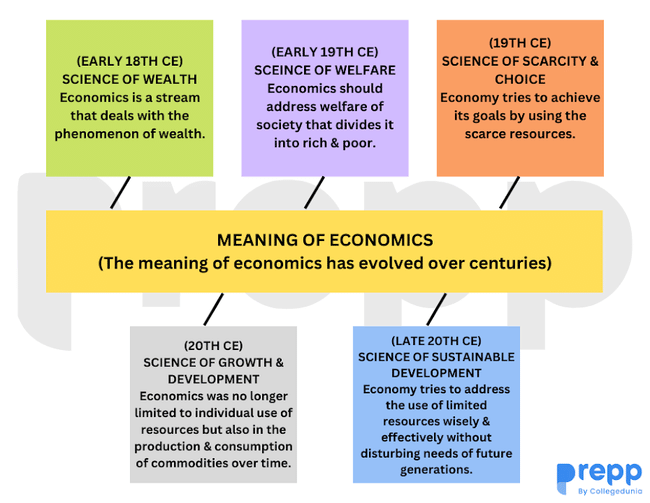
Due to its vastness, the meaning of economics has changed over the course of time. Let us see the evolution of the meaning of economics from the late eighteenth century.
Science of Wealth
- The late eighteenth-century classical thinkers viewed that economics deals with the phenomenon of wealth.
- This includes the nature and causes of wealth and the creation of wealth by individuals and nations.
Science of Welfare
- In the early nineteenth century, scholars felt that economics should address the welfare of society as only wealth divided the society into rich and poor.
- Welfare is both quantitative and qualitative. The quantitative aspects involve consumption of goods and services, increase in per capita income, etc.
Science of Scarcity and Choice
- The welfare definition only explains the material goods aspects of welfare and not the non-material services aspects.
- Since resources available in society to individuals are scarce, we try to achieve our goals by alternatively using resources and using them appropriately.
- For instance, consider an example where cloth and wheat are produced with fixed limited resources.
- When the demand for Wheat is increased either we ignore the demand and produce the same quantities of cloth and wheat or allocate more resources to wheat production by cutting from cloth production to meet the demand.
Science of Growth and Development
- In the twentieth century, the role of government to ensure the growth and development of the entire economy gained momentum.
- Therefore economics was no longer limited to individual decision-making and use of resources but included production and consumption of commodities over time.
- It is well acknowledged that in order for an individual to be able to fulfil his or her desires, the entire economy must grow and appropriate mechanisms must be found to transfer the advantages of growth among individual residents.
- As a result, the economy’s performance is critical in terms of resource utilisation, production, and distribution of products and services.
- The economy must distribute its resources across numerous alternative activities, assure their efficient utilisation, and figure out how to grow them for future economic development.
Science of Sustainable Development
- In the late twentieth century, economists talked about the welfare of future generations and the protection of the environment.
- To achieve high growth and development the natural environment is exploited.
- Increased consumption leads to wastage and it should be noted that many minerals are available in limited quantities which we may not leave behind for future generations.
- It is our moral obligation to use the limited resources available wisely and efficiently in order to secure the well-being of future generations.
- Nobel Laureate Prof. Samuelson has spelt out Economics as follows: “Economics is the study of how men and society choose, with or without the use of money, to employ scarce productive resources which could have alternative uses, to produce various commodities over time, and distribute them for consumption now and in the future among various people and groups of society”.
Sustainable Development
|
Branches of Economics
The study of economics is separated into two branches: microeconomics and macroeconomics.
Microeconomics
- The term “micro” refers to something that is extremely little. As a result, microeconomics refers to the study of economics on a very tiny scale.
- In other words, microeconomics studies the behavior of individuals and firms when allocating scarce resources and how they interact.
- It explains why and how different goods have different values, how individuals and businesses conduct and benefit from efficient production and exchange, and how people best coordinate and cooperate with one another.
- Example: Concepts of Law of Demand and Supply, Market Equilibrium, etc.,
*Click Here to read more about Microeconomics.
Macroeconomics
- The term “macro” refers to something that is extremely enormous. The society, country, or economy as a whole is enormous in relation to one individual. As a result, macroeconomics is concerned with economic decisions made at the national level.
- In other words, macroeconomics studies the behavior of the overall economy.
- It includes the behavior of markets, businesses, consumers, and governments.
- Macroeconomic factors include inflation, price levels, economic growth rate, national income, GDP, unemployment, etc.
- Example: Aggregate Demand and Supply, Keynesian Economics, etc.
*Click Here to read more about Macroeconomics.
Conclusion
Economics is a social science that studies how products and services are produced, distributed, and consumed. Human behaviors thus play a central focus in economics, which is founded on the notion that humans act rationally, seeking the highest amount of benefit or value. In today’s time, a nation’s prosperity is totally dependent on Economic Development, thus understanding the science of economics is very important.